Knowing how to interview a scientist comes down to three habits: read their work before you speak, ask questions a general reader can follow, and verify every technical claim before you publish. Give it 30 to 60 minutes of preparation and a 45-minute conversation, and you can turn an hour of talking into a page of accurate, quotable reporting. This guide is for reporters, editors, freelancers and students on a science, health, climate or technology beat, including people with no science degree at all.
Scientists are not difficult sources. They are trained to be precise, which means their default register is hedged, qualified and full of terms like “effect size” and “confidence interval” that mean nothing to your readers. Fix the register and the rest is ordinary interviewing: one honest person, one honest question at a time.
Table of Contents
- What You Need
- How to Interview a Scientist Step by Step
- Define the story and audience before choosing questions
- Research the scientist’s work and primary sources
- How to read a research paper in 20 minutes
- Write open, neutral questions that invite explanation
- Conduct the interview as a conversation, not a checklist
- Verify technical claims and preserve the scientist’s meaning
- Close with a useful follow-up and next step
- Common Mistakes
- Frequently Asked Questions
- How should I prepare before interviewing a scientist?
- What questions help a scientist explain complex research clearly?
- How do I interview a scientist who uses unfamiliar jargon?
- How can I check the accuracy of a scientist’s statements?
- What should I do if the scientist disagrees with my framing?
- How do I conduct a scientific interview remotely or by phone?
- Conclusion
What You Need
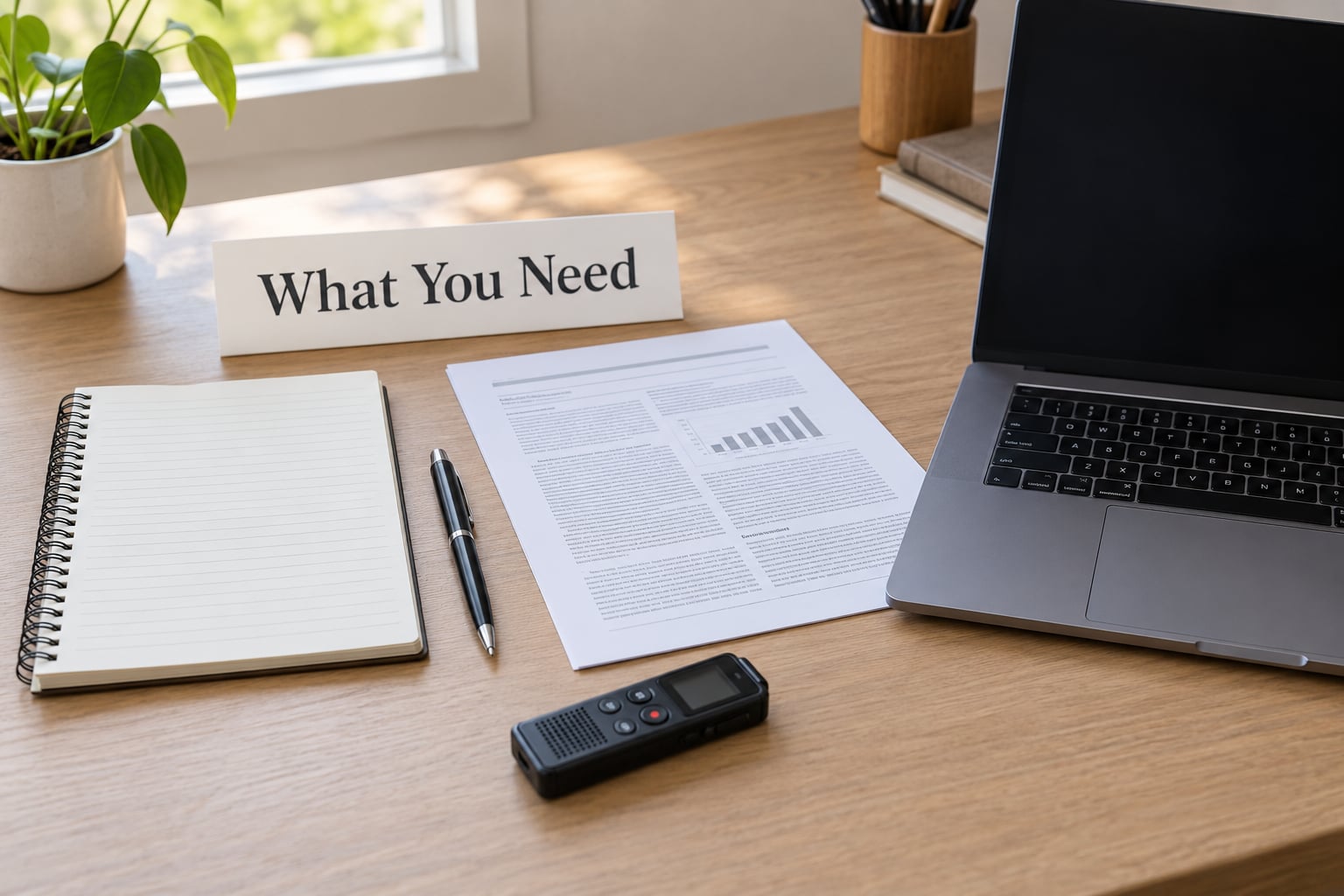
You need five things before the call, and none of them require a science credential. Most reporters who struggle with scientists are missing item one.
- The paper itself. Pull the actual PDF from the journal site or the preprint server. If a result is still a preprint, it has not been peer reviewed yet, which changes what you can say about it.
- The scientist’s plain-language writing. Most researchers have blog posts, op-eds, podcasts or a lab page aimed at non-specialists. That writing shows you the level of explanation this person can actually reach.
- A recording setup. A phone recorder or laptop app, plus a backup device, plus consent. Ask permission to record in the first two minutes rather than the last.
- A one-page question sheet. Ten questions maximum, ordered, with the two or three that must be asked left visible.
- A second reader. Any scientist, postdoc, grad student or graduate journalist who will tell you which of your questions are naive. Reporters who consulted another scientist informally before the call describe it as the biggest single improvement to their questions.
Add a notepad for verbatim quotes, not just ideas. You will want exact wording for attribution later.
How to Interview a Scientist Step by Step
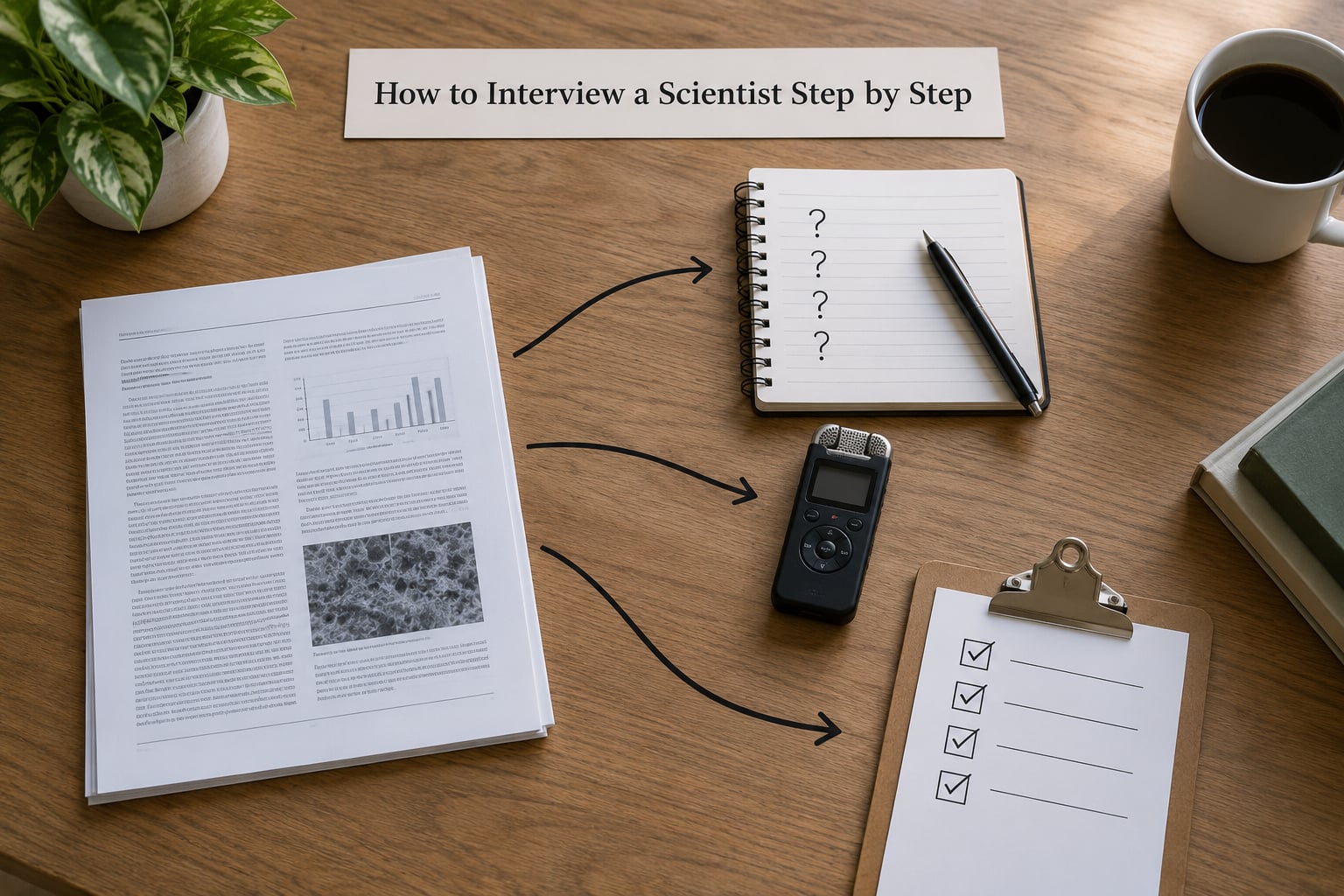
The workflow below runs in chronological order, from the decision about what the story is to the email you send after publication. Each step says what to do and how you will know it worked.
Define the story and audience before choosing questions
Write one sentence that says what the reader learns from this interview, before you decide a single question. “Readers will understand why the new trial did not change clinical guidance” is a spine. “Interview the cancer researcher” is not.
Then fix four things in your head: the audience, the format, the deadline and the outcome. Knowing the reader is a general news audience, not a clinician, tells you not to accept an answer that opens with “in the cohort”. Knowing the piece runs tomorrow morning tells you which questions to drop.
On a short deadline, cut in this order: biographical colour, institutional history, comparative angles on other studies. Never cut the question about limitations. A story that reports a finding without its main caveat is a story you may have to correct.
You know this step worked when every question on your sheet traces back to the spine sentence, and any question that does not gets deleted.
Research the scientist’s work and primary sources
Read in tiers. The paper first, the scientist’s own lay writing second, the general science press third, and last the coverage of other people about the work, which is usually the least reliable and the most likely to frame things you should question.
Reporters describe this tiered order as the thing that improved their questions most, and it also sets a respectful tone. Opening with “I read your paper, and the bit about the control group confused me” does two things at once: it proves you did the work, and it gives the scientist something concrete to help you with.
How to read a research paper in 20 minutes
| Section | What you extract | Question it generates |
|---|---|---|
| Abstract | The population studied, the size of the effect, the claim in one sentence | “In one sentence, what did you actually find?” |
| Introduction | The gap the authors think exists and who they argue against | “What did the field believe before this?” |
| Methods | Study design, sample size, control group, how long it ran | “How many people, and how were they chosen?” |
| Results | The numbers, the outliers, the parts that did not work | “Which result surprised you most?” |
| Discussion | Stated limitations, competing explanations, what the authors would test next | “What is the biggest thing this study cannot tell us?” |
| Conclusions | How far the authors are willing to go | “What should a reader not conclude from this?” |
When you finish, you should be able to explain the study to a smart friend in your own words. If you cannot, the interview will not rescue you; you will simply get the same explanation back.
Write open, neutral questions that invite explanation
Open-ended questions get you sentences you can quote. Closed questions get you yes or no, and you already knew the answer. Start broad, then narrow toward the specific number, the specific limitation and the specific human consequence.
A weak question contains the answer and pushes the scientist to agree with you. The strong version asks the same thing without the trap.
| Weak question | Strong version |
|---|---|
| “So this proves the drug works, right?” | “What does this result support, and what would you need to see next to be confident?” |
| “That’s a huge effect size, isn’t it?” | “How big is the effect in plain terms, compared with normal variation?” |
| “Is this study reliable?” | “What are the weaknesses in this design?” |
| “When will this be available to patients?” | “What are the steps between this result and something a patient could use?” |
| “Do you think the government should fund more of this?” | “What would it take for this to become routine practice?” |
Here is a question bank you can lift from, grouped by what you want out of the answer. Against each one, note what a strong answer gives you.
Background
- What is this field trying to solve, in one sentence? (Calibration: how they simplify on purpose.)
- What did people believe about this five years ago? (Change over time.)
- Who is doing the work nobody is talking about right now? (New sources.)
Method and evidence
- How many participants, and how were they chosen? (Sample size and selection.)
- What was the comparison group? (Whether a claim means anything.)
- How long did you follow them, and what happened to people who dropped out? (Attrition bias.)
- How would you know if this result were wrong? (Falsifiability, and it exposes weak designs.)
- How do you know that? (The single most useful follow-up in science interviewing.)
Findings
- Which number in the paper are you most proud of, and which would you change? (Self-awareness.)
- What did you expect to find and did not? (Real science rather than a press release.)
- Does this replicate work that came out before, or does it conflict with it? (Consistency.)
Limitations and uncertainty
- What is the biggest thing this study cannot tell us? (The caveat, in their words.)
- What would have to happen for this finding to be overturned? (Fragility.)
- Where does the uncertainty in your numbers come from? (Error bars, explained.)
- What is the difference between statistically significant and practically important here? (The question readers cannot ask themselves.)
Implications
- Who acts on this if it holds, and who is likely to object? (Stakeholders.)
- What would a regulator or a clinician ask you that you could not answer? (Preparation gaps.)
- What is the most likely way this gets misreported this week? (Your headline’s risk.)
Human
- What moment in this project made you doubt it? (Motivation, and it is memorable copy.)
- What do you wish the public understood about this work? (Values without grandstanding.)
- What are you working on that you have not published yet? (Forward-looking quotes.)
The 5 C’s of interviewing are a useful final filter. Competence: you have done enough reading to be worth their time. Confidence: a source reads your certainty about the reporting, not your expertise in their field. Curiosity: you ask because the answer changes something, not to fill silence. Caring: you treat the work and the person seriously. Congruity: what you say and what you do match, which is why over-preparing and then ignoring the answers is a disservice.
Conduct the interview as a conversation, not a checklist
Start with 30 seconds of human small talk before any question. Scientists report being genuinely nervous about being misrepresented, and a short opener measurably lowers that guard. Say what you are publishing, who reads it, and your deadline in the first minute; transparency is the fastest trust-builder there is.
Ask one question at a time, then stop talking. The silence after a question is where the good material lives, and most reporters lose it by jumping in too fast.
Two follow-ups do most of the work in science interviews: “What do you mean?” and “How do you know that?” The first is your permission slip to ask for plain language. The second is how you get from a conclusion back to the evidence, and it is a question almost no one outside science ever asks, so it never feels adversarial.
Keep three asks ready. If the answer turns jargon: “Can you say that without the technical term?” If it turns abstract: “What does that look like in practice?” If it turns abstract again: “Give me the analogy a first-year student would get.” If the source launches into a PowerPoint mode, do not fight it. Let them go for a minute, then say: “That background is helpful, and I want to come back to the result you mentioned earlier, because that’s what my readers need.”
On topic, the 80/20 split usually holds: spend about four-fifths of the call on the finding, its limits and its meaning, and one-fifth on background. And expect the ratio of tape to copy to be brutal. An hour of conversation might yield a minute of usable material in a short video, or three or four quotes in a piece. Nobody gets a tight, quotable scientist for free.
For a phone or video call, the basics matter more than you would think. Send the topic and your questions in advance; scientists do not prepare as casually as politicians, and surprise is not a good way to get their best thinking. Confirm the time zone, the name of the platform, and whether there is a background noise problem before you record. A second person on the call takes notes so you can stay present instead of writing.
You know this step worked when the conversation went somewhere you did not plan for, and you caught it.
Verify technical claims and preserve the scientist’s meaning
Accuracy work starts during the interview, not after it. Summarize every substantive answer back in one sentence and ask if you have it right. A source who corrects your summary costs you 15 seconds; a source who corrects your published story costs you a correction.
Ask the questions that make a claim measurable. How many participants. What the comparison was. Whether the result has been replicated by an independent group. Whether the paper has been peer reviewed or posted as a preprint. How it is funded, and whether the funder had a role in design or analysis. None of this is adversarial, and researchers who are asked routinely tend to answer it directly.
Define the terms the first time you use them, for your readers: a peer review is outside experts checking the work before publication; a preprint is posted publicly before review, so its findings are provisional; statistical significance means a result was unlikely under certain assumptions, not that it matters; replication means an independent team got the same result. Readers who do not know these words cannot evaluate what your source is claiming.
When you are covering contested or retracted work, widen the frame before you call. Ask the author what the retraction was, ask an independent researcher who has not worked with them what they think, and report the disagreement as a disagreement rather than picking a winner. Two credible experts who flatly contradict each other is a legitimate story and often a better one, as long as you give each the same space and the same scrutiny.
Expect a request to see the draft, and decide your policy before the interview so you are not deciding under pressure. Most outlets will verify quotes and factual claims without showing copy, and offering that is usually enough. If a source insists, a workable middle path is: “I’m happy to check any specific quote for accuracy, and I’ll read back anything I attribute to you in a technical sense. What I can’t do is share the draft or give an editing veto.” Politeness costs nothing and keeps the relationship.
Also settle attribution in the room. Ask directly: “Are you on the record for all of this, or was any part background?” Scientists are used to peer review norms, not media ones, and they frequently assume conversational asides are not for print.
Close with a useful follow-up and next step
End by summarizing. List the two or three things you are going to report, ask which are wrong, and ask what you have missed. Reporters and sources both describe a closing “let’s review” as the single best guard against factual error, and it takes about three minutes.
Before you hang up, ask for the follow-up material you need: the paper, the dataset, the reviewer’s comments, a figure in a usable format, the name of another person who disagrees with them. Ask for a photograph or lab access if the story calls for it.
Send a short confirmation email the same day with your notes on the technical points, ask them to flag anything misdescribed, and state when you plan to publish. Then send the finished piece when it runs. Following through is the cheapest way to get a scientist to answer your next call.
Common Mistakes
These are the errors that show up again and again, and each one has a straightforward fix.
- Skipping the paper. You get generic answers, because the scientist is now teaching you the field instead of discussing their work. Fix: read at least the abstract, methods and discussion before the call.
- Letting the scientist set the pace for 40 minutes of background. Your piece needs the finding. Fix: set the topic up front, and keep a clock visible if you are on a live call.
- Accepting the first explanation of a term. The answer stays unusable for readers. Fix: rephrase once, then a second time if needed. Reporters describe relentless rephrasing as the technique that fixes this most often.
- Over-scripting. You get a polished interview that sounds like a press release. Fix: prepare the spine and the first question rigorously, and leave the rest loose.
- Treating a preprint as a settled result. You overstate the science. Fix: ask whether it is peer reviewed, and say so in the copy if it is not.
- Reporting a finding without its main limitation. Readers take away something the researcher does not claim. Fix: ask for the limitation in those words, and put it near the finding, not in a footnote at the end.
- Going through the press office and stopping there. One institution supplies every quote and the story skews. Fix: use the press office to reach the person, then find at least one source outside that institution, including more junior researchers.
- Getting only the paper authors. A study has people who agree, people who disagree, and people who are still deciding. Fix: ask the source who is skeptical of their own field, and interview them too.
- Taking hedges out of quotes. “Suggests” becomes “proves” and the meaning changes. Fix: quote the hedge. Reporters and sources alike treat it as the fastest way to lose trust.
- Failing to confirm attribution. An aside you considered casual appears in print. Fix: ask about on and off the record before the call ends, and again in the confirmation email.
Frequently Asked Questions
How should I prepare before interviewing a scientist?
Read their primary paper first, then their own plain-language writing, then general science coverage. From the paper, pull the sample size, the comparison group, the main effect and the stated limitations. Write one sentence naming what your reader should learn, and cap your sheet at ten questions. Send the topic and questions ahead when the call is remote, and confirm whether it is a phone, video or in-person conversation.
What questions help a scientist explain complex research clearly?
Ask broad first, then narrow: what is the field trying to solve, what did you expect to find, which result surprised you, what is the biggest thing this study cannot tell us. The two follow-ups that do the most work are What do you mean, and How do you know that. Follow every technical term with Can you say that without the technical term, and keep rephrasing until the answer works for a general reader.
How do I interview a scientist who uses unfamiliar jargon?
Use jargon as a signal rather than a problem. When a specialist term appears, write it down and ask for a version without it, then ask for a concrete example of what it looks like in practice. Say plainly that you want to get it right for readers who do not know the field, which is a request most researchers respond to well because they spend their careers making difficult work legible.
How can I check the accuracy of a scientist’s statements?
Verify during the call by summarizing each substantive answer back and asking if you have it right. Ask how many participants, what the comparison was, whether independent groups have replicated the result, and whether the paper is peer reviewed or a preprint. Ask about funding and funder involvement. Then confirm quotes and technical descriptions by email the same day.
What should I do if the scientist disagrees with my framing?
Let them finish the objection before responding, then ask them to expand it. Report the disagreement as a disagreement, and give their view the same space and scrutiny as anyone else’s. If the dispute is factual, check the underlying source yourself rather than adjudicating by seniority. Several credible experts contradicting each other is a story, not a problem to solve.
How do I conduct a scientific interview remotely or by phone?
Send your topic and questions in advance, because scientists prepare carefully and are thrown by surprises. Confirm the time zone, the platform and the recording consent in writing beforehand. Keep a second person on the call for notes so you can stay present. Finish the call by summarizing what you plan to report, and send that summary by email while it is still fresh.
Conclusion
Learning how to interview a scientist is a reporting habit, not a credential. Read the primary work first, write one neutral opening question that proves you read it, and build the rest of the conversation around background, method, finding, limitation and meaning. Then verify what you were told before you write a word of it.
Start small. Take the next story on your desk, spend twenty minutes on the paper, and see how the call changes when you open with something specific.