If you are working out how to structure a narrative podcast episode, break the runtime into named beats, give each one a time budget, and sequence your reporting so the tension rises before it pays off. The core template runs cold open, setup and stakes, inciting incident, rising action, climax, resolution, outro. Most of the work happens before you record, in a one-page episode brief and a tape pull of your interviews.
Budget three to five hours of planning for a 30-minute episode. Recording a solo narration takes about as long as the runtime, but the structural decisions are what separate an episode people finish from one they abandon halfway.
This guide walks through the planning materials, the eight-step process from central story to final edit, and the mistakes that flatten a narrative arc. No product recommendations, no gear talk. Just structure.
What You Need
You need a central question, a transcript of your best interview material, selected supporting evidence, scene notes, and a simple production timeline. Without those five things you are assembling an episode from clips, and the order will feel arbitrary no matter how good the tape is.
The central question
Write down the single question the episode answers. If you cannot state it in one sentence, the reporting is not finished. A working central question looks like: why did the county approve the route, and who paid for it? Everything you keep has to serve that.
The tape pull
Practising story editors pull their tape before they write prose, not after. You transcribe the interviews, mark the moments where a person says something concrete, and build a document of usable lines with timecodes. When you sit down to structure the episode, you are arranging quotes on a page rather than hunting through forty minutes of audio.
Selected evidence
Collect the documents, data points, and expert explanations you will use. Flag anything you cannot verify twice. In audio there is no visual reference for a listener to re-check, so an unverified number is a liability.
Scene notes
Two to four sentences describing each place you visited: the room, the weather, what was happening when you arrived. These notes are where your cold open usually comes from, and they are the cheapest way to make an audio story feel like it happened somewhere.
A production timeline
Decide when the script is due, when recording happens, when the edit starts, and when the show notes are written. A 30-minute narrative episode often runs past ten hours of total work for a small team, so the timeline is not paperwork. It is what stops the edit from eating the week before publication.
A script length target
Narrated audio runs at roughly 150 words per minute, and scripted passages land closer to 140 because of pauses and tape cues. Interview audio varies more, between 120 and 160. Set your target before you write so you do not discover at the edit that you are forty minutes over.
| Finished runtime | Narration words (150 wpm) | Scripted passages (140 wpm) | Typical beats |
|---|---|---|---|
| 20 minutes | 3,000 words | 2,800 words | 6 |
| 30 minutes | 4,500 words | 4,200 words | 7 |
| 45 minutes | 6,750 words | 6,300 words | 8 |
| 60 minutes | 9,000 words | 8,400 words | 9 |
Those numbers cover the whole episode, including interviews, cold open, and outro. If your cold open is 120 words and your outro is 90, subtract roughly 210 from your narration budget before drafting anything else.
Step-by-Step: How to Structure a Narrative Podcast Episode
The process runs in eight stages. Each one produces a decision you can check, rather than a feeling you have to trust. Work through them in order and the episode writes itself more or less, beat by beat.
Step 1: Define the Central Story
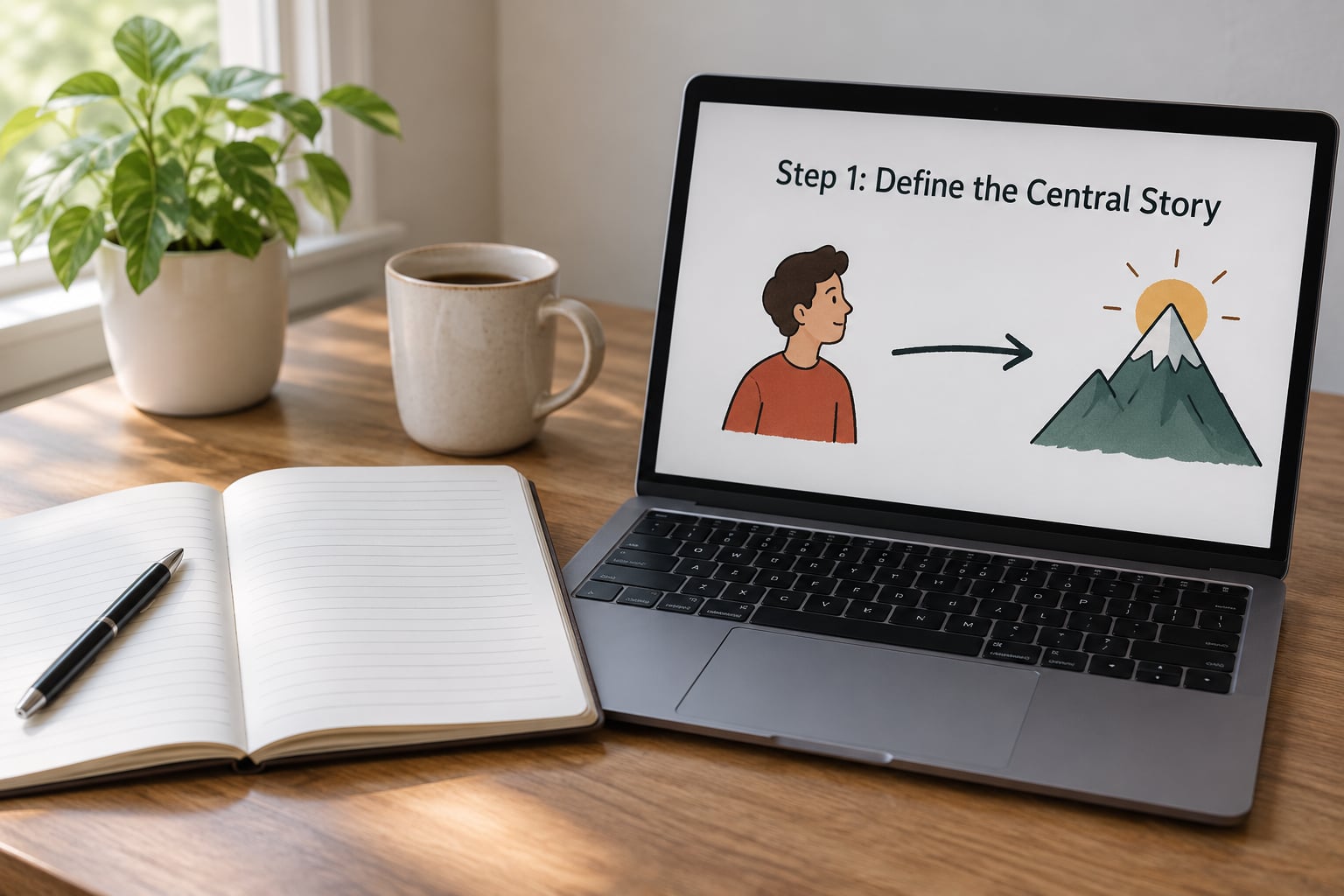
Write a one-sentence editorial promise before you structure anything. Name the protagonist, the change or conflict driving the episode, who the audience is, and what they get at the end.
A promise reads like this: a county inspector lost her job chasing a bad road contract, and the paper trail shows who she was up against. The test is simple. Read every planned section and ask whether it advances that sentence. Anything that does not is cut, however good the tape.
The payoff matters as much as the question. If you cannot name what the listener gets in the last five minutes, you are building an explainer with no ending, and those rarely hold attention past the midpoint.
Step 2: Map the Narrative Arc
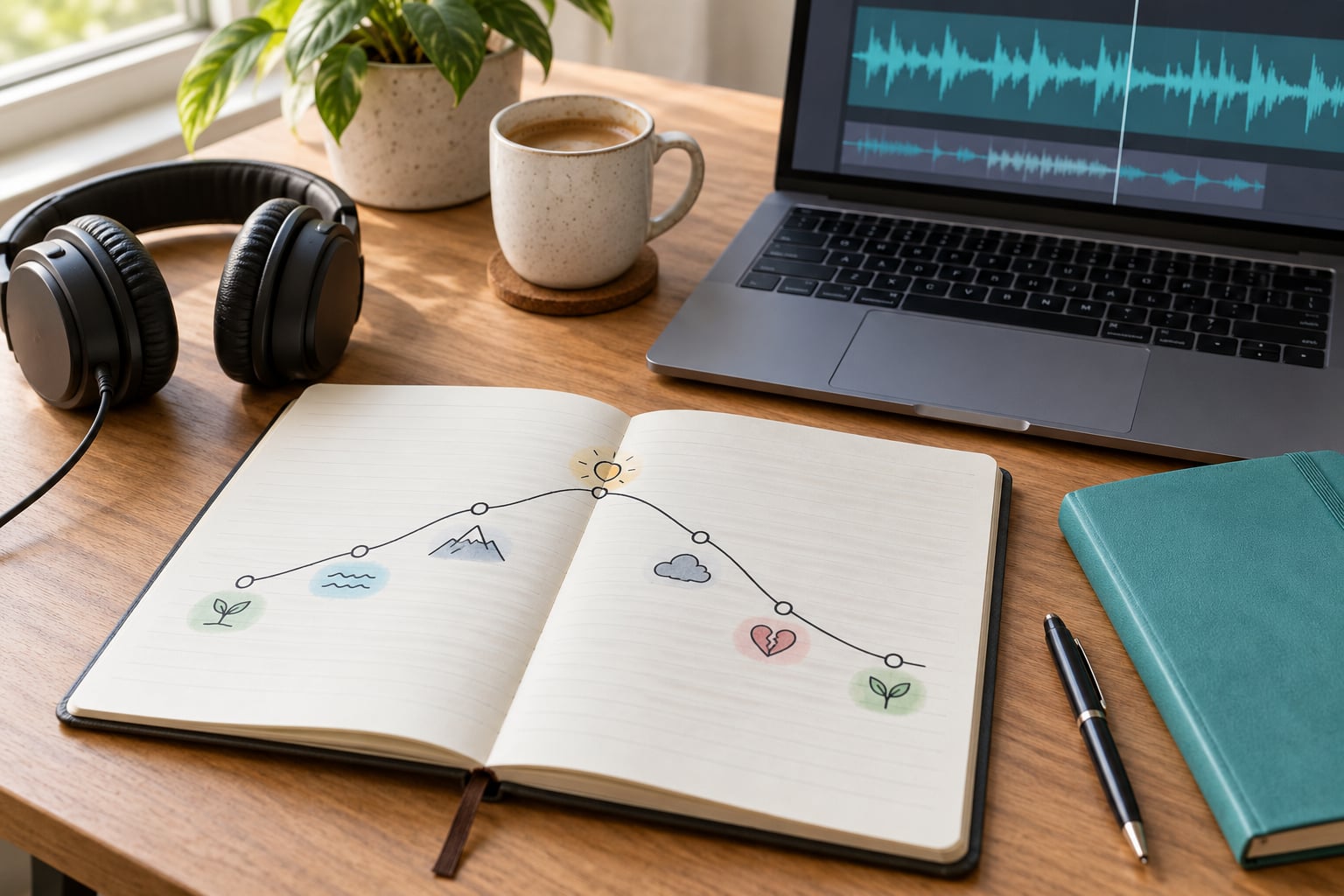
Map your reporting across five movements: opening, rising stakes, turning point, resolution, and a reflective ending. Each beat has to change what the listener understands or expects. If a section ends where it started, it is not a beat, it is filler.
Screenwriting models translate cleanly here. Three-act structure splits the episode into setup, confrontation, and resolution. The e structure opens on the most exciting moment, jumps back to explain how it happened, then returns to that moment with the listener holding the whole picture. In medias res drops the listener into the middle of the action with no preamble at all.
For a 30-minute reported episode, three acts is the safest default. Use the e structure when the strongest scene happens late in your reporting. Save in medias res for episodes where mystery carries the listener rather than information.
| Beat | Typical timecode (30 min) | Share of runtime | Words | Cut this first if you are over |
|---|---|---|---|---|
| Cold open | 0:00–0:45 | 2–3% | 110 | The weather description |
| Setup and stakes | 0:45–6:00 | 18% | 810 | Background on the institution |
| Inciting incident | 6:00–9:00 | 8% | 360 | Extra expert framing |
| Rising action | 9:00–21:00 | 40% | 1,800 | The third interview on the same theme |
| Climax | 21:00–25:00 | 12% | 540 | Restating the reveal in your own words |
| Resolution | 25:00–28:30 | 10% | 450 | Callback detail that is not load-bearing |
| Outro and CTA | 28:30–30:00 | 5% | 225 | House ad read |
Step 3: Choose the Opening Scene
Start in a moment, not in a preamble. A concrete sound, an observed action, or a line of dialogue pulls the listener in far better than welcome back to the show or a recap of last week.
Your opening scene needs to do three jobs: establish place, establish mood, and raise stakes. Twenty to forty-five seconds is usually enough. Anything longer and listeners who pressed play during your warm-up have already found something else.
A weak open describes a setting. A strong open drops a listener into the middle of an argument, hands them one detail that does not add up, and asks them to stay. You will hear the difference instantly in playback, because the strong one leaves you slightly behind, which is exactly where you want people.
Step 4: Build in Context and Stakes
Give listeners the minimum background they need, introduce the protagonist fast, and show what is at risk. New listeners should be able to explain the situation to someone else after hearing this section once.
Stakes work best when they are concrete. A number that goes up, a deadline that lands, a person who stands to lose something specific. Abstract stakes such as this affects everyone produce no tension at all.
Watch your name load too. Listeners cannot hold a large cast of characters in audio, and there is no cast list on screen to check. Keep the named cast small and treat anyone outside it as a function rather than a name. Signposts help here: a brief restatement of who is who at each major shift buys you attention you would otherwise lose.
Step 5: Sequence Evidence Into the Narrative Podcast Structure
Place each quote, document, observation, and expert explanation where it answers a question the listener already has, or where it deepens the tension. Then cut anything that only repeats a point already made.
Test every element against four jobs: does it add a fact, a perspective, a scene, or a consequence? If it does none of those, it is padding, however well it was said.
Signposting is what makes sequencing work in audio. Useful moments to mark: a time jump, a turning point, a payoff that was foreshadowed, a return to something mentioned earlier, a big idea the listener should remember, and a recovery after a quiet stretch. If you fix the underlying writing problem, would you still need this signpost? When the answer is no, cut it.
Over-signposting is the more common failure. Writers worry about sounding patronizing, then under-signpost until a listener drops off without telling anyone why. Under-signposting is a structural defect, not a stylistic one.
Step 6: Create a Turning Point
A turning point moves the story from complication toward resolution: a decision, a discovery, a reversal, or a shift in perspective. It has to be supported by your reporting. A twist you manufactured in the edit reads as a betrayal of the listener’s time.
Place it around the 65 to 75 percent mark for most episodes. Much earlier and you spend the back half explaining. Much later and the ending has no room to land.
Foreshadow it lightly earlier. A line that seems incidental at 12 minutes becomes the hinge at 22 minutes, and the listener gets the satisfaction of having seen it coming.
Step 7: Land the Resolution and Ending
Show what changed, answer the central question from Step 1, close the strongest thread you opened, and connect the result to the larger theme. That is your resolution, and it is the most important minute of the episode.
Keep the outro separate from it. The resolution is story. The outro is your thank-you, your credit where it is due, and one clear action you want from the listener. If you need one line for the ask, this is the document we talked about, and the vote is next month beats anything generic.
Test the ending by listening to the final five minutes without editing. If you cannot restate the episode’s promise in one sentence afterward, rewrite the resolution.
Step 8: Edit for Narrative Flow
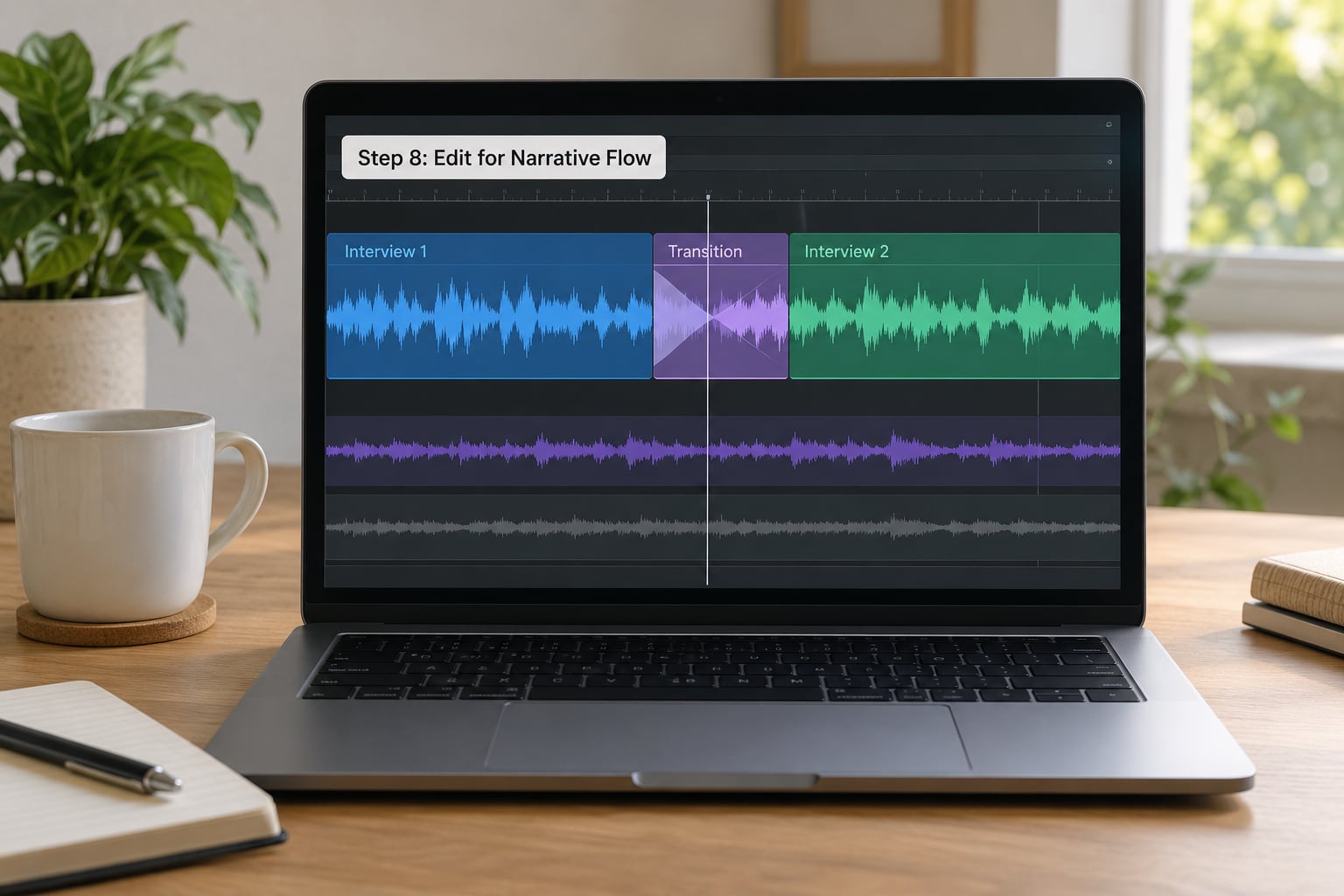
Editing a narrative episode is a structural pass, not a noise-reduction pass. Read the whole timeline top to bottom against your beat map and ask whether each section still does its job at the length it actually runs.
Work through these in order:
- Chronology. Mark every time jump. If a listener could not tell when a scene moved from 2019 to last Tuesday, add a signpost or reorder the clips.
- Transitions. Cut hard between scenes or bridge them with a line of narration. Half-measures feel accidental.
- Pauses. Keep the breath before a reveal. Trim the filler after it.
- Repetition. Two clips making the same point means one clip is too long.
- Factual clarity. Check names, dates, and figures against your sources one more time.
- Comprehension. Play the finished cut once while doing something else. That approximates your listener, and the gaps show up fast.
Music cues are structural too. A bed under the cold open, a drop at the turning point, and a clear end to the score before the outro will do more for pacing than a dozen edits inside the audio.
Common Mistakes
Most failed narrative episodes fail for one of five reasons. Each has a straightforward fix.
Opening with background
Starting with institutional history is the most common mistake and the easiest to spot. Fix: cut everything before your first scene, then move the essential context into the setup beat, where a listener will accept it because the story is already moving.
Packing in unrelated clips
A great quote does not belong in an episode if it does not advance the promise. Fix: run every clip against the four-part test, fact, perspective, scene, or consequence. Anything that fails comes out, no matter how much you liked it in the moment.
Relying on experts to carry the story
Three expert quotes saying the same thing in different words is one quote in a trench coat. Fix: keep the strongest and let the reporting do the work. If a listener could remove your expert and the episode still held, the expert was decoration.
Weak transitions
Audio has no grammar of transitions, so gaps read as confusion rather as style. Fix: signpost every time jump and turning point, and remember that the e structure is well understood by listeners already. Only the return trip needs a cue.
Endings that simply stop
An episode that fades out after the last fact leaves the listener doing your work. Fix: answer the central question out loud, name what changed, and close the thread you opened in the first minute.
How much should you script?
This is the most-asked question from writers moving from commentary into narrative, and the answer is that you script the load-bearing parts. Fully script your narration, cold open, and resolution. Keep interviews mostly raw and let tape carry them, with a loose outline of the beats you need to hit. Improvisation works in the middle, where you can adjust what the tape gives you.
Three short tips before you start drafting. Write the resolution first, because knowing where the story lands tells you what to keep. Keep your named cast small, since listeners cannot re-check names in audio. And put your one-sentence promise somewhere visible while you edit, so every cut can be tested against it.
Frequently Asked Questions
What is the typical structure of a podcast script?
A typical narrative podcast script follows seven beats: cold open, setup and stakes, inciting incident, rising action, climax, resolution, and outro with a call to action. The cold open runs under a minute, setup and stakes take about a fifth of the runtime, rising action eats the largest share, and the climax plus resolution close the final quarter. Interview sections sit inside rising action rather than replacing it.
What is a narrative podcast?
A narrative podcast is an audio show built around a story rather than a conversation. A narrator or host guides listeners through a plot with a beginning, escalating tension, a turning point, and a resolution, using editing, music, and sound design to shape the arc. Interview shows gather opinions, while narrative podcasts select and sequence reporting so that one thing changes for one person over time.
How long is a 30 minute podcast script?
About 4,500 words of narration, or roughly 4,200 words if your script is heavily scripted with pauses and tape cues. That figure covers the entire episode, so subtract your cold open and outro before you budget the body. Interview audio runs closer to 150 words per minute because speakers pause and answer at their own pace.
Should I script my podcast?
Script the load-bearing parts and let tape carry the rest. Fully script your narration, cold open, and resolution, since those carry the structure and any drift shows. Keep interviews largely raw with a loose outline of the beats you need to hit. Fully scripted episodes feel consistent; partly improvised ones feel alive. Most narrative shows land somewhere in the middle.
What is a good closing statement for a podcast?
A good closing statement answers the question the episode promised to answer, names what changed, and closes the thread you opened in the first minute. It should be a specific sentence, not a summary. Finish by pointing the listener at the next thing worth their time: the document, the vote, the follow-up episode, or a related story.
What is a good outro for a podcast?
Keep the outro short, usually 30 to 60 seconds, and separate it from the narrative resolution. Thank the people who made the reporting possible, say where the supporting material lives, and make one clear ask. Ask for exactly one action rather than three, since a listener who is driving can hold one instruction but not a list.
Start with the one-sentence promise, then map your reporting across the five movements before you record a word. Everything after that, the cold open, the time boxes, the signposts, the edit, gets easier once those two decisions are made.