
The question of how to find mentors at a tech conference comes down to three things: decide what kind of help you actually need, research the speaker list two weeks ahead so you can name specifics, and follow up within 48 hours of any promising conversation. Conferences compress months of networking into two days, which is exactly why the people worth meeting are easy to miss.
Most first-timers leave a conference with a stack of business cards and nothing else. Not because they were pushy, but because they waited for the perfect moment that never came. The people who get useful mentoring out of a conference are the ones who arrive with a shortlist, an opening line, and a plan for what happens after the badge scanner runs out of battery.
This guide is written for journalists, developers, designers and newsroom builders. It works just as well for product people, founders and career changers. I have watched the same pattern repeat at conference after conference: the useful conversations happen in the boring gaps between sessions, not during the headline talks.
Table of Contents
- What You Need Before You Travel
- Step-by-Step
- Define the right kind of mentor
- How to research speakers, exhibitors, and attendees
- Prepare a 20-second professional introduction
- Start conversations during lower-pressure moments
- Ask a specific question and test the fit
- Propose one concrete next step
- Send a personal follow-up within 48 hours
- Build the relationship without overusing it
- Common Mistakes
- Frequently Asked Questions
- How do I approach a speaker at a tech conference?
- What if I am nervous about asking someone to be my mentor?
- How do I choose between a senior leader and a peer as a mentor?
- When should I follow up after meeting someone at a conference?
- What should I ask a potential mentor at a tech conference?
- How do I keep a conference mentoring relationship going after the event?
- Conclusion
What You Need Before You Travel
You need five things ready before you arrive, and four of them take an evening.
A specific goal, not a general one
Write down the one problem you want help with in a sentence. “I need career guidance” gives a mentor nothing to work with. “I’m a data journalist moving from a weekly newsletter into a product role and I don’t know which portfolio pieces employers actually read” gives them somewhere to start.
Carry two or three secondary questions. That way, if your first question gets a fast answer, the conversation doesn’t die.
A 20-second professional introduction
Four beats: who you are, what you do now, the specific thing you’re stuck on, and what kind of insight would help. That last part matters most, because people agree to conversations far more readily when they know what is being asked of them.
Three questions worth asking
Write them down where you can see them mid-conversation. The point is to have something to hand over when the silence arrives, which it will.
A way to capture contacts
Phone notes beat business cards here. After each conversation, type two lines while it’s fresh: who they are and what they said they could help with. Six contacts recorded properly beat thirty cards in a jacket pocket.
A realistic follow-up window
Block the hour after you get home for emails. The 48-hour window is not arbitrary. People clear their inbox in a predictable rhythm after an event, and a message that arrives on day four reads as an afterthought.
Step-by-Step
Define the right kind of mentor
Five kinds of person at a conference can help you, and asking for the wrong one wastes both your time. Sort your list by role before you write a single opening line.
- Career navigator — someone a few steps ahead of you on the path you want. Asks about transitions, portfolios and referrals.
- Subject-matter adviser — someone deep in the technical or editorial question you are stuck on. Asks one narrow question and takes notes.
- Project collaborator — someone who would benefit from working on the same thing. Trade contribution, not advice.
- Peer mentor — someone at your level who gets the specific obstacles you face. Often the most useful person in the building.
- Connector — a recruiter, founder or community organiser whose main currency is introductions. Ask them who else to talk to.
The signal that you sorted correctly: each name on your list has a specific question attached to it. If you cannot write the question, they are not a target yet.
How to research speakers, exhibitors, and attendees
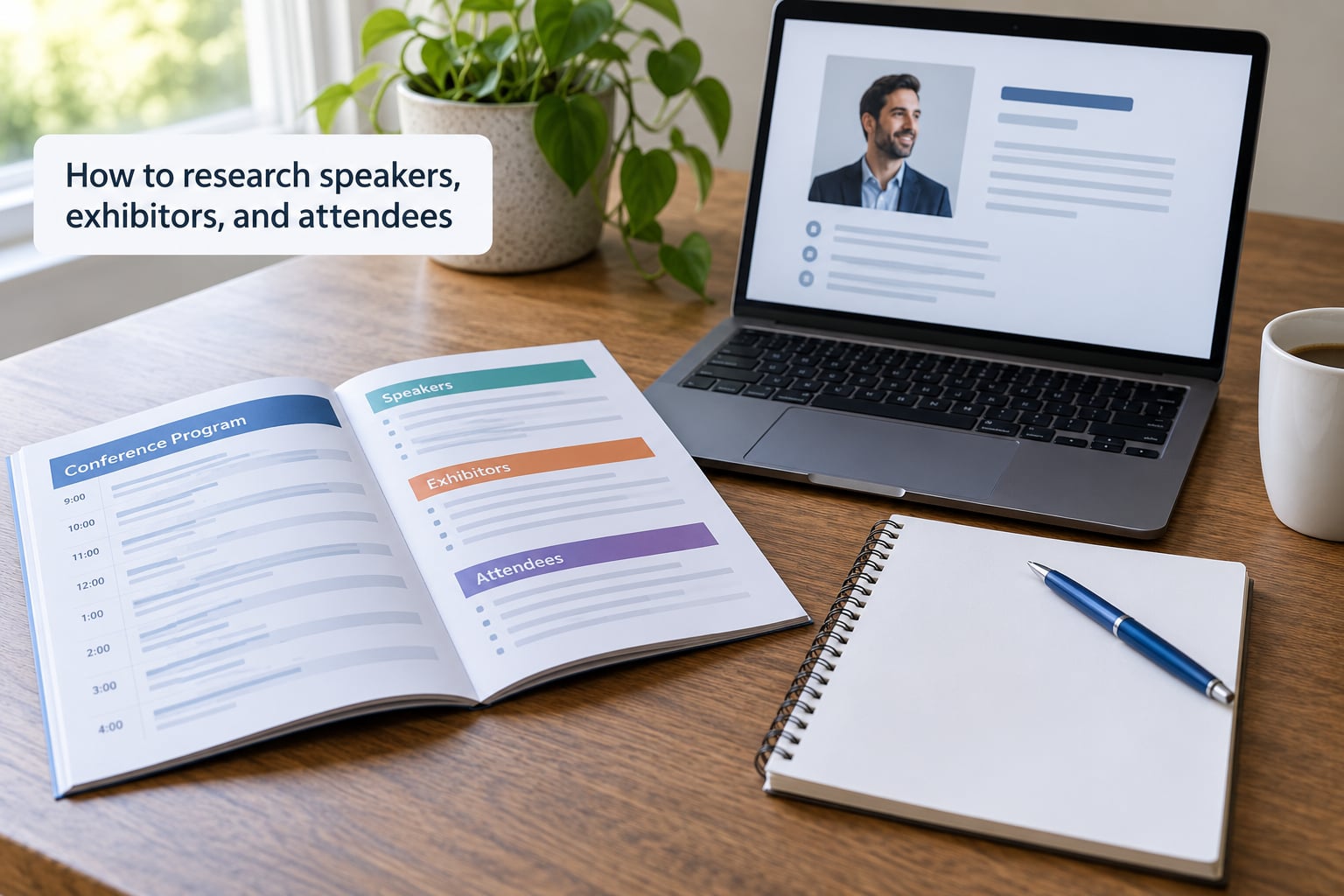
The published program does more than tell you who is speaking. Session abstracts reveal who has actually shipped the thing you are trying to build, which is a better filter than job titles. Read them and note the sessions where the right person will be in the room and not on stage.
Speaker profiles usually link to a portfolio, a company page or an open-source repository. Ten minutes of reading gives you a specific opener later: “I tried the approach you described in your session and hit the same wall at the pagination step.”
Shortlist three to five people, no more. A list of fifteen is a to-do list you will abandon on day two.
Prepare a 20-second professional introduction
Here is the formula that works: role, context, question, ask.
“I’m a data editor at a regional paper. I’ve been rebuilding our election results pipeline in the open, and I’ve gotten stuck on how newsrooms handle corrections at scale. You’ve done something similar — would you be up for fifteen minutes?”
It is not flawless speech. It is short, it is specific, and it ends with a question the other person can answer yes or no to. People say yes to yes-or-no questions.
The signal it worked: you hear a specific follow-up rather than a polite “send me an email.” Specificity in their answer means they were listening.
Start conversations during lower-pressure moments
The hallway track is the stretch of corridor between sessions where most real introductions happen, because nobody is performing. Target the ten minutes before your target’s session and the ten minutes after, when they are standing, unoccupied and not on stage.
Other good windows:
- The registration desk queue on the first morning, when experienced people are still in a generous mood.
- The end of a workshop or breakout session, while people are packing up and lingering.
- Sponsor booths during the quiet mid-afternoon stretch, not the opening hour.
- The lunch table or poster session area, where sitting down next to someone is socially free.
- The day after a session, when someone has had a night to forget how busy they were.
The signal it worked: the conversation outlasts your 20 seconds. If they are scanning the room over your shoulder, thank them and move on. That is not a failure; it is information.
Ask a specific question and test the fit
Questions that invite real advice ask about a decision, not a fact. “How did you get into this?” gets a LinkedIn bio. “You moved from agency work to in-house — what would you tell someone making that move now?” gets a conversation.
Then test the fit while you are still standing there. Do they ask you a question back? Does the advice connect to the specific problem you named? Are they already telling you which of their contacts you should meet?
A poor match is easy to recognise and cheap to exit: “That is really useful context, thanks. I think I need someone closer to the day-to-day side of this.” No apology, no over-explaining.
Propose one concrete next step
Good conversations die because nobody converts them. Before you part, ask for one specific thing, and keep it small: a 20-minute call the following week, a look at a portfolio link, an introduction to one named person, or a specific question answered by email.
“Keep in touch” is not a next step. “Could I send you my repo link on Thursday and get ten minutes of feedback?” is. The second version is easy to say yes to and easy to honour.
The signal it worked: you agree on a day, not a feeling.
Send a personal follow-up within 48 hours
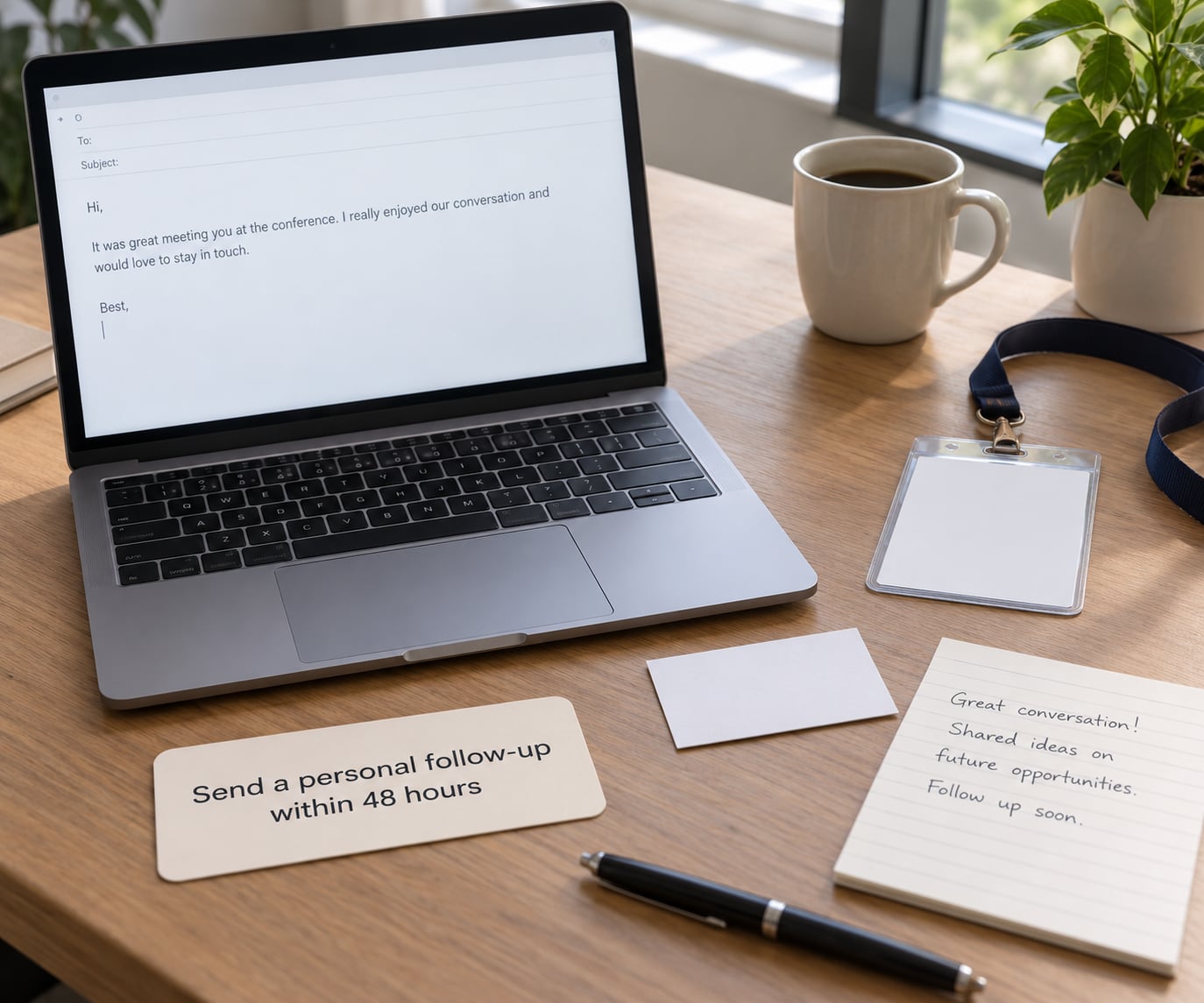
Reference the actual conversation, thank them for something specific they said, restate what you asked for, and propose a time. Four moves, about 120 words.
Subject line: Following up — the pagination question from Tuesday
Body: “Hi [name], good to meet you in the corridor after the Tuesday session. Your point about caching the aggregate rather than each district is still sitting in my head, and it’s the piece I was missing. As I mentioned, I’d value ten minutes on the pipeline I’ve been building. Are you free Thursday afternoon or the week after? Happy to work around your calendar. Either way, thanks again — the talk was the reason I came.”
If they do not reply in a week, send one short bump referencing the original ask, then stop. Two messages is persistence. Ten is a burden.
Build the relationship without overusing it
A useful cadence for most people is a check-in every six to eight weeks with something specific: a thing you shipped, a question you could not answer last time, or a job you looked at. Updates that carry news get replies. “Just checking in” does not.
Watch the boundaries experienced mentors describe publicly: a defined intake window, a set meeting length, and clear rules about contact. Some cap how many people they take on each season and publish a cadence rather than answering whoever messages them. That structure is not cold; it is what makes the relationship last.
Reciprocate in a way that costs them little. Share a relevant article, flag a job, introduce someone who needs what you now know.
Common Mistakes
Mistake: approaching with no context. A bare “can I pick your brain?” gives someone nothing to evaluate. Fix: name their work in one sentence before you ask for anything.
Mistake: pitching instead of asking for guidance. Conferences are not hiring fairs, and attendees notice the difference fast. Fix: ask a question you genuinely cannot answer yourself and follow through on the advice, even if you disagree.
Mistake: targeting only the most senior people in the building. Founders and heads of engineering are surrounded all day. A mid-level engineer who did the thing you want to do has more time and less caution. Fix: build your shortlist from relevance, not rank.
Mistake: collecting contacts without follow-up. A card in a pocket is a dead end. Fix: write the follow-up the same evening, while the conversation is still clear in your head.
Mistake: asking for too much in the first meeting. A request for a job, an introduction to a board member and feedback on your portfolio is three asks wearing one hat. Fix: one ask per conversation, offered with an exit.
A few general networking tips that hold up: send the follow-up from the address you connected with, not a brand-new one. Share their talk or work with a sentence about why you liked it, not just a link. And if someone gives you a specific piece of advice, tell them what you did with it.
Frequently Asked Questions
How do I approach a speaker at a tech conference?
Catch speakers in the ten minutes before or after their session, not during the Q and A. Open by naming one specific thing from their talk, then ask a question about a decision they made rather than a fact you could have read on their website. Offer a specific next step, such as sending your work on Thursday for ten minutes of feedback. Approaching in the corridor after the session is the easiest version of this conversation to have.
What if I am nervous about asking someone to be my mentor?
Ask for a conversation, not a mentorship. Mentorship implies a commitment you have not established yet, and people decline it politely. Ask for fifteen minutes on one question, then let the relationship grow from there. Most people who ask for a small, specific thing either say yes or redirect you to someone better, and either outcome is useful. Anxiety usually drops once you have said the opening line out loud twice beforehand.
How do I choose between a senior leader and a peer as a mentor?
A senior leader is better for navigation: how decisions get made, how careers move, what hiring committees actually look at. A peer is better for tactics and encouragement, because their obstacles are current and specific. Many people need both at different stages, and a career changer usually gets more from a peer in the first six months. If you only have time for one relationship, pick the person whose path looks most like yours.
When should I follow up after meeting someone at a conference?
Within 48 hours, while the conversation is still fresh in both your inboxes. Reference something specific they said, thank them for it, restate your ask, and propose one or two concrete times. If you have no reply after a week, send a single short bump. After that, stop. Silence usually means a busy month rather than a rejection, and a third message converts a missed connection into a burden.
What should I ask a potential mentor at a tech conference?
Ask about a decision they made rather than a fact about their career. How they chose a stack, how they handled a failed launch, or what they would tell someone repeating their career move. Questions like how do I get into tech have generic answers that help nobody. The strongest version names your situation first, then asks how they would handle it, then checks whether your assumption is wrong.
How do I keep a conference mentoring relationship going after the event?
Set a cadence you can sustain, such as a short check-in every six to eight weeks, and always bring something specific: work you shipped, a question you could not answer, or a role you are considering. Never send a bare checking-in message. Match the frequency to how much they respond, and stop when a relationship goes quiet for two cycles. People stay mentors longer when updates are cheap to read.
Conclusion
Finding a mentor at a tech conference comes down to preparation, timing and follow-through: shortlist a handful of relevant people, catch them in the corridor between sessions, ask one specific question, and send a personal note within 48 hours. Two or three real conversations beat thirty business cards.
Pick one person from the program before you travel, write your 20-second introduction, and prepare the single question you want answered. That is the whole first step. Everything after it depends on you sending the email.