
If you have built a tool inside your newsroom and you think other newsrooms would benefit from it, learning how to open source a newsroom tool is mostly about process discipline rather than code. You get written permission, audit the repository for secrets and client work, pick an open source license, clean out internal configuration, write real documentation, publish it publicly, and commit to a maintenance level you can actually sustain. A focused first release takes one developer a few weeks if the tool is small.
The part most guides skip is the boring part: the permission email, the credential grep, the dependency licenses, and the conversation about who maintains the repo after you leave. Miss any of those and a release can create real legal exposure for your employer, or produce a public repository that nobody can safely run.
Table of Contents
- What You Need
- Step-by-Step: How to Open Source a Newsroom Tool
- 1. Decide What You Are Releasing
- 2. Check Legal, Ethical and Security Readiness
- 3. Choose a License and Set Contribution Rules
- 4. Prepare the Public Repository
- 5. Write Documentation That Helps Journalists Use It
- 6. Test the Release With Real Users
- 7. Publish and Announce the Project
- 8. Maintain the Project Responsibly
- Common Mistakes
- Frequently Asked Questions
- Can a newsroom legally open source the tools its developers built?
- Which open source license should a newsroom choose?
- How do I remove API keys and secrets before making a repository public?
- Can I open source code built with client data or a grant-funded project?
- What happens to an open source project when the maintainer leaves the newsroom?
- How long does it take to open source a newsroom tool?
What You Need
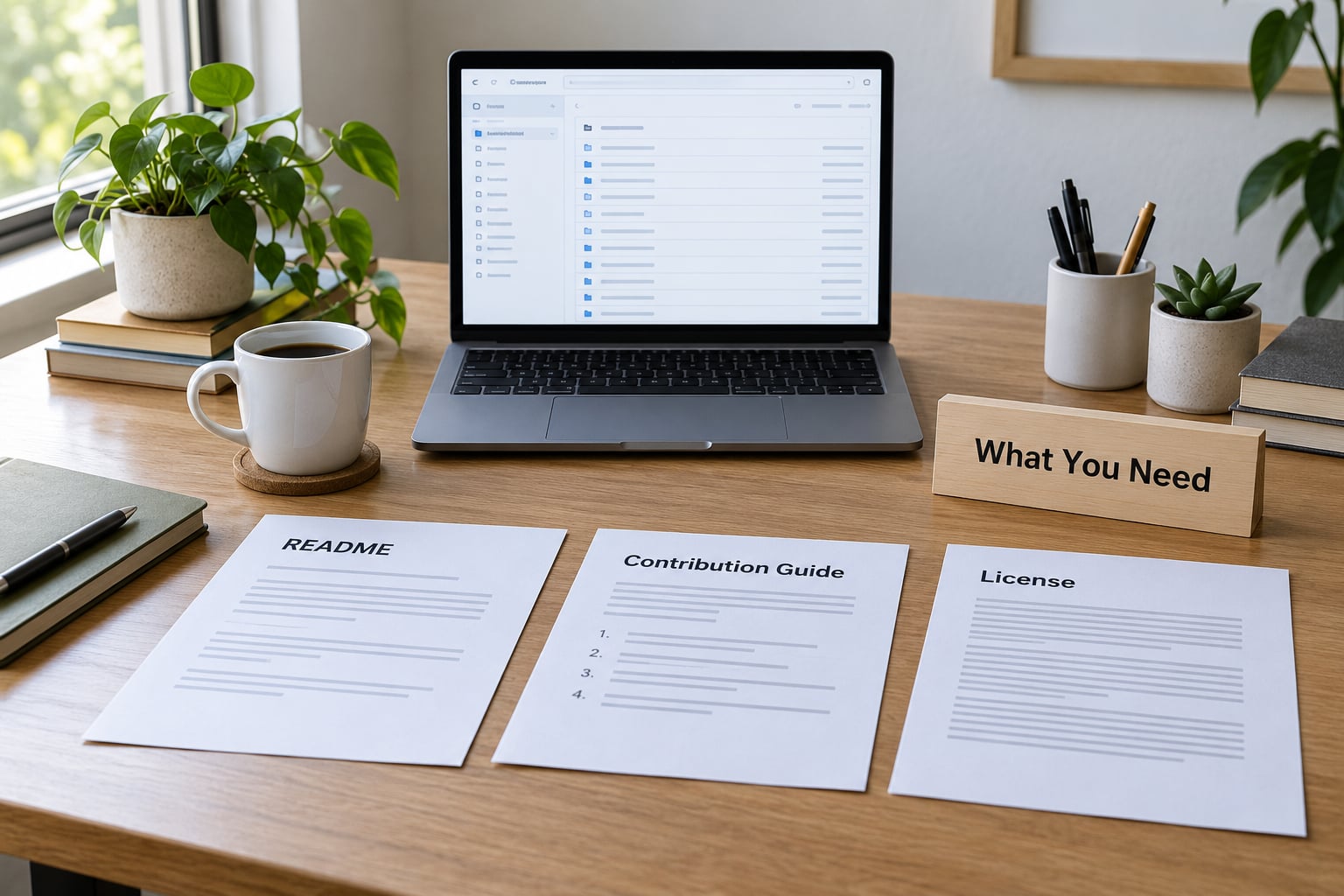
Before you touch a single line of documentation, you need six things in place. Skipping the first one is the most common way a newsroom ends up in an awkward conversation with legal.
Written permission. Your employer usually owns the copyright in code written for hire, which means you cannot release it on your own authority. Get it in writing from an editor or your manager, with legal copied in, before you clean anything.
A repository that actually builds. If nobody outside your newsroom can install the tool and run it, publishing it just makes your newsroom’s mess public. Confirm a clean clone works on a fresh machine first.
A license decision. Pick the license before you write the README, because it changes who can use the tool and what obligations come with it.
Documentation. A README covering what the tool does, who it is for, how to install it, and how to run it. Everything else can follow later.
A named maintainer. One person, by name, who owns the repository and answers issues. Anonymous ownership is how projects rot within a year.
A security review. Someone other than the author reads the code for credentials, unpublished data and anything proprietary before the first commit goes public.
A support plan. Decide in advance what you will and will not do. “Best effort during working hours, no guaranteed response time” is a perfectly acceptable thing to publish, as long as it is written down.
Step-by-Step: How to Open Source a Newsroom Tool
1. Decide What You Are Releasing
Start by writing down the tool’s purpose in one sentence, and the users it serves. “A reporting toolkit for election results” is a purpose. “Our internal stack” is not.
Then list what it deliberately does not do. Non-goals are the cheapest protection you have against a maintenance spiral, because they let you turn down well-meaning feature requests without a fight.
Map the dependencies honestly. Which libraries does it pull in, which internal services does it assume exist, and which newsroom conventions does it bake in? A tool that assumes your own CMS’s schema will not survive contact with another newsroom.
Triage each repository before you commit to anything. The taxonomy newsrooms use after a shutdown still works well: Reusable (worth releasing properly), Just publish (release it with minimal effort, warts included), NO (never goes public), and Bury it in a swamp (archive it privately and stop thinking about it). Publishing forty repositories at once when you had six weeks and under two of them for cleanup is how you end up with forty undocumented ones.
You know it worked when you can describe the release to a colleague outside your team and they immediately see what it replaces in their own newsroom.
2. Check Legal, Ethical and Security Readiness
This is the step that protects you, and it is the one most likely to be skipped under deadline pressure. Work through it in order: third-party code, then data rights, then credentials, then newsroom policy.
Third-party code. Generate a dependency list and check the license of every package. Most permissive licenses are fine. A GPL or AGPL dependency inside code you want to license permissively is a genuine conflict, and you need to know about it before you publish, not after someone files a takedown notice.
Assets. Fonts, icon sets, sample images, logo files and any copied CSS or JavaScript snippets from other sites carry their own licenses. A font bundled with a commercial-only license is one of the most common and most embarrassing problems in released newsroom tools.
Data and client work. Anything built for a client, a grant-funded project with restricted terms, or an internal investigation that is not yet published has to come out. Fixtures, test data, screenshots and example stories are where leaked material hides. If you are unsure whether a piece of data is publishable, the answer is no until someone with authority says otherwise.
Credentials. Search the repository history, not just the current tree. Run a secrets scanner across every commit, and search for key-shaped strings: API_KEY, SECRET, TOKEN, PASSWORD, AWS_, PRIVATE KEY, internal hostnames, and hardcoded database URLs. If a key was ever committed, rotating it is non-negotiable, because a public repository is indexed by scrapers within minutes.
You know it worked when a second person has read the audit list and signed off, and when the credential scan on every commit returns nothing.
3. Choose a License and Set Contribution Rules
Pick one from the four below and stop deliberating. There are dozens of licenses; newsrooms need four.
MIT. Others may use, copy, modify, merge, publish, distribute, sublicense and sell the code, including commercially and inside closed-source products. You must keep the copyright notice and the license text in copies. There is no patent grant. This is the one to reach for with internal utilities, scrapers, scripts and templates, because it is the shortest legal text and creates the least friction.
BSD-3-Clause. The same permissions as MIT, with one extra obligation: do not use contributor names to endorse your product. No patent grant. Choose it instead of MIT when you want that clearer endorsement clause and nothing else changes.
Apache 2.0. The same permissions as MIT, plus an express patent license and a patent retaliation clause. You must keep the notice, state what you changed, and preserve the contents of any NOTICE file. Pick it when an outside organisation might build a commercial product on top of your work, because the patent grant removes an argument you would rather not have later. That clause is why larger organisations default to it.
GPL-3.0. Others may use, study, modify and redistribute, but any derivative distribution has to stay GPL. You must publish source and the license text for derivatives and keep the same license. It carries a patent grant. Use it for shared infrastructure where you want improvements to come back to everyone, such as a shared parsing library.
For most newsroom tools, MIT or Apache 2.0 is the right answer. Pick MIT for internal scripts and templates because it is a page of text people can read in five minutes. Pick Apache 2.0 when an outside organisation might build a commercial product on top of your work.
Then set the contribution rules. A CONTRIBUTING.md that says how to set up the project, run the tests, format the code and open a pull request does most of the work. A CODE_OF_CONDUCT.md naming a contact for reports is standard for public projects and expected by many contributors. Both documents live in the repository root and both are linked from the README.
State who owns the final decision. Contributors keep copyright in their contributions; you keep the right to merge or decline them. Say that plainly, because ambiguity here slows everyone down.
4. Prepare the Public Repository
The cleanest release path is to build a new public repository from scratch rather than flipping an internal one from private to public. It forces you to copy in only what belongs there, and it avoids publishing a commit history you have not audited.
Start from a stable structure: src/, tests/, docs/, examples/, and a small number of top-level files. Strip everything internal: newsroom hostnames, CMS-specific paths, internal user accounts, staging URLs, Slack webhook endpoints and config files with real values.
Add the four files every released repository should contain: LICENSE with the actual copyright holder named, README.md, CONTRIBUTING.md, and CODE_OF_CONDUCT.md. Add a CHANGELOG.md even if it has one entry, because the empty file becomes the habit later.
Pick a version number and follow semantic versioning: a major bump for breaking changes, a minor bump for features, a patch bump for fixes. Tag the first release, write a short note about what it does and what it does not yet do, and label open issues so a first-time visitor can tell “known bug” from “help wanted”.
State the project status plainly at the top of the README. Something like “actively maintained, used in production by two newsrooms” tells a stranger more than any amount of marketing copy.
You know it worked when a colleague who has never seen the tool can clone it, install it and run the example in under ten minutes without asking you anything.
5. Write Documentation That Helps Journalists Use It
Your README is written for two different people, and you need both. There is the journalist who wants to run this today, and there is the developer who may extend it. Put the journalist first.
A workable README covers: what the tool does in one paragraph, who it is for, what it needs (language version, OS, accounts or API keys), how to install, how to run, a minimal working example with real output, configuration options, how to run the tests, known limitations, how to get help, and a link to the license and contributing guide.
Write a template you can copy and fill in:
# Tool Name

One paragraph: what this does and the reporting problem it removes.

## Who this is for
## What it does not do
## Requirements
## Install
## Usage
   minimal example, real output
## Configuration
## Running the tests
## Known limitations
## Contributing
## Code of conduct
## License
## Maintainers
The most common documentation failure is assuming context your reader does not have. Inside jokes, internal acronyms, unstated assumptions about which newsroom system you run, and error messages that only make sense if you already know the cause are the four that generate the most wasted support emails. Fix the error message before you fix the docs.
Move longer material into a docs site or a docs/ folder, and keep the README short enough to read in five minutes. Document configuration and troubleshooting properly, since that is where first-time users get stuck and where most of your future issues will come from.
6. Test the Release With Real Users
Do not skip this. Run a small pilot with three to five people who did not build the tool: a journalist from another desk, a developer from another team, and ideally one person from another newsroom entirely.
Give them the repository and nothing else. Do not answer questions while they set it up. Watch where they stop, because every stop is a documentation defect you can fix before launch rather than after.
In practice the same four things break every time. Someone cannot tell which runtime version they need. The install step assumes a package manager they do not have. The example references a file that is not in the repository. And the error message for a missing credential is a stack trace.
Then verify it works outside its original environment, which usually means a different operating system, and ideally a different newsroom’s setup entirely. Anything hardcoded to your infrastructure shows up here.
You know it worked when every pilot user runs the example without contacting you.
7. Publish and Announce the Project
Publish under a GitHub organization rather than your personal account whenever you can. An organization survives you leaving, it lets colleagues share maintenance, and issues are triaged in one place. A personal account is fine for a quick pilot release but it is a weak place to leave a tool other people depend on.
Make the governance visible on the release itself. Who maintains it, how decisions get made, what response time people can expect, and what happens if the maintainer stops. Publishing your support expectations in the README prevents the worst version of this problem, where a stranger files an urgent issue and reads silence as rejection.
For the announcement, aim at the audience that will actually use it rather than your general professional network. Channels that work for newsroom tools: OpenNews and its community channels, the Knight Foundation and Lenfest Institute project pages, niche technology newsletters, the r/Journalism and r/Data Journalism communities, and the GitHub topic pages where newsroom tooling already clusters.
Lead the announcement with the problem rather than the stack. “This removes the two-day rebuild every newsroom does before election night” travels further than a framework comparison.
8. Maintain the Project Responsibly
The first ninety days after release tell you what kind of project this is going to be. Expect the same pattern every time: a burst of curiosity, a handful of genuine issues, a few pull requests that are helpful, and one that is clearly a job application in disguise.
Triage with labels so you are not re-reading everything: bug, documentation, help wanted, good first issue, and out of scope. Answer issues even when the answer is “this is not something we plan to support” — a clear no is faster than silence.
Separate pull request review from merge approval, and review the work rather than the contributor. Code review on an open project gets emotional quickly, especially when the reporter is more experienced than the reviewer.
Track documentation debt as real work, not a nice-to-have. Decide up front what triggers a documentation pass; a newsroom convention of filing documentation tickets once they accumulate works fine, and it keeps docs honest long after the enthusiasm fades.
Set up a private security reporting channel and respond to it faster than to ordinary issues. Then plan for the end, because every project ends: transfer it to an organisation that can maintain it, hand over with a written maintainer handover, or archive it deliberately with an archive notice, a final commit and a pointer to what replaced it. Announcing a sunset clearly is better than letting users discover an abandoned repository during a crisis.
Common Mistakes
Publishing code that contains secrets. Rotating credentials and rewriting history are both required, and the second one is easier to do on a fresh public repository than on an internal one with years of commits. This is the mistake with the worst consequences, because scraping of public repositories is automated and fast.
Choosing the license late. Decide before you write documentation. Retrofitting a license onto a repository with forty contributors creates a licensing mess that takes weeks to untangle, because every contribution needs to be reassigned.
Ignoring third-party and asset licenses. Run a dependency license audit and check bundled fonts and images manually. A commercial font or an AGPL dependency inside a permissively licensed tool is a real exposure, and no automated scanner catches everything.
Releasing client work and unpublished material. Test fixtures, screenshots and example stories are where this leaks. Have someone who was not on the project read every data file before launch.
Writing documentation after the deadline. The Project Thunderdome team at Digital First Media released roughly 40 repositories under an MIT license with about six weeks to wind down and under two weeks for cleanup. Their retrospective is blunt about the sequencing: documentation written after the deadline is documentation that never got written. Document as you go, then publish.
Overpromising support. Announcing a tool without saying what maintenance means generates support load you cannot sustain and a reputation you cannot fix quickly. Write the expectations down before launch.
Ignoring security reports. If you publish a disclosure contact and then do not answer, the next reporter with a real vulnerability goes to a newsroom security desk instead. Respond to private reports within a day, even if the answer is “not yet”.
Assuming the project survives you. The most common long-term failure is not technical, it is personal. The maintainer leaves the newsroom, the codebase sits unmaintained for two years, and the next user discovers a security fix nobody applied. Name co-maintainers early, write a handover note, and put a maintainer section in the README.
Chasing new contributors before you have users. Open source is not a growth strategy. Ship something people can run, get a few newsrooms depending on it, and let the contributor base follow the usage.
Frequently Asked Questions
Can a newsroom legally open source the tools its developers built?
Usually yes, but not on the developer’s authority alone. Code written as part of your job is typically owned by the newsroom as a work made for hire, so you need written sign-off from an editor and a copy to legal before any public commit. Contracts with clients, funders or prior employers can override that, so check for them too. Get the sign-off in writing and keep it with the release record.
Which open source license should a newsroom choose?
MIT for internal utilities, scrapers, scripts and templates, because it is short and almost nothing gets in the way. Apache 2.0 when an outside organisation might build a commercial product on top of the tool, since it adds an express patent grant. GPL-3.0 only when you want derivatives to stay open. Pick one and publish it with the copyright holder named.
How do I remove API keys and secrets before making a repository public?
Search the whole commit history, not just the current files. Run a secrets scanner over every commit and grep for API_KEY, SECRET, TOKEN, PASSWORD, AWS_ and private key headers, plus internal hostnames and hardcoded database URLs. Rotate every credential that was ever committed, because public repositories are scraped within minutes. Rewriting history is the safe fix; deleting the file is not.
Can I open source code built with client data or a grant-funded project?
Rarely in the same form. Client work is the most common blocker, because contracts often restrict disclosure, and grant and fellowship terms can carry the same restriction. Pull all real data out and replace it with synthetic fixtures or a small public sample, and check whether the contract allows the code itself to be published at all. When in doubt, ask before you publish rather than after.
What happens to an open source project when the maintainer leaves the newsroom?
Without a plan it usually goes unmaintained, and users find out the hard way during an incident. Name co-maintainers in the README while you still have the energy, write a handover note covering deployment, credentials rotation and open issues, and prefer a GitHub organization over a personal account. If nobody can take it on, archive it deliberately with a final notice rather than letting it decay quietly.
How long does it take to open source a newsroom tool?
A small internal utility is roughly one to three weeks of focused developer time once permission is settled: a few days for the audit and cleanup, a few days for documentation and the pilot with outside users, and a day for the release and announcement. Larger tools take considerably longer, and the schedule almost always goes to documentation and review rather than to code.
Start with the two steps that cannot be redone: the written permission and the secrets audit. Everything else on this list is craft, and craft improves with a second release. Once those two are done, the fastest way to a credible first version is to publish small and early rather than waiting for the polished tool you will never finish.