Most civic data projects don’t stall because the data is missing. They stall because the people who live with the issue were never in the room, so the framing misses, nothing reaches the people who need it, and the work dies a month after launch. So knowing how to find collaborators for a civic data project is less about networking and more about working outward through channels that already gather the right people, and about approaching connectors first with one specific, small ask.
Civic data is public and community-collected information — records, open datasets, administrative data, and locally gathered numbers — used to answer a concrete question about how a place works and who it serves. Civic tech is the practice of building or analysing that information with and for the people affected by it, rather than shipping a tool at them.
Here are the eight places I would work through, in rough order:
- Your local civic tech meetup or Code for America brigade. The fastest room in town, and the easiest place to be handed a small task.
- The Civic Tech Field Guide (civictech.guide). A searchable directory of projects by place and topic; find what exists near you before assuming you’re the first.
- Data collaboratives directories. DataCollaboratives.org and National Neighborhood Indicators Partnership (NNIP) list real people running data work with communities.
- Hackathons, codesprints and data jams. A weekend of shared purpose is the lowest-friction way to test whether strangers actually want to work with you.
- Public libraries and librarians. The most underused civic data channel in most cities, and usually eager.
- Community-based organizations and neighborhood groups. They hold the lived experience and the trust your dataset will never have on its own.
- City or county open data offices and open data liaisons. Named staff who can authorize access, answer questions and co-publish.
- Universities, journalism schools and online communities. Students and researchers want scope and credits; Slack, Discord, GitHub organizations and forums hold active volunteers.
The rest of this guide walks through the preparation, the outreach order, and the decisions you make once people start saying yes.
Table of Contents
- What You Need Before You Find Collaborators for a Civic Data Project
- Step-by-Step: How to Find Collaborators for a Civic Data Project
- Step 1: Define the Civic Problem and the Collaboration
- Step 2: Map Potential Collaborators Around the Problem
- Step 3: Choose Collaboration Formats Before You Reach Out
- Step 4: Create a Clear Collaboration Pitch
- Step 5: Reach Out to Find Collaborators Through Multiple Channels
- Step 6: Evaluate Responses and Select the Right Team
- Step 7: Onboard Collaborators and Agree on Next Steps
- Common Mistakes
- Frequently Asked Questions
- Where can I look first to find collaborators for a civic data project?
- Should I pay community members for their time?
- How do I approach a city or county open data office?
- What is a data collaborative and how is it different from a one-off partnership?
- How do I handle disagreement about framing or methodology with a collaborator?
- How do I keep participation inclusive when collaborators are volunteers?
- Conclusion: Start with One Useful Conversation
What You Need Before You Find Collaborators for a Civic Data Project
Most outreach fails because the ask arrives before the preparation. Assemble these eight things first, and your first email can be three sentences long instead of three paragraphs.
- A one-page project brief. The civic question, why it matters, what you plan to publish, and what you need. One page. If you cannot fit it, the project isn’t scoped yet.
- A defined ask. Data access, subject-matter expertise, technical help, community trust and review, distribution, funding — these are six different asks and they go to six different people. Pick one per message.
- A stakeholder list grouped by contribution. Not a list of names. A list of groups, each with the thing they could add.
- One named contact per organisation. A general inbox gets ignored. A person gets answered.
- Something to look at. A sample dataset, a chart sketch, a five-slide deck. It does not need to be finished.
- A timeline with one small first deliverable. Volunteers filter out projects asking for 200 hours. Offer something completable in a single sitting.
- A simple budget. Include an honest line for paying community members for their time. More on this below.
- A reciprocity menu and a code of conduct. Decide in advance what you can offer: co-authorship, the cleaned data back in usable form, amplification, access to a fellowship, or funding. Have the code of conduct ready before you need it.
If you are starting from nothing, read this next section first — it decides which of these eight items you actually need this month.
Step-by-Step: How to Find Collaborators for a Civic Data Project
Step 1: Define the Civic Problem and the Collaboration
Turn the broad idea into a single public question. “Housing data” is not a question; “which blocks in this county saw the biggest jump in assessed value while renter households did not increase” is. One question produces one dataset, one analysis, one set of collaborators who care about the answer.
Then name who experiences the issue directly. Not “the public” — the renters, the clinic patients, the students in one school cluster. Those are your reviewers and your distribution list.
Finally, decide which kind of help you are missing. Subject expertise, data access, technical skills, community trust, distribution, or money. Writing this down is what stops you sending the same paragraph to a data engineer and a tenant association.
You know it worked when you can finish this sentence: “I am asking for a data source, and I am asking a specific person for it, because they hold it.”
Step 2: Map Potential Collaborators Around the Problem
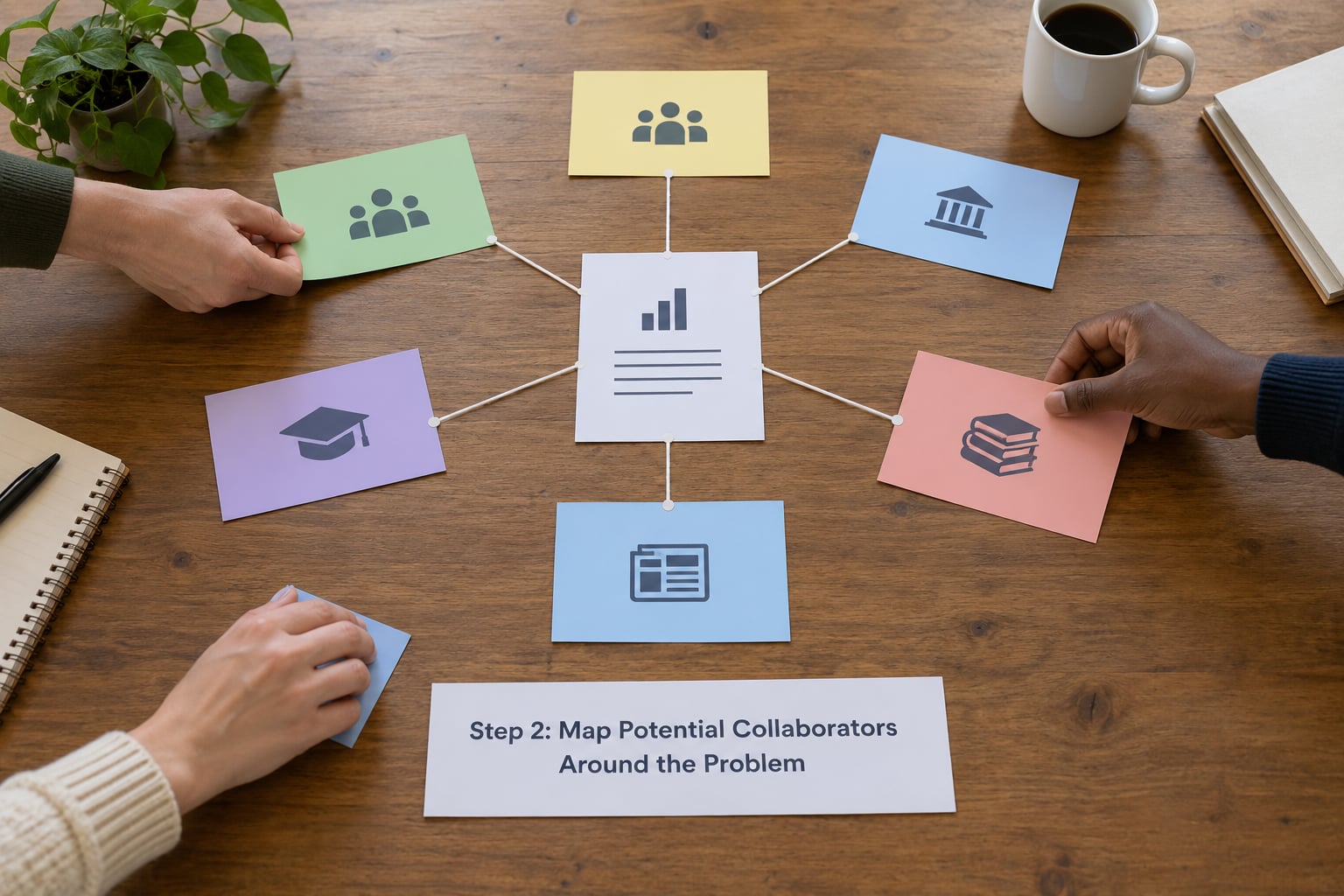
Build the map around the problem, not around your organisation’s wish list. Write the civic question at the centre, then branch outward through group types: community-based organizations, public agencies, nonprofits, universities, libraries, local businesses, journalists, developers and civic organizations. For each one, record two fields — why they are affected, and what value they could contribute.
That second field is the part people skip, and it is the whole exercise. “Why relevant” produces a list you will never act on. “What they could contribute” produces a list you can turn into outreach, because each row now has a role attached.
A typical map for a housing-transparency project has eight groups on it: a tenant association, a housing department, a legal aid clinic, two researchers at a nearby university, the public library’s data services lead, a local housing reporter, a mutual-aid network, and a data journalist. Eleven roles, eight rows. The duplication is fine; it tells you which gaps need filling.
Step 3: Choose Collaboration Formats Before You Reach Out
Pick the format before the message, because the format determines the size of the ask and the length of the relationship. These are the ones that hold up in practice.
- Informal advisory conversation. One 30-minute call with someone who has done this before. Cheapest way to find out you have misunderstood something.
- Interview. You record their account of the problem. Small, fast, and it produces material you can quote later.
- Data-contribution partnership. They hold records you need and share them under a data sharing agreement.
- Co-design workshop. Ninety minutes where a group decides what gets measured, with refreshments and childcare budgeted if you want real attendance.
- Event-based collaboration. A codesprint or data jam, usually one weekend.
- Fellowship. You pay someone to do scoped research over three to twelve months. Best fit for students and early-career researchers.
- Co-published analysis. Two organizations publish the same finding together, splitting audience and credit.
- Community data stewardship agreement. A longer document that sets control, retention and reuse rules over community-collected data.
- Formal vendor or nonprofit partnership. A contract. Slow, and worth it when money or liability is involved.
Most first outreach should be one of the first two. Everything bigger comes after someone has said yes once.
Step 4: Create a Clear Collaboration Pitch
The pitch is a one-page document and it does eight jobs: the public problem, the concept, the data or expertise needed, the proposed role, the time commitment, the outputs, the decision rights, and the next step. If the compensation is anything but zero, say so on the page.
A cold outreach message has about four sentences. Something close to this works more often than anything longer: who you are in one clause, the question in one sentence, the specific thing you need from this specific person, and the ask for a short call with two times suggested.
What not to put in a first message: your entire methodology, a request for feedback on your life story, a vague “would love to pick your brain”, or a request for a large free deliverable. None of those get a reply.
Decision rights deserve a line. Say who decides the framing, who decides the analysis, and who holds the final say if the two disagree. Projects that skip this discover the disagreement at publication time, which is the worst possible moment.
Step 5: Reach Out to Find Collaborators Through Multiple Channels
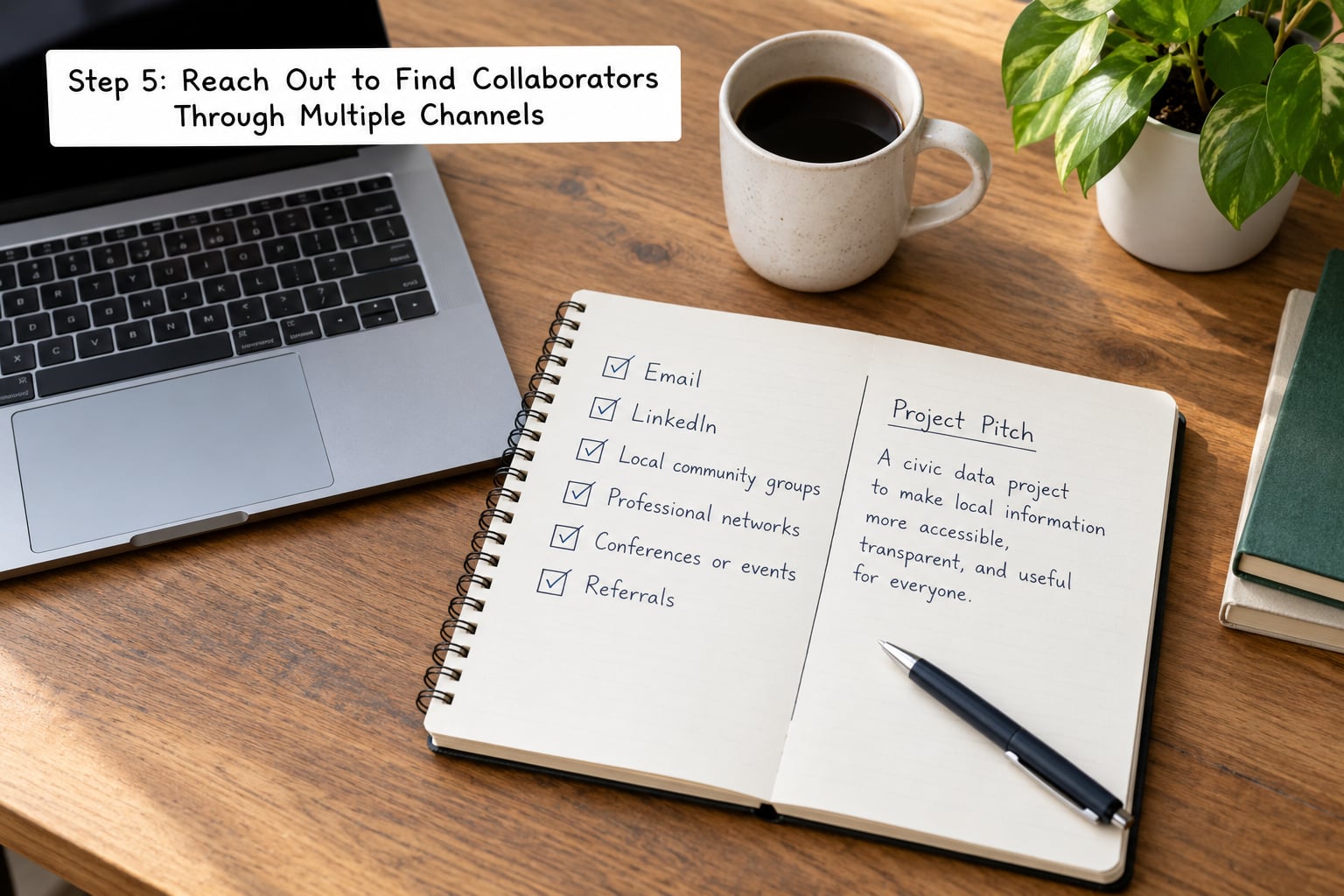
One channel gives you one network, and one network rarely covers everything. Run five or six in parallel, with the same ask adapted to each. Here is what each one gives you and roughly what it asks in return.
- Local civic tech meetup. Developers and designers, plus warm introductions. Monthly, about two hours. Show up twice before you pitch anything.
- Code for America brigade. Volunteers and a working list of projects. Monthly, with occasional project commitments. Go through the brigade’s currently listed organizer rather than an old address.
- Civic Tech Field Guide. A map of what already exists nearby. Self-serve, no commitment. Browse by place and topic.
- Data collaboratives directory. Practitioners already running community data work. Varies by project. Contact the collaborative directly.
- Codesprint or data jam. Fast pilot output and a batch of new names. One to three days. Propose a project and bring your own data.
- Public library. Public space, data skills and a trusted local brand. Program-length. Ask for the data services or digital inclusion lead.
- Open data office. Access, a named liaison and co-publishing. Ongoing or one project. Contact the open data team directly.
- University or journalism school. Researchers, students and faculty supervision. A semester or a year. Approach a department or a center.
Each channel needs its own reason for contacting that person. A librarian is not being pitched the same way as a tenant association: one is being asked for meeting space and data literacy help, the other for review of the framing and a place to distribute the result.
Two things about timing. First, many brigades reorganised after Code for America wound down its brigade relationship, so old contact details are unreliable — find the current organizer through the project’s own site or a recent event listing rather than a link from an old article. Second, email alone skews the room. If someone who matters to you has a public meeting, show up.
Step 6: Evaluate Responses and Select the Right Team
Scoring responses keeps this from becoming a popularity contest. Rate each candidate on eight things, and write the reasoning next to each score.
- Expertise — do they actually know this domain or dataset?
- Lived experience — are they affected by the question, or only interested in it?
- Community trust — are they trusted by the people in the data, and do they have standing to speak?
- Availability — hours per month they can realistically give, not hours they could ideally give.
- Complementary skills — does this person cover a gap you have already identified?
- Communication — do they respond, and do they tell you when they disagree?
- Conflicts of interest — anyone paid by the outcome, or with a stake in the finding?
- Agreement on goals and decisions — can you settle the framing question in one conversation?
A strong scorecard is boring on purpose. People with high trust and low availability are worth keeping in a different role, such as reviewer, and telling them that is more honest than leaving them in an unpaid-build queue.
Step 7: Onboard Collaborators and Agree on Next Steps
The gap between a yes and a working project is where most civic collaborations quietly die. Close it with a short written record that everyone has agreed to, sent within a day of the call.
It needs confirmed roles, working norms, data permissions, attribution, deadlines, the communication channel, the risks you know about, and one first small deliverable. That deliverable should be real and finishable — a data dictionary for one source, a draft annotation schema, a validated sample of 200 records.
Then schedule the follow-up before you leave, and keep a lightweight collaborator record: name, role, what they agreed to, last contact, what they are owed. This is the document that prevents the second project from starting from zero.
Common Mistakes
Asking a dozen people for large free work. One realistic ask to one person beats twelve vague ones. Fix: aim for a first deliverable under an hour of effort.
Sending a pitch that could go to anyone. If the recipient’s name could be swapped without the message changing, it will be ignored. Fix: name their specific dataset, their specific meeting, or their specific question.
Skipping lived-experience expertise. Data collected about a neighborhood without someone from that neighborhood in the room produces a technically correct answer to the wrong question. Fix: bring a resident into co-design before the workshop, not after publication.
Ignoring decision rights. Disagreements about framing and methodology are normal. Fix: agree in writing who decides what, and what happens when the decision does not go your way.
Overlooking data ethics. Community-based organizations are cautious about sharing community-collected data, and they are right to be. Before you share anything people handed over, settle four things: what it is used for, who sees raw records, whether names are aggregated, and whether the community can review the finding before it runs.
Overpromising outcomes. “This will change how the county allocates funds” is not something you control. Fix: promise the deliverable and the timeline, not the policy result.
Failing to define what happens after the first meeting. Fix: end every call with a named next action, a date, and who does it.
Recruiting from one channel, one timezone, or one skill type. A project staffed entirely by developers has no one to check whether the question matters. Fix: recruit for the gaps on your stakeholder map, not for convenience.
Two smaller habits that pay off. Publish a code of conduct before you need one, and make tasks discoverable — a list of small issues rather than one large invitation. Volunteer energy fades when newcomers have to figure out what to do on their own.
Frequently Asked Questions
Where can I look first to find collaborators for a civic data project?
Start with channels that already gather the right people: a local civic tech meetup or brigade, the Civic Tech Field Guide to see what already exists nearby, DataCollaboratives.org and NNIP for practitioners, public libraries, the city open data office, and community-based organizations affected by your question. Run several in parallel. Each channel gives you a different network, and no single one covers subject expertise, technical skills, trust and distribution at once.
Should I pay community members for their time?
If you are asking for several hours of someone’s expertise, treat it as work and budget for it, even if the amount is modest. Underpayment is the fastest way to lose a community partner, and unpaid asks are also the most common reason organizations decline. Small stipends, paid cohort roles and funds for childcare or transit cover the cases where a formal salary is not possible.
How do I approach a city or county open data office?
Send a short note to a named open data liaison or data services contact with one specific question about one dataset — access, format, update cadence or a correction. Agencies respond far better to narrow technical questions than to project overviews. Ask early whether anything about the data carries restrictions, and check the portal’s terms before you build a plan around a source.
What is a data collaborative and how is it different from a one-off partnership?
A data collaborative is a durable arrangement, usually hosted by an organization, where several groups pool data and staff over years to answer questions none could answer alone. A one-off partnership produces a single analysis and then ends. The collaborative model suits recurring questions like neighborhood indicators or service access; the partnership model suits a defined investigation with a clear deadline.
How do I handle disagreement about framing or methodology with a collaborator?
Agree the decision rights before the work starts, then use them. When framing is contested, name the disagreement out loud and test it against the question the project set out to answer, not against who is senior. If it cannot be resolved, document both interpretations and publish the disagreement as a finding, with the dissenting view attributed.
How do I keep participation inclusive when collaborators are volunteers?
Remove the barriers you control: pick meeting times that do not exclude shift workers, offer childcare and transit reimbursement, provide materials in plain language, and never treat a low-friction first task as a test of commitment. Keep expectations written down and small, and make the code of conduct public before the first session rather than after an incident.
Conclusion: Start with One Useful Conversation
Pick one civic question and write it down. Identify three groups who could contribute different things — one with the data, one with the lived experience, one with the technical or distribution capacity. Turn that into a one-page brief with a single small ask, and send one specific invitation to one named person this week.
That first conversation is the whole method. Everything after it — the roles, the agreements, the credit, the next deliverable — gets easier once somebody has already said yes.