A collaborative investigation workflow is a documented, repeatable process that decides who does what, where evidence lives, how decisions get made, and how work moves between people across a multi-desk investigative project. Get the definition right here: it is a shared set of roles, a single place for evidence, written handoffs, and scheduled verification checkpoints, agreed before reporting starts rather than improvised halfway through.
The unglamorous version matters because long investigations almost never fail on reporting. They fail on coordination. Two reporters chase the same council member, nobody knows which version of a spreadsheet is current, and the editor finds out about a legal problem three days before publication.
This guide is written for cross-functional newsroom teams coordinating reporting, data, design, development, sourcing, verification and publication. It works for a two-person team as much as a multi-outlet partnership, though the heavier machinery only earns its keep once you have four or more people working at once.
Table of Contents
- What You Need
- Step-by-Step: How to Build a Collaborative Investigation Workflow
- 1. Frame the investigation and assign clear roles
- 2. Create a shared source and evidence register
- 3. Break reporting into trackable work
- 4. Set handoffs and review checkpoints
- 5. Standardize verification and documentation
- 6. Choose tools and version control
- 7. Test the collaborative investigation workflow before the deadline
- 8. Publish, archive, and improve
- Common Mistakes
- Frequently Asked Questions
- How do you build a collaborative team for an investigation?
- What should a collaboration agreement include?
- What tools should a collaborative investigation team use?
- How do you handle source confidentiality across a team?
- How do you avoid duplicate work on a shared investigation?
- How do you archive a finished investigation?
- Conclusion
What You Need
Most of what follows costs nothing but a decision. You need six roles filled by name, not by job title, and a handful of shared systems that everyone agrees to use.
The people
- An investigation lead who owns scope, deadlines and final calls.
- One or more reporters doing the field work.
- A research, data or design specialist, whoever your story needs most.
- A verification editor who checks claims rather than prose.
- A standards or legal reviewer for pre-publication risk.
- A partner contact if you are working with another desk or newsroom.
The materials
A one-page scoping memo, a signed collaboration agreement, an evidence register, a task board grouped by track, and a version-controlled repository for code, data and copy. Write the agreement down. Memory is not a contract, and it forgets interesting things.
The permissions
Decide who can see source-identifying material, who can see only the redacted version, and when access expires. Most teams skip this and then discover, mid-project, that their intern has read the entire source list.
The systems
One shared workspace for documents, one task board, one messaging channel, one secure intake for tips and leaked material. Four tools, not forty. If a task can only be found in someone’s chat history, it does not exist.
Step-by-Step: How to Build a Collaborative Investigation Workflow
1. Frame the investigation and assign clear roles
Turn the idea into a single reporting question before anyone files anything. “Something is wrong with this contract” is not a question; “why did this county waive three bids in four months” is.
The scoping memo carries four things: the question, what would prove it wrong, the publication date, and a named owner per track. If you cannot write it in a page, you are not ready to brief reporters.
How you know it worked: a reporter who has never spoken to you can read the memo and tell you what they are being asked to find.
2. Create a shared source and evidence register
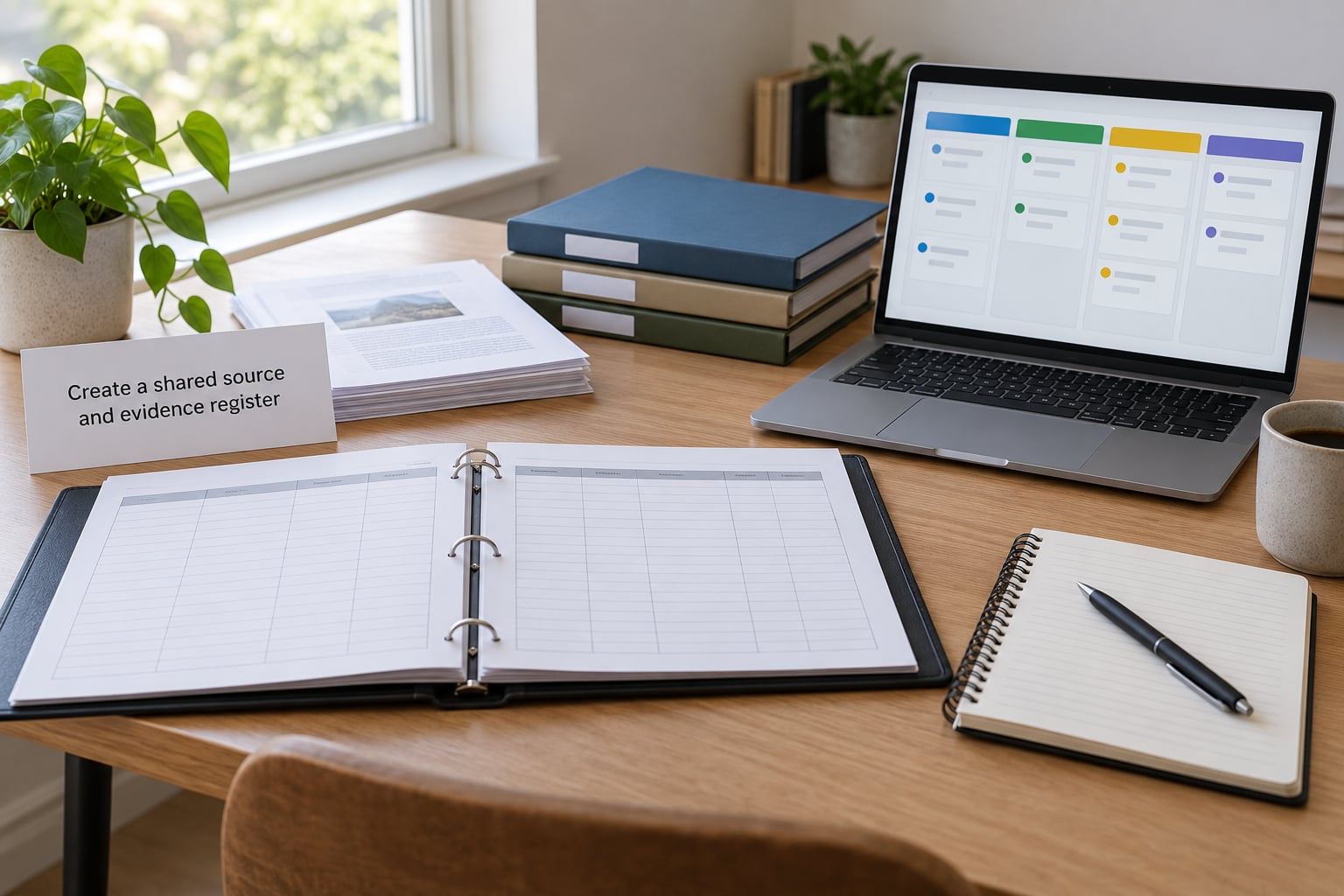
Every document, dataset, interview and claim goes into one searchable register. Columns worth having: ID, what it is, where it came from, date obtained, sensitivity level, verification status and who checked it.
Naming is the part teams skip and then regret. Use a pattern like 2026-03-11_vendor-invoice_v03_JR so any file sorts by date and version, and the initials tell you who touched it last.
Keep claims separate from documents. A claim is a sentence you intend to publish; it needs its own row, its own verification status and its own reviewer. This is the single change that most reduces arguments at deadline.
3. Break reporting into trackable work
Split the work into tracks, not a flat list of tasks. Reporting, research, data, design, development, legal and fact-checking each have an owner, and each task names the track it belongs to.
Then mark dependencies. Design cannot start before the data structure is fixed; legal review cannot start before copy exists. Dependencies you do not write down become dependencies you discover in week six.
Cap the board. If everything is urgent, nothing is. Most teams do better with eight active tasks than with forty.
4. Set handoffs and review checkpoints
A handoff is a written answer to four questions: what is done, what is not, what you decided and why, and what the next person must not break. Anything less is a conversation you will have to repeat.
Put handoffs in the register itself, not in private messages. When someone joins in month four, the handoff history is the fastest orientation available.
Checkpoints should be recurring and boring: a 30-minute weekly sync, a mid-project read-through, a verification pass two weeks before publication. Unresolved questions need a named person and a date, or they quietly become somebody else’s problem.
5. Standardize verification and documentation
Verification is a stage in the workflow, not the last read of the draft. The verification editor works through the claim register, not the prose, and marks each claim confirmed, partly confirmed, unverified or contradicted.
For anything obtained from a source, record provenance: who gave it, how, when, under what condition. Chain of custody is not courtroom theatre, it is what lets you explain a document’s origin to a standards editor six months later.
Keep leads and assumptions visibly separate from confirmed information. The register should make it obvious at a glance which claims are still soft.
6. Choose tools and version control
Pick tools by job to be done, not by popularity. Documents and datasets, task tracking, messaging, data analysis, code, design and publication are seven separate jobs, and no single tool is genuinely good at all seven.
Common-sense picks for newsrooms: a cloud office suite for documents and a task board that supports assignment and due dates, a structured database or spreadsheet for the register, GitHub for code and published notebooks, a secure file share with per-folder permissions, and a secure drop such as SecureDrop for tips and leaked material.
For messaging, the deciding question is whether it retains what you will need later. Ephemeral chat is fine for coordination and terrible for anything you may need to quote to a lawyer.
Version control rules matter more than the tool. One writer per file for anything prose-like, branches for anything code-like, and nobody edits a published document in place. When versions conflict, the person who made the change explains it, rather than the person with the loudest opinion.
7. Test the collaborative investigation workflow before the deadline
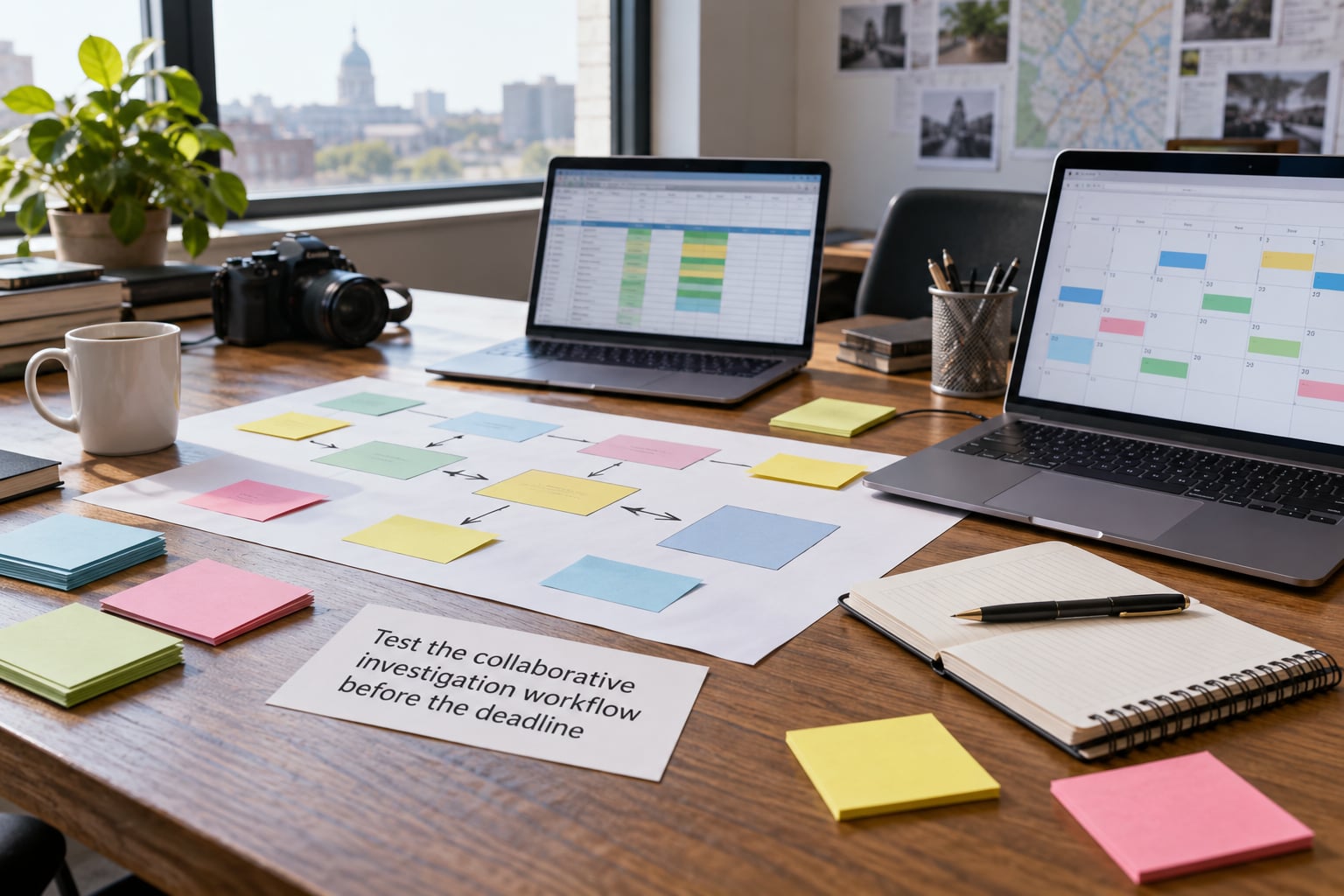
Run one small mock investigation end to end, roughly a day of work. Pick a real but minor story, give three or four people the roles, and push it through every stage including verification and handoffs.
You are testing the process, not the reporters. Watch for the four things that break under pressure: nobody knows who owns a task, evidence lands in a personal folder, handoffs arrive as a two-line message, and verification gets squeezed to the last hour.
Run it once before a deadline, and again after your first real investigation. The second run is usually the one that finds the real problem, because by then people trust the process enough to skip it.
8. Publish, archive, and improve
Archive the whole thing: source notes, the claim register, the collaboration agreement, the methods write-up, the code and any decisions about data cleaning. Someone will want this in two years, either for a follow-up or because a source complained.
Keep the corrections log with the archive, not in someone’s inbox. When a correction lands, it goes into the log, into the published piece, and back into the register with the reason recorded.
Then write a short handoff note: what the team learned about working together, which stages wasted time, which tools earned their keep. That note is the institutional memory, and it is the reason the second investigation is cheaper than the first.
Common Mistakes
Reporting starts before roles are named. Two people chase the same lead, and the second one to return has the better version. Fix: no memo, no reporting.
Evidence lives in personal drives and inboxes. When someone leaves or a laptop fails, the investigation loses a third of itself. Fix: everything lands in the register on the day it arrives.
No collaboration agreement. Authorship, credit, embargo terms and republication rights get negotiated after everyone is tired. Fix: sign the ground rules in week one, when nobody is invested yet.
Conflicts resolved by volume. Two drafts, one document, no history. Fix: one writer per file, branches for code, and a written decision note whenever a merge happens.
Verification happens at the last minute. The verifier finds three problems in eight hours and fixes none of them properly. Fix: claims, not prose, reviewed weekly from week two.
Access that never expires. A partner or freelancer still has the source list a year after publication. Fix: set an expiry date when you grant access, not after you remember.
Three habits keep it alive. Review the register in the same weekly slot, every week, so it becomes a ritual rather than a chore. Keep the board to what is genuinely active. And when something goes wrong, write the fix into the workflow the same day, while the annoyance is still fresh.
Frequently Asked Questions
How do you build a collaborative team for an investigation?
Name one investigation lead with real decision rights, then write down who is responsible for reporting, data, design, verification and legal. Give every track an owner and at least one backup. Hold a kickoff where each person states what they are committing to and what they need from the others. The team forms around shared deliverables, not around whoever happens to be loudest.
What should a collaboration agreement include?
Scope of the investigation, named roles, authorship and credit, embargo terms, republication rights, data-sharing terms, confidentiality and source protection, cost sharing, verification responsibilities, correction handling and an exit clause. Ten clauses is a reasonable target. Sign it before reporting starts, because the terms that matter are the ones nobody assumes in advance.
What tools should a collaborative investigation team use?
Choose by job to be done: a shared document workspace, a task board with assignments and deadlines, a structured evidence register, secure messaging that keeps searchable history, Git for code and published notebooks, a design collaboration tool, and a secure drop for tips and leaked material. Seven tools, each with one job. Resist suites that promise to replace all of it.
How do you handle source confidentiality across a team?
Grant the minimum access each person needs, keep source-identifying material in a separate restricted folder, and give access an expiry date. Log who requested material and who shared it. Discuss source protection verbally, in person or on a channel that is not archived. Never let a convenience tool become the weakest link in a promise you made to a source.
How do you avoid duplicate work on a shared investigation?
Keep one task board and make the register searchable. Before starting any lead, the owner searches for it. Assign tasks by track rather than by topic so ownership is unambiguous. Hold a short weekly sync where each person states what they are working on next. Duplication usually comes from missing information, not from people being careless.
How do you archive a finished investigation?
Store the source notes, claim register, collaboration agreement, methods documentation, code and data-decision log in one archive folder with a written index. Keep the corrections log with it and update it whenever a change is published. Decide up front how long the archive is retained and who can open it. An unindexed folder of files is not an archive.
Conclusion
Start with the scoping memo, not the reporting. Twenty minutes writing down the question, the deadline and the six names behind it prevents most of the coordination failures that sink group investigations later.
A collaborative investigation workflow works when ownership, evidence and handoffs are written down and shared. The tools matter far less than those three things, and any team can run the whole sequence on free software inside a week.