
A journalism hackathon is a time-boxed event, usually one to three days, where reporters, editors, developers and designers build a rough prototype of something that solves a real newsroom problem. Learning how to run a hackathon for journalists comes down to four things: one editorial goal, a balanced room, pre-secured data access and a clear plan for what happens after the weekend.
The format is easy to describe and harder to pull off. The failure mode is well documented: a room full of journalists with no developers, an afternoon of enthusiastic brainstorming, and a Monday with nothing to show. The organizers who get past that treat the event as newsroom production with a compressed deadline, not as a technology showcase.
Below is the sequence I would follow, from the first planning conversation to the post-event review. Each step lists the action, the output you should have in hand, and a quick way to tell whether it actually worked.
Table of Contents
- What You Need
- Step-by-Step: How to Run a Hackathon for Journalists
- Step 1: Set a Clear Editorial Purpose
- Step 2: Choose Challenges That Fit the Available Time
- Step 3: Recruit the Right Mix of Participants
- Step 4: Prepare Teams, Roles and Collaboration Tools
- Step 5: Run the Event With a Visible Schedule
- Step 6: Judge Projects Against Shared Criteria
- Step 7: Capture Learning and Decide What Comes Next
- Common Mistakes
- Frequently Asked Questions
- Conclusion
What You Need

Most of the work happens before anybody registers. Have these pieces ready and the event itself becomes the easy part.
An organizing team with named owners
Three to five people is enough. One lead owns the editorial goal and challenges. One owns recruiting, for both journalists and developers. One owns logistics: venue, food, equipment, accessibility. One owns data, API and permission requests. A fifth can handle communications and the post-event write-up. Assign a named backup to each role, because people get ill.
Participants from both sides of the room
Aim for a mix where roughly a third to a half of the room can build. Reporters bring the editorial instinct, the audience knowledge and the sense of whether an idea is worth a week of reporting time. Developers, engineers and data specialists bring the ability to turn a sketch into something clickable. Designers, audience editors, product managers and at least one newsroom decision-maker make the judging and the follow-up possible.
Challenge briefs written in advance
Each brief needs a problem statement, why it matters to the audience, what data exists, a scope limit for the time available and what a demonstration would look like. Write the brief before recruitment opens. It doubles as your registration page copy and your source material for the opening briefing.
Judging criteria, published in advance
Participants should know how they will be scored before they pick a challenge, not at the judging table. Publish the rubric with the registration form. A short rubric of four to six weighted criteria is easier to use than a long one.
Data sources and access, sorted before the doors open
List every dataset and API you plan to offer, with the key, the rate limit and the terms of use, and put the test credentials in a shared folder with a working example. Requests for commercial or restricted data often take weeks, so start them the moment the theme is fixed. Get legal or standards review on anything involving scraping, personal data or AI before the event, not during it.
Tools, venue and practical materials
For in-person events: power and network for every table, a room that stays open late, a whiteboard or wall for team space, printing, and a way to hear you in a room of forty people. For virtual events: a single chat and call setup, one shared document per team, a working screen-share setup you have tested with a non-technical person, and printed materials mailed to anyone who asks. Also plan name badges with skill tags, team formation worksheets, mentor contact details and a printed schedule.
Permissions and ethics paperwork
Photography consent, a data handling agreement for anything participants bring, and a one-page note on responsible practice: no scraping against terms of service, no real personal data in demos, no publishable claims without sourcing. Ten minutes of reading now prevents an uncomfortable conversation on stage.
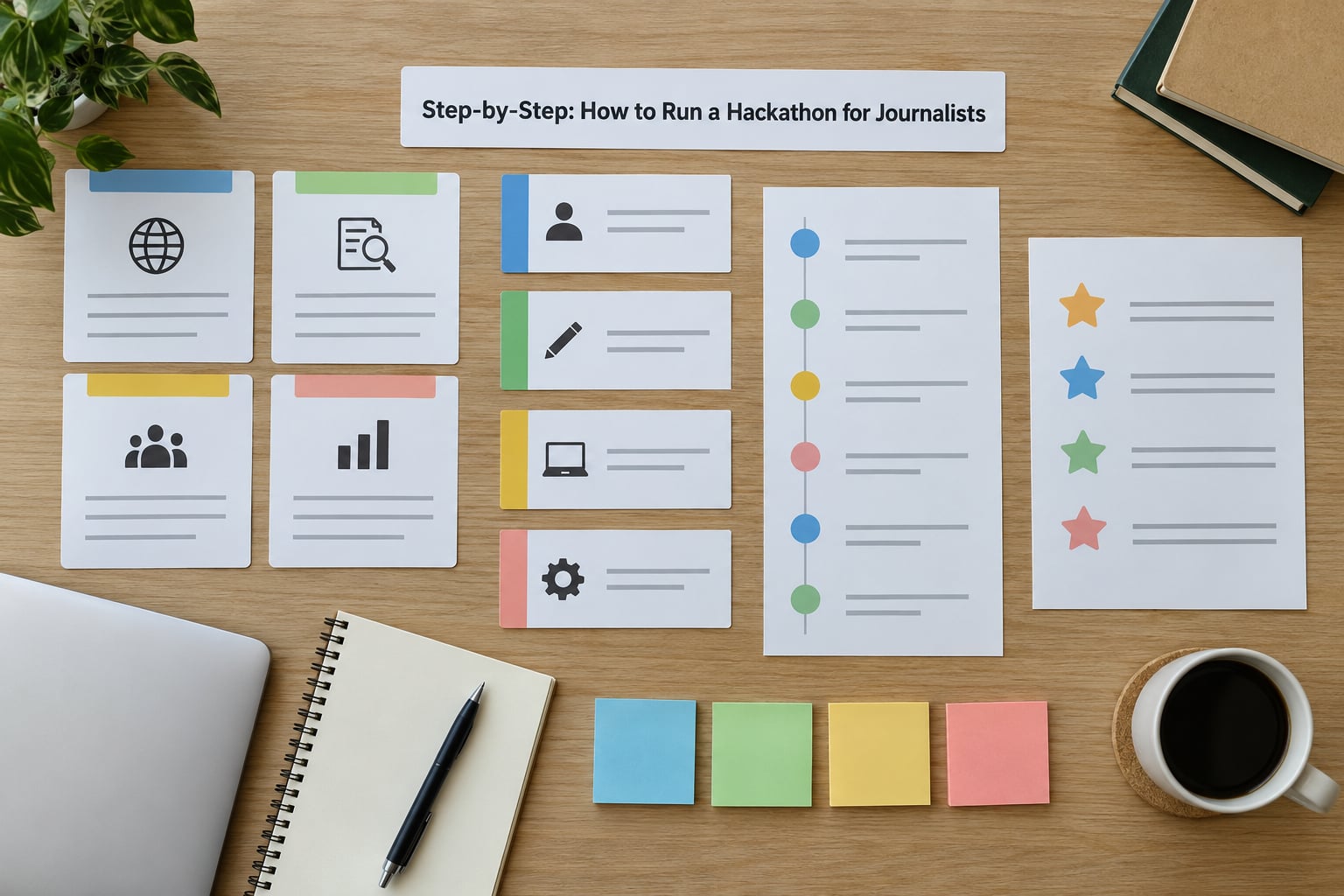
Step-by-Step: How to Run a Hackathon for Journalists
Step 1: Set a Clear Editorial Purpose
Write one sentence that says what this event is for, and nothing else. “Explore tools that help reporters file and verify data faster this quarter” is an editorial purpose. “Build the future of news” is a slogan that will produce noise for two days.
A useful journalism challenge starts from a problem someone actually has. Ask your reporters where reporting time disappears, where handoffs between the graphics desk and the copy desk break down, where readers drop off, or which story type your team keeps proposing and never has the resources to build.
How to tell it worked: you can read your sentence to a new hire and they can name a first project they would want to attempt. If they cannot, keep rewriting it.
Step 2: Choose Challenges That Fit the Available Time
Scope every brief to the clock. A twenty-four-hour event should produce a clickable prototype, a working script against one real data source, or a short structured document explaining a data story with a chart or two. It will not produce a production tool. Say so in the brief.
Challenge types that suit newsrooms include: a public-interest data story using an open dataset, a tool that speeds a recurring reporting task, a mapping or timeline format for a story you already know you want to tell, an audience engagement mechanic tied to a live investigation, a news app or embed concept, a data visualization of something currently shown as a table, or an internal workflow that handoffs keep breaking.
Give each brief a named data source, a named reporter problem and a one-paragraph description of the demo. Offer five or six briefs, never twenty. How to tell it worked: teams pick challenges in under fifteen minutes and the room’s questions during selection are about scope rather than confusion.
Step 3: Recruit the Right Mix of Participants
Recruitment is the hardest part, because you are filling one room from two populations who do not normally attend the same events. Plan separate recruitment messages.
For journalists, lead with the reporting problem, not the technology. Ask editors to nominate specific staff, and treat a nomination as a booking. Tell first-timers what they will and will not be asked to do, because intimidation is the most common reason a signed-up reporter does not come. Say plainly: you are not expected to code, and there is a named person whose job on the day is to sit with you.
For developers, lead with the data and the problem. Most engineers say no to a vague weekend, and yes to “help a local newsroom build a tool against a public records dataset you can see beforehand.” Give them a sample dataset and a sample brief in the invitation.
Ask anyone who has organized one of these and they will tell you recruitment, not technology, decides whether the weekend works. That is the least intuitive lesson in how to run a hackathon for journalists, and the one most teams learn a week too late.
How to tell it worked: you know the split before registration closes, and the registration form collects a skill self-assessment. If the room skews heavily toward one side, invite more of the other before the deadline rather than hoping on the day.
Step 4: Prepare Teams, Roles and Collaboration Tools
Do not assign people to teams yourself unless the event is small or participants booked as a group. Let teams form around shared interests after the briefing, then help anyone standing alone find a group. A facilitator walking the room at team-formation time does more for team health than any printed rule.
Once teams settle, ask each to name a reporter, a builder and a note-taker. The reporter owns the editorial question, the builder owns what gets made, and the note-taker records decisions, dead ends and data sources so the team can be asked about its thinking later. Temporary roles work better than job titles, and they help junior reporters step up.
Pick one collaboration tool per team and set it up before the event: a shared repository for code and a shared document for decisions. Give new participants a fifteen-minute tutorial in the first hour rather than a pre-event email they will not read. How to tell it worked: no team spends its first hour on account setup, and every team can show you its document on request.
Step 5: Run the Event With a Visible Schedule
Put the schedule on the wall and repeat it at every check-in. Participants relax once they know what happens next, and an unplanned hour of dead time is where hackathons lose people.
| Time | Session | What it is for |
|---|---|---|
| 09:00 | Registration, breakfast, setup | Badges, Wi-Fi check, repository access |
| 09:45 | Opening briefing | The editorial purpose in one sentence, the ethics rules, the schedule, the rubric |
| 10:15 | Short data briefings | Five-minute pitches on each dataset and API, with a working example |
| 10:45 | Challenge pitches and team formation | One minute per brief, then teams form |
| 11:30 | Mentor office hours | Twenty-minute slots with data, design and engineering coaches |
| 12:00 | Lunch and scoping | Each team writes down what it will demonstrate |
| 13:00 | Build block one | Two uninterrupted hours, no presentations |
| 15:00 | Check-in | Two minutes per team, blockers named out loud |
| 15:15 | Build block two | Working session with coaches circulating |
| 18:00 | Demo dry run | Optional five-minute rehearsal, and a hard time to stop building |
| 19:00 | End of day one | Demos in three minutes each, then close |
| 09:30 | Day two check-in | Reset the rooms, re-paste the schedule |
| 10:00 | Build block three | The longest uninterrupted window of the event |
| 12:30 | Demo preparation block | Slides, demo script, fallback video or screenshots |
| 14:00 | Final presentations | Five minutes per team to the room |
| 15:30 | Judging and feedback | Panel scores against the published rubric, judges meet privately |
| 16:15 | Showcase and close | Winners announced, next steps named, survey sent |
How to tell it worked: no one asks what is happening next, and the final build block runs long. A schedule that holds together to the last hour is a good sign.
Step 6: Judge Projects Against Shared Criteria
Give judges the rubric before the demos start, and ask them to score independently before they discuss anything. A panel that talks first and scores afterwards produces a group verdict dressed as a panel decision.
| Criterion | Weight | What judges look for |
|---|---|---|
| Usefulness to the audience | 25% | Who is this for, and what does the person do with it |
| Editorial value | 25% | Does it serve a real reporting need, and would an editor commission it |
| Feasibility of the next step | 20% | What remains between the prototype and something a newsroom could use |
| Use of data or APIs | 15% | Real data handled thoughtfully, with sources shown |
| User experience and storytelling | 10% | Can someone follow the demo without a technical background |
| Responsible practice | 5% | Consent, source protection, no exposed personal data, honest about limits |
Mix the panel. A newsroom editor, a working developer and someone from the audience you are building for will disagree productively. Tell teams the weights up front, give each team a hard five-minute limit, and hold a separate feedback conversation after scoring so weak teams get something useful. How to tell it worked: teams can predict roughly how they scored, and nobody objects to the winner on process grounds.
Step 7: Capture Learning and Decide What Comes Next
The weekend is the cheap part. What organizers usually skip is the fortnight afterwards, when enthusiasm fades and a team of four volunteers has three other jobs.
Run a thirty-minute review with participants while it is still fresh: what worked, what wasted time, what should change next time. Ask teams to leave a short write-up of their approach, the data they used and the open questions, and delete anything that contains personal data before you publish it.
Then sort the output into three piles. Publish it: prototypes worth putting on an open repository with clear licensing and a stated level of maturity. Continue it: pick one or two projects with a named owner, a budget line and a date when someone reports back. Release it: say thank you, archive the write-up and release the data, so the effort is not wasted even when the tool is not.
Measure something simple afterwards. How many teams finished, how many journalists came, how many developers came, how many prototypes exist six weeks later, and how many people signed up for the next one. The two weeks after the closing session are the part of how to run a hackathon for journalists that most organizers postpone, and they are where the event’s real value is decided. How to tell it worked: you already know which date the next event is on, and at least one prototype has an owner.
Common Mistakes
Starting from a technology instead of a reporting problem. Frame every brief as a newsroom pain point. A tool with no reporting need behind it gets judged on its interface and loses to a scrappy working demo.
Letting the room fill with one profession. A journalist-heavy room talks and does not build. The Knight Lab debrief of the first UNC Journalism School Hackathon described exactly that pattern, with more time spent brainstorming than coding and nothing finished by the end. Recruit deliberately and check the split before the deadline.
Forcing teams together. Presenting assignment to mixed-skill teams tends to produce a reporter with nothing to do. Let interests form the teams, then help solo participants join one.
Announcing data access on the day. Requests for commercial or restricted sources take weeks. Publish the dataset list with test credentials before the event, and describe anything you could not secure in the brief itself.
Overloading the schedule. Three parallel tracks on day one feels generous and produces a room of people with no idea what to do. One opening, one build block, one demo block. Leave a real break in the middle.
Judging on polish. A slick deck built in two hours is not a signal of anything. Score against the published rubric, have judges score independently, and weight what a newsroom would actually use.
Letting AI use happen by accident. Decide the rules before the event and say them out loud at the opening. Generative tools are fine for brainstorming, boilerplate code and mock data. They are not acceptable as a data source for a demo, and any use of a model trained on paywalled reporting needs legal review.
Running the event once and never again. A single weekend is a project. Recurring meetups, the model Hacks/Hackers chapters use, are what turn a hackathon into a community. If you cannot commit to a second one, say so at the start.
Two smaller habits carry a lot of weight. Assign a named troubleshooter whose only job on the day is unblocking people, and print the schedule, the rubric and the ethics rules on paper as well as posting them. Machines fail, and the people who need the information most are the ones who will not have scrolled your page.
Frequently Asked Questions
How long should a journalism hackathon last?
One day works when the goal is a clickable prototype or a scoped data story, and it suits newsrooms that cannot spare a weekend. A two-day weekend gives teams enough time to reach real data, which is where most journalism hacks either succeed or stall. Three days are worth it when your challenges involve hard data cleanup. Whatever the length, reserve the final ninety minutes for demos and stop building on time.
How do you get journalists and developers in the same room?
Recruit the two groups separately and with different messages. Ask editors to nominate named staff for journalists, and promise first-timers that they will not be expected to code. Send developers a sample dataset and a sample challenge with the invitation, because engineers decline vague weekends. Then track the split as registrations come in and open a second push for the smaller group before the deadline, rather than hoping the balance sorts itself out on the day.
What does a journalism hackathon cost?
The main costs are venue and travel, food for the hours you run, prizes, equipment and communications, plus staff time to organise and run it. Newsrooms and universities often cover venue and food in kind, which shrinks the cash requirement considerably, and many events run with no prize money at all, rewarding teams with continued time on the project instead. Costs scale mostly with headcount and length, so a smaller room over a shorter window is the fastest saving.
Can we use AI tools like ChatGPT during the hackathon?
Yes, with rules you state at the opening and repeat in writing. Generative tools are useful for brainstorming, drafting boilerplate code and generating mock data, and most teams will use them that way. Draw the line at feeding a model paywalled reporting, proprietary datasets or personal data, and at presenting model output as a finding. Any project that relies on a model for accuracy in a real story needs legal and standards review before it goes anywhere near publication.
How do you pick the winners?
Publish a rubric of four to six weighted criteria before the event, so teams know how they are scored. Give every judge the sheet in advance, require independent scoring before any discussion, and hold teams to a hard five-minute limit. Weight usefulness to the audience and editorial value above polish, since a demo built in a weekend will never look finished. Follow the scores with a separate feedback conversation so teams that place low still get something useful.
What happens to the prototypes afterwards?
Decide in advance, because this is where most events quietly lose their output. Sort results into three piles on the final afternoon. Publish the ones worth sharing, with a stated maturity level and a license. Continue one or two with a named owner, a budget line and a date to report back. Release the rest with a thank-you and the documentation, so the thinking is not wasted even when the tool is not built. Publish nothing that contains personal data.
Conclusion
If you are organising this for the first time, do three things this week. Write the one-sentence editorial purpose, and cut it until it names a reporting problem. Send invitations to two named journalists and two developers with a sample challenge attached. Then open the data requests, because those take the longest.
A journalism hackathon works when the problem is real, the constraints are honest about the clock, the room is mixed, and somebody has already decided what happens to the prototypes on Monday. Everything else is logistics, and logistics you can fix.
Keep the date of the next one on the calendar before the first one ends. That is the difference between an event and a program.