To make a podcast for a small newsroom, you need three things: a fixed format your team can hit on a schedule, a two-microphone recording setup in a treated room, and a named editor who signs off before anything publishes. The format matters most. A newsroom show is a published news product with a byline and a corrections policy, so it needs the same assignment, reporting, and review chain a written story goes through, just in audio form instead of on a page.
This guide walks through that chain in the order a small team will actually hit it: what to buy or borrow, how to plan an episode around reporting you have already done, how to record in a room and in the field, what a loudness standard is and why -16 LUFS matters, how to publish so the episode is findable, and how to fix the six mistakes that sink most first-season shows.
If your newsroom is three people and nobody owns audio, start with the resource-fit test in the last section before you buy a single microphone.
Table of Contents
- What You Need
- How to Make a Podcast for a Small Newsroom: Step-by-Step
- Set the format for how to make a podcast for a small newsroom
- Plan episodes around a newsroom reporting goal
- Prepare a consistent recording environment
- Record narration and interviews for clarity
- Edit the episode into a publishable audio story
- Publish the podcast with useful show notes and distribution
- Common Mistakes
- Frequently Asked Questions
- What equipment does a small newsroom need to start a podcast?
- How long should a news podcast episode be?
- Where do you create and host a newsroom podcast?
- How do you record a remote interview so the audio is usable?
- Do news podcasts need transcripts for accessibility?
- How much does it cost to make a podcast episode for a small newsroom?
- When a Small Newsroom Should Not Start One
- Turning One Audio Hour Into Five Assets
- Conclusion
What You Need
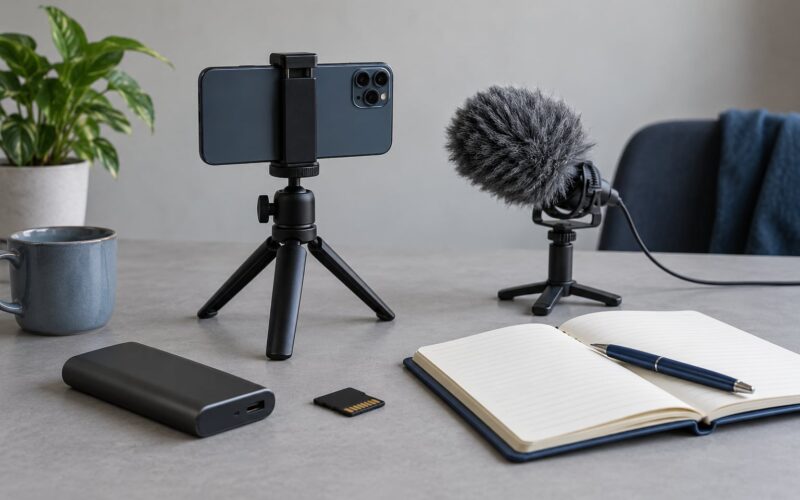
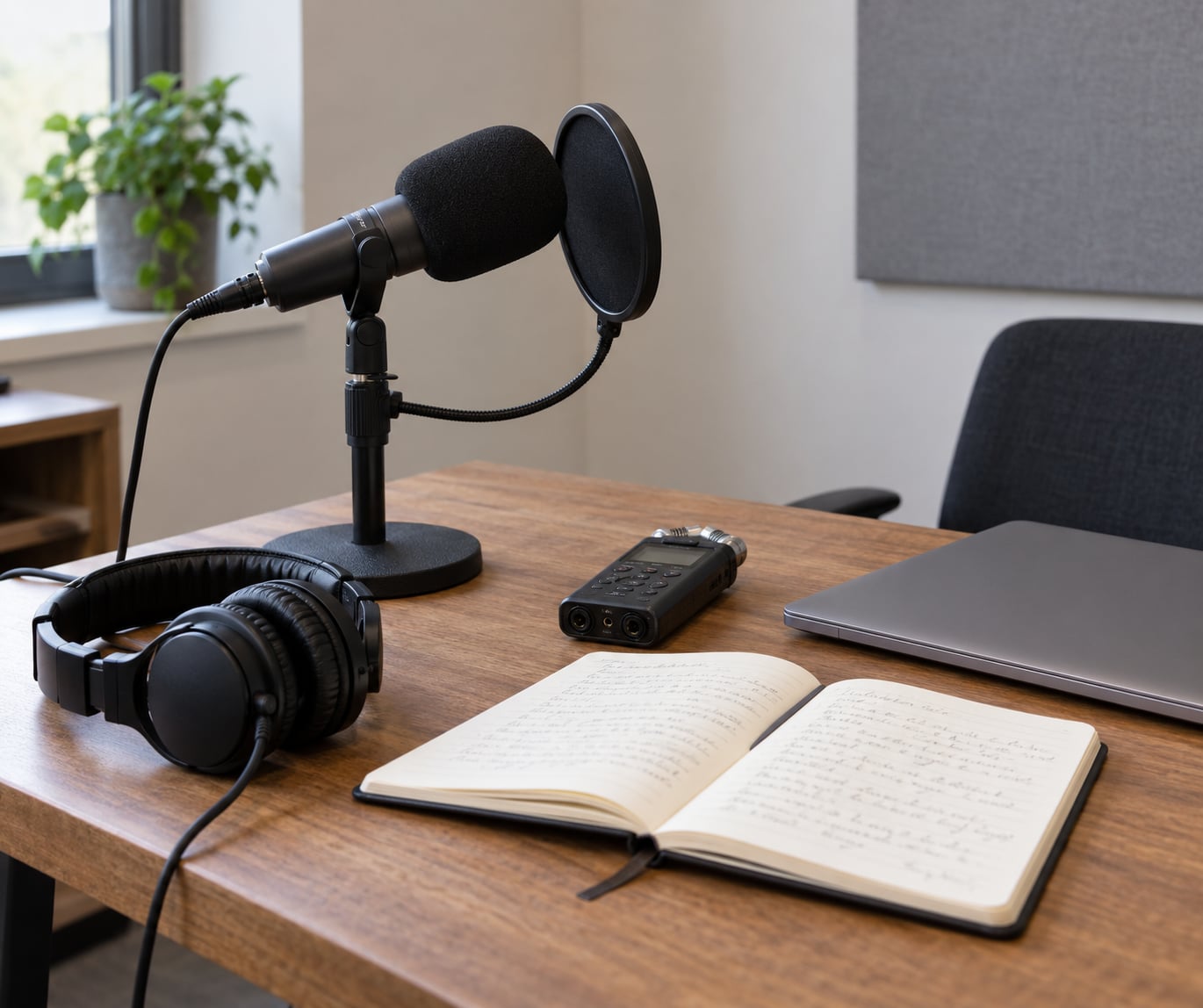
The minimum kit is smaller than the gear lists suggest. A reporter who can record cleanly, edit to a standard, and publish on a schedule needs a dynamic microphone, closed-back headphones, a pop filter, a treated corner, a recorder or laptop, an editor, and a hosting account that generates an RSS feed. Everything else is preference.
The four essentials
One dynamic microphone per speaker. A dynamic mic rejects room noise better than a condenser and needs no phantom power. In a newsroom that also has to record officials in offices, hallways, and council chambers, that rejection is the feature that decides the purchase.
Closed-back headphones. Every person on a recording needs to hear themselves. Open-back headphones leak sound into the mix, which is the fastest way to ruin a two-person interview.
A pop filter and a treated space. Twenty minutes and a heavy blanket over a closet curtain behind the mic removes more noise than any software plugin you will buy. The distance from the mic to the mouth matters more than either: a fist, roughly four inches, is the working rule.
An editor with a signing key. Not “whoever is free that week.” One person owns the final export, the show notes, and the transcript.
What you can share, borrow, or skip
One mic does not cover two people in the same room, but it does cover an in-person interview recorded with two tracks if you record host and guest separately. A single newsroom kit works for briefings and reported interviews; only a narrative production with scene audio needs a second dedicated recorder and a field kit.
Borrowing is a legitimate strategy, not a compromise. In r/Journalism threads about starting a podcast, the most repeated practical advice is to check whether a university library, a nearby public radio station, or a local media lab will lend you a studio and better microphones for a first season. Many stations and community colleges have unused equipment and a genuine interest in local audio work.
Skip the shock mount if the mic comes with one, skip the second interface if the recorder is already USB, and skip anything described as a podcast bundle before you have a room you like. If you have never recorded in a room, the room is the first purchase, not the microphone.
Software and services
Recording software needs three things: multitrack capture, so each microphone is its own track, and local backup of each track while you record. That rules out software that only records a mixed stream, because a mixed file cannot be repaired.
Editing software needs the same multitrack timeline plus noise reduction and loudness normalization. Audacity, Adobe Audition, Descript, and Riverside all cover spoken-word news; Descript edits the audio through a text transcript, which suits reporters more than general editors because the transcript doubles as the caption file.
Hosting is where the RSS feed comes from. Buzzsprout, Libsyn, Podbean, and Simplecast all generate a feed automatically when you upload an episode, which answers the single most common question new podcasters ask: you do not build or maintain the feed by hand. The host generates it, and the directories read it.
For transcription, automated tools are good enough for roughing out a transcript and terrible enough to quote. Numbers, names, agency titles, and negations are where they fail, and those are the words a newsroom cannot get wrong. A human always reads the transcript against the audio before it publishes.
People and preparation
Budget for three roles even in a newsroom of three: the reporter who reports and records, the editor who reviews and signs off, and whoever publishes and promotes. When one person holds two of those, the show still runs; when one person holds all three, it stops after about six weeks.
Before any recording, you also need a consent process. Audio releases are easier than video releases and just as necessary, especially for anyone under 18 or anyone who expects the recording to be public.
How to Make a Podcast for a Small Newsroom: Step-by-Step
The workflow runs in seven steps: set the format, plan the episode around a reporting goal, prepare the room, record, edit, publish, and fix what goes wrong. Each step has an output you can check, so you know it worked before you move on.
Set the format for how to make a podcast for a small newsroom
Set the format first: decide the audience, the episode shape, the length, the schedule, and who edits, then write it on one page. Format is the decision that determines everything downstream, because the recording, the editing, and the promotion all differ by type.
Pick a cadence your strongest beat can survive on a bad week. A weekly show built on one well-reported story is safer for a three-person newsroom than a daily briefing built on whatever happened that morning.
| Format | Typical length | Hours per episode | Staffing | Best for |
|---|---|---|---|---|
| Daily news briefing | 5 to 12 minutes | 1.5 to 2.5 | 1 reporter, shared edit | Establishing a habit and covering breaking news fast |
| Weekly analysis or interview | 20 to 35 minutes | 5 to 8 | 1 reporter, 1 editor | Authority on a beat, sponsorship and guest relationships |
| Reported narrative or audio feature | 10 to 20 minutes | 15 to 30 | 1 reporter, 1 audio editor | Flagship work, grant and membership funding |
| Newsletter read-aloud | 8 to 15 minutes | 1 to 2 | 1 person end to end | Repurposing reporting that already exists |
The categories you will see everywhere else on the web are news, interview, narrative or documentary, educational, and panel. All five exist in newsrooms, but the daily briefing and the read-aloud are the two a small team can actually sustain, and they are the two most first-season shows should choose.
Finish the format decision with a one-page episode brief: the show’s promise in one sentence, the audience, the cadence, the target length, the host, the editor, and the two or three topics that count as finished reporting. If an episode is not on the brief, it is not an episode yet.
Plan episodes around a newsroom reporting goal
An episode starts with an assignment, not a microphone. Take a reporting assignment and turn it into an episode by naming the central question, the angle, the sources, the deadline, the rights status, and what the listener gains.
The angle is the part newsrooms skip. “Council approved the budget” is a story, not an episode. “What the budget increase means for the road project scheduled for next summer, and which households pay for it” is an episode, because the listener now has something to act on.
List the sources before you book the interview, and note for each one whether they are on the record, on background, or simply a voice for texture. On background material cannot be quoted in audio without permission, which is a much harder conversation than editing it out of text at draft stage.
Set the deadline against the news cycle rather than the recording calendar. A weekly analysis show can take three days to record and edit. A same-day briefing can only be built from reporting that already exists, so its plan has to be a standing one, not a fresh one each week.
Check rights before you record, not before you publish. Archival tape you do not hold, a council chamber you were not permitted to record, and a music bed you licensed for video all create problems at the edit stage that cost more time to fix than they would have cost to avoid.
The output of this step is a script outline or narration draft with every claim sourced. If you cannot point to the source for a sentence, it does not go on air.
Prepare a consistent recording environment
Prepare one room that you treat once and reuse for every episode, and check it with a test recording before each session. Consistency beats perfection: a room you know how to work in produces a faster edit than a better room you have to fight.
Set the microphone distance, the level, and the monitoring path, then change nothing between episodes. Write those three values on a card taped to the desk. New reporters record with the same setup, which is what makes your loudness and gain structure consistent across the season.
Run a check on every recording session, in four parts:
- Levels. Watch the input meter during a full-volume sentence. Peaks should land near -12 dBFS with headroom left, never touching 0.
- Room noise. Record ten seconds of silence. Listen back on good headphones, not the speakers, and note what you hear: hum, air handling, traffic, a fridge.
- Pronunciation. Names and agency titles are the words that get mis-transcribed and mispronounced, so say them clearly and, for a regular series, write a pronunciation note in the script.
- File integrity. Stop recording, open the file, and scrub through ten seconds. If the file does not open or plays with dropouts, you have a storage or driver problem and you fix it now.
For remote recording, the test is the same and happens before you need it. Have the guest record thirty seconds on their own machine with their own microphone and headphones, send you the file, and confirm the levels are usable. A remote guest on a laptop microphone in a noisy room is the single most common cause of a rerun, and a thirty-second test costs you nothing.
Record narration and interviews for clarity
Record clean source audio and treat enhancement as a fallback. The consensus in r/podcasting is that you cannot fix a bad take with noise removal, and the same is true for a newsroom: software cannot restore a clipped word or invent the presence a missing microphone left behind.
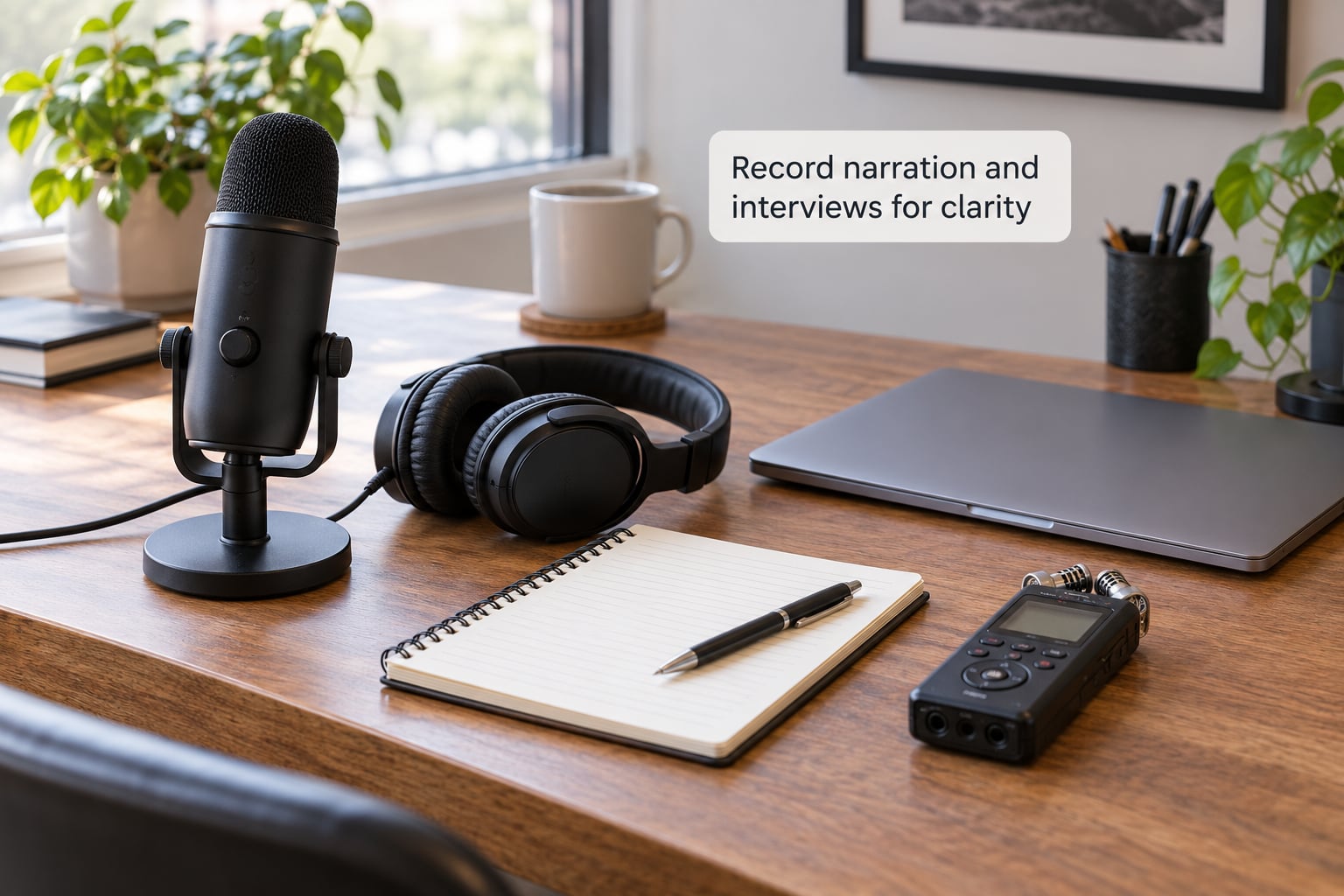
For narration, stand or sit a fist’s width from the microphone, keep the pop filter between you and it, and keep your script on the same axis as the mic so you do not move off-axis mid-sentence. Mark the paragraph breaks in the script; breaths and pauses are where dead space comes from, and knowing where they should be means you cut the mistakes instead of the rhythm.
For interviews, record each side on its own track. Two people in one room with one microphone produces a track where the quieter speaker is unusable, and no amount of editing recovers it. Give the reporter a second microphone, put it at the same distance and angle, and have each person wear headphones.
For remote interviews, use a double-ender, also called localized recording: both sides capture locally on their own machine and the tracks merge only in the edit. It costs nothing, it removes the compression artifacts of a phone or video call, and it means one person’s connection cannot wreck the whole recording.
Capture a clean reference for every interview. Record thirty seconds of room tone at the location, and for a remote guest ask for thirty seconds of their room as well. Room tone is the texture that lets an editor bridge a cut; without it, every splice announces itself.
On preparation, send the questions in advance unless the reporting requires surprise. Ask what the guest expects to be asked and what they cannot discuss. On consent, record an explicit yes for publication at the top of the interview, note it in your reporting notes, and keep the release.
On pacing, do not let a silence sit for ten seconds on tape. A short gap gives the editor an option; a long one is dead weight. When the answer matters, ask the follow-up immediately, because the second answer is the honest one and it comes with the same breath as the first.
Edit the episode into a publishable audio story
Edit in four passes, in order: structure, levels, cleanliness, then transcript. Doing the passes in any other order means redoing them.
Structure. Cut the dead space, the false starts, and the throat-clearing. Then cut the parts that slow the story without adding anything. Leave the natural pauses; a show with every breath removed is exhausting.
Levels. Normalize the finished episode to about -16 LUFS integrated with peaks no higher than -1 dBTP. That combination is the spoken-word standard that directories and players expect, and hitting it means you are not quietly louder or quieter than every other news show in the app. Balance levels between sources before the loudness pass, not after.
Cleanliness. Apply gentle noise reduction, fix plosives with a small amount of gain reduction, and cut rumble. All three are one-pass adjustments. If you find yourself processing the same passage three times, the fix is in the room, not the timeline.
Transcript. Generate a rough transcript automatically, then have a person read it against the audio and correct it. Check every number, name, title, date, and negation. This is the human-review step that keeps an automated convenience from becoming a published error.
Add music with intent: a bed under the intro and outro, well below speech level, and licensed for podcast use. Add sound under a pause rather than over a fact.
Export a WAV master at 48 kHz and 24-bit and keep it. Distribution copies can be MP3 at 128 kbps or better, but the master is what you make future edits from, and it is the only version you can fix.
Name files so you can find them: date, slug, version. “2026-03-14-budget-explainer-v3” tells you everything a hundred files named “final-final-2” will not.
The final review is short and non-negotiable. Listen once on headphones at volume, once on a phone speaker, and once at half speed for the parts with numbers in them. Anything you catch here costs seconds; anything you miss costs an emailed correction.
Publish the podcast with useful show notes and distribution
Publishing is a newsroom product launch, not a file upload: episode page, title, description, transcript, show notes, artwork, chapters, credits, source links, and an embed. Get those right and the audio reaches people; skip them and the episode is a file in a folder.
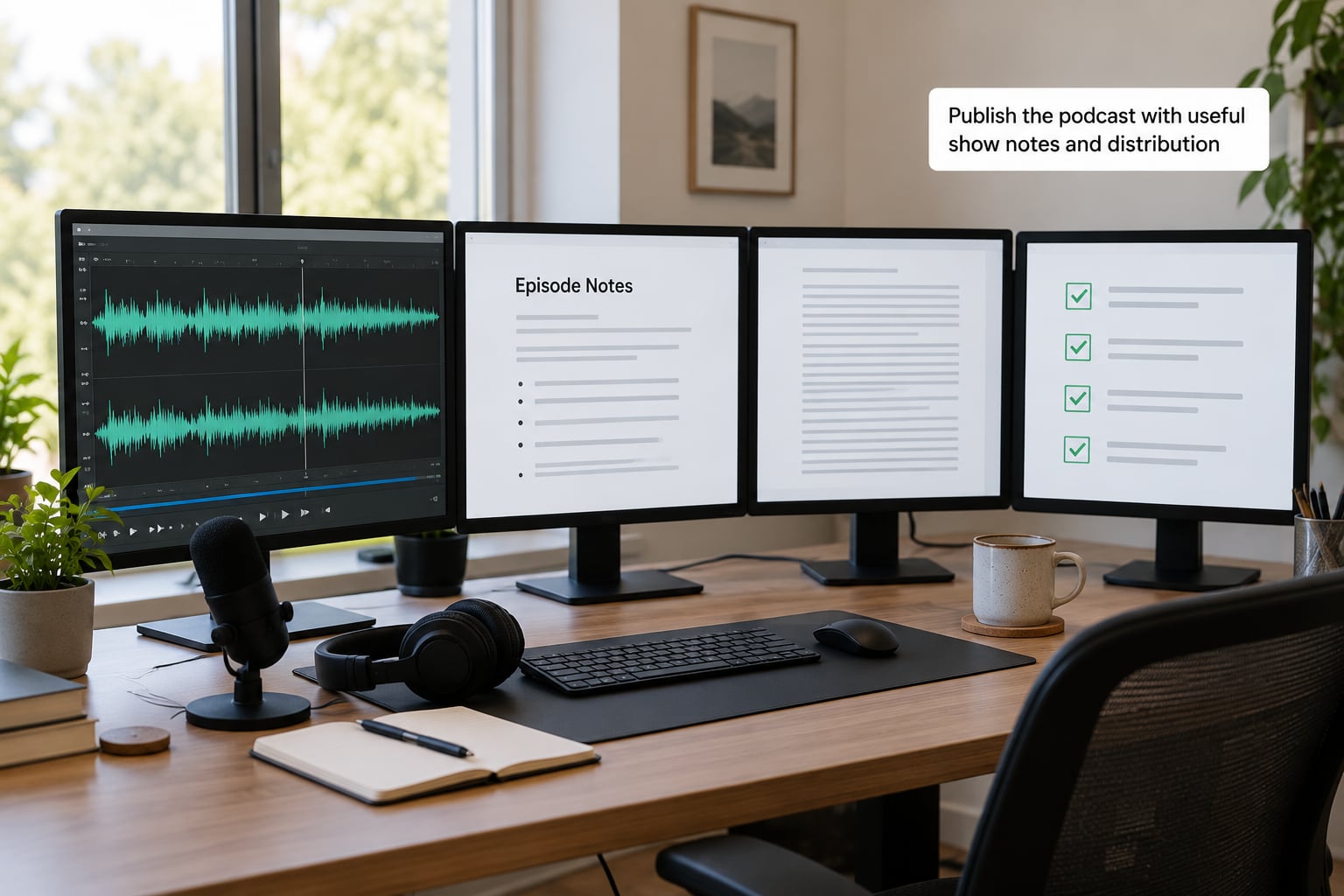
The canonical file lives with your host. Everything else points to it: the episode page on your site, the newsletter, the social posts, and the directory entries. Never re-upload a copy somewhere and let the versions drift apart.
Write the title as a sentence with the news in it. “Council raises water rate by 12 percent, starting in July” beats “Episode 14: Water.” The description is two or three sentences, the transcript, and every source with a link. Include the correction line, so people know how to reach you.
Transcript parity means the published transcript matches the published audio, in the same order, with the same words. Publish the transcript on the same page as the audio, not as an afterthought elsewhere. It serves readers who are deaf or hard of hearing, it makes the episode searchable, and it lets your own reporters find the moment they need to quote.
Artwork needs to be square at 3000 by 3000 pixels, and it has to read at thumbnail size in a directory listing. Simple beats clever.
Distribute in a fixed order every time: the episode page on your site, the newsletter, the social channels, then the directories. Directories are not a launch event; they read the feed continuously. Add your new feed to the directory submission forms once, at the start, and from then on the feed updates itself.
Measure what follows the publish, not just the publish. Watch completion rate on the first five minutes, the drop-off point per episode, and where listeners come from. A story that loses people at minute two has a problem in the first thirty seconds, not in the audio quality.
Common Mistakes
The failures below show up in almost every first season. Each has a fix and a prevention step, and both matter more than the fix.
Poor source audio
Poor audio is the one mistake you cannot edit out. A thin, roomy recording stays thin no matter what you run on it, because the missing information was never captured.
- Fix: re-record if you still can. If you cannot, cut around the damage and use a second, cleaner source for the same information.
- Prevent: do the four-part session check every time, including the ten seconds of silence.
Weak episode focus
An episode that tries to cover everything covers nothing. Listeners drop within minutes, and you spend the time to find out.
- Fix: pick one question. Move everything else to a later episode or to the newsletter.
- Prevent: write the one-sentence promise on the episode brief before you book the interview.
Inconsistent publishing
A schedule you miss twice becomes a schedule nobody waits for. In local news, cadence is the whole value: people decide whether to depend on you by the third week, not the first.
- Fix: go to a fortnightly or monthly cadence immediately rather than pretending the weekly slot still holds.
- Prevent: keep a slate of four to six finished or nearly finished topics so a bad week becomes a delay instead of a gap.
No transcript, or an unchecked automated one
A missing transcript costs you accessibility, search visibility, and quotability. An unchecked automated transcript costs you accuracy, which for a newsroom is much worse.
- Fix: publish a corrected transcript with the episode, not later.
- Prevent: make transcript review a line item on the brief, with a named person and a deadline before publish.
Inaccurate show notes and missing credits
Show notes that omit the sources make the episode unciteable, and audio that omits the reporter’s name makes it unaccountable. Listeners who hear a claim they cannot trace will not come back.
- Fix: rewrite the notes with a source link for every claim, and add full credits.
- Prevent: build the notes from the script outline, so sources are already written down.
Copyright and consent gaps
Recording someone without a documented release, or using music licensed for video in a podcast, creates a problem you cannot edit away.
- Fix: for a consent gap, be honest about what happened and how you handled it. For a music licensing problem, replace the bed.
- Prevent: capture the consent line on tape at the start of every interview and keep a music licensing record per track you use.
Frequently Asked Questions
What equipment does a small newsroom need to start a podcast?
One dynamic microphone per speaker, closed-back headphones for everyone on the recording, a pop filter, and a treated corner are the essentials. A laptop or standalone recorder with multitrack capture and local backup does the recording, Audacity or Descript handles the edit, and a host such as Buzzsprout, Libsyn, or Podbean generates the RSS feed. Borrowing a studio and better microphones from a library, college, or nearby station is a sensible first-season move.
How long should a news podcast episode be?
For a daily briefing, five to twelve minutes is the workable range. A weekly analysis or interview show usually runs twenty to thirty-five minutes, and a reported narrative piece fits in ten to twenty minutes. Length matters less than the promise you make in the first thirty seconds: state what the episode delivers, then deliver it. A short episode that finishes as promised beats a long one that pads.
Where do you create and host a newsroom podcast?
On a hosting platform. Buzzsprout, Libsyn, Podbean, and Simplecast all generate the RSS feed automatically when you upload an episode, so nobody on your team maintains XML. You embed the hosted player on your own episode page, submit the feed once to the major directories, and every future episode then appears in those apps on its own. Keep the hosted file canonical so the versions never drift.
How do you record a remote interview so the audio is usable?
Use a double-ender, also called localized recording: each side records locally on its own machine with headphones, and the tracks merge only in the edit. Ask the guest for thirty seconds of test audio before the real interview, confirm the levels, and confirm they are not on a laptop microphone in a noisy room. Consider a local-track backup only if your tool records a separate file per participant.
Do news podcasts need transcripts for accessibility?
Yes, and the newsroom case goes past accessibility. A transcript serves deaf and hard-of-hearing listeners, makes the episode searchable, and lets other reporters find and quote a passage. Aim for transcript parity, meaning the published transcript matches the published audio in the same order. Automated transcription handles a first draft, but a person must check numbers, names, titles, dates, and negations before it goes live.
How much does it cost to make a podcast episode for a small newsroom?
The dominant cost is staff time, not equipment. A weekly analysis show runs roughly five to eight hours per episode across reporting, recording, editing, fact-checking, and publishing, while a newsletter read-aloud takes one to two. Cash costs range from nothing, using borrowed gear and a free editor with a low-cost host, to a monthly host subscription plus a small hardware outlay. Decide the hours first, because that is the number that decides whether the show survives.
When a Small Newsroom Should Not Start One
Do not start a podcast if any of these are true: nobody owns audio end to end, your written output is already behind, there is no steady reporting pipeline to draw stories from, or no one on the team is comfortable on mic and willing to stay that way.
The honest test is the resource one. Count the hours per episode from the table above, multiply by the number of episodes you would publish in a season, and compare that with the hours you actually have after the existing coverage. If the number does not fit, pick a different format: a newsletter read-aloud that reuses reporting you have already done, or an audio format published only when a story is genuinely finished.
The second test is ambition. If the goal is to replace broadcast, an audio-first newsroom strategy is a longer project than most three-person teams can fund, which is the argument Nieman Lab has made in its coverage of newsroom audio strategy: build a core around podcasts instead of treating them as a side project. That argument works for stations with a production budget and a marketing team.
If both tests pass, publish the first four episodes as a pilot and decide afterwards from the retention data, not from the applause on episode one.
Turning One Audio Hour Into Five Assets
Repurposing is what makes the time cost defensible in a small newsroom. One finished episode should produce the audio, a newsletter issue built from the same reporting, two or three short clips for social, a transcript that works as a standalone page, and a set of quotable moments your own reporters can pull into written work later.
Cut clips from the interview, not from the intro. A thirty-to-sixty-second clip with a real answer in it travels further than a highlight reel, and vertical video with a visible caption subtitle gets watched in feeds where audio alone does not.
Schedule the repurposing inside the episode plan rather than treating it as extra work. Clip selection takes twenty minutes at the edit stage; the same task on a finished episode takes an hour.
Conclusion
If you do one thing from this guide, write the one-page episode brief before you buy anything. Pick the format, name the editor, set the length, and decide what the show is not.
Then treat a microphone, a treated corner, and a named reviewer as the whole minimum kit. The reporting you already do is the asset; the audio just carries it to people who would never open the article.