
Five minutes is 300 seconds, and a project that took six months has to fit inside them. You do not summarise the work — you time-box it: decide the one thing the audience should remember, spend your 300 seconds proving it, then ask for something specific. Nothing here is tied to a tool or a trend; it is the same run sheet I would hand a presenter in 2026.
One mix-up to clear up first. An elevator pitch runs 30 to 60 seconds and sells the idea. A five-minute project pitch has room for evidence, and that is the whole difference — the extra four minutes are not for more features, they are for proof. Budget an hour for prep, twenty minutes to build the slides, and three timed rehearsals. That is the honest time cost of a five-minute talk done properly.
By the end you will have a written one-sentence objective, a five-slide deck, a timed run sheet and a closing request. If your project is a data investigation, an app build or a design prototype, the same structure works — only the evidence changes shape.
What You Need

You can do this with almost nothing. What you need is decisions, written down, before you open any slide software. Prepare these eight items and the talk builds itself.
- One sentence stating the objective. Not a topic, a goal: “the panel should understand why this project exists and agree the next phase is worth funding.”
- A sentence on your audience. What do they already know, and what decision are they in a position to make?
- The problem in one sentence. If you need two sentences, you have two problems, and five minutes will not hold them.
- Three supporting points. Three, not seven. These become your middle slides.
- One demonstration moment. A single feature, workflow or data story that proves the thing works.
- One piece of evidence. A number, a quote, a before-and-after screenshot, a change in a real workflow. One.
- A specific request. Feedback, a pilot, a follow-up meeting, funding, a collaborator. Vague closes waste the last thirty seconds you fought for.
- Speaker notes with timings, plus a backup deck. The notes carry the detail you will not say out loud. The backup deck exists so a curious question can be answered after the clock stops.
If the project has no results yet, the evidence slot takes something else: a pilot finding, a failed approach that taught you something, a dataset you assembled, or a realistic timeline with a decision point in it. Panels forgive missing results far more often than they forgive a project with no method and no ask.
Step-by-Step: How to Present a Project in Five Minutes
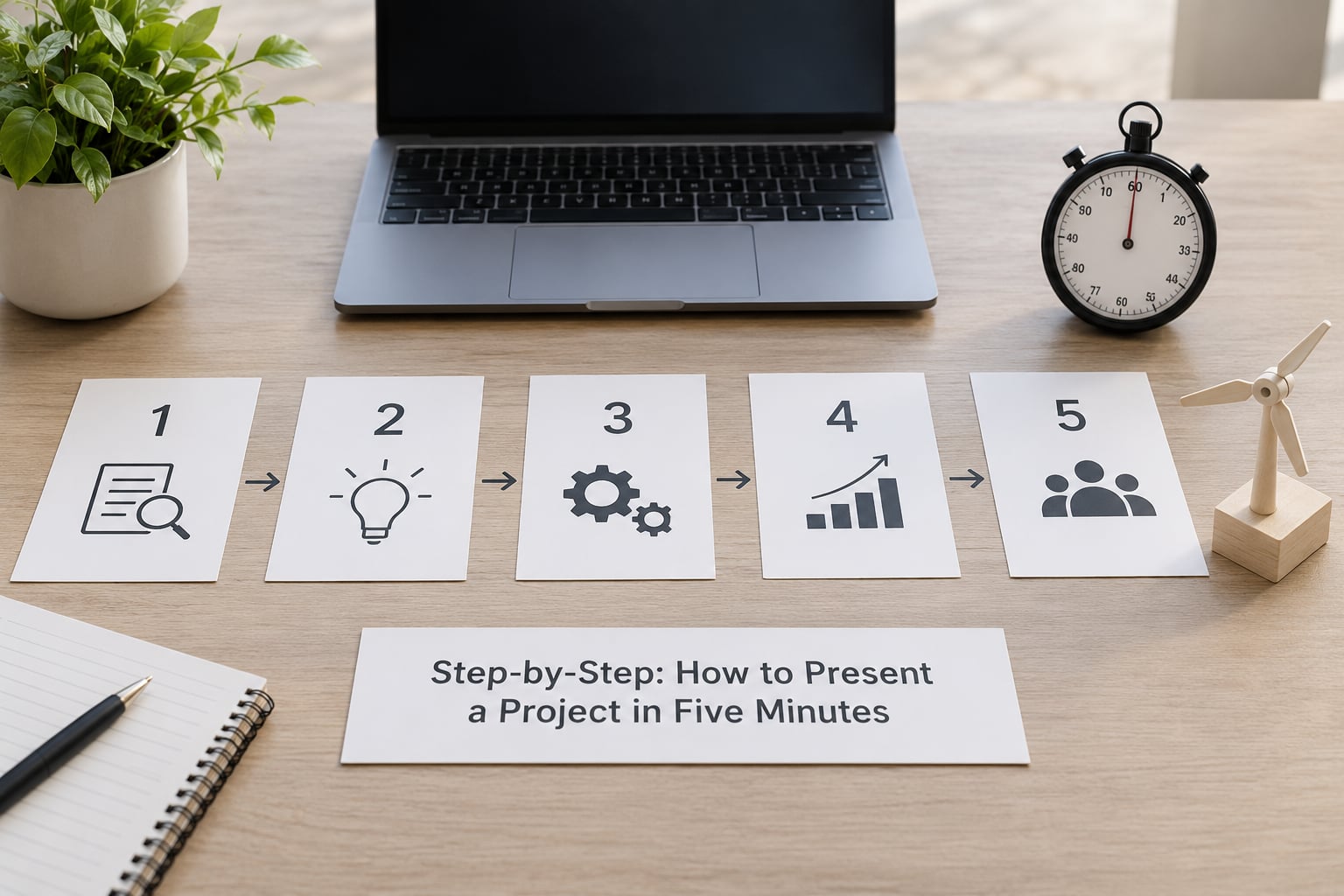
The sequence below is the whole talk. Work through it in order and you will have a finished five-minute presentation before you start designing anything.
1. Decide what the audience should remember
Write a single sentence in the form: “After five minutes, [audience] should believe [the one thing].” That sentence becomes your filter. Every fact, chart and anecdote that does not serve it gets cut, no matter how much you enjoyed collecting it.
Test the sentence on a colleague who knows nothing about the project. If they can repeat it back in their own words, it works. If they say “nice work” instead, keep rewriting it — that is the polite version of not understanding.
2. Build a simple five-part story
Now time-box the talk. Here is the run sheet, and it holds whether you are talking to three people on a panel or three hundred in a lecture theatre.
- 0:00–0:30 — Hook. One line that earns the next four minutes. A number, a surprising contrast, or the outcome stated first.
- 0:30–1:15 — Problem. What is broken, who it affects, and what it costs them. Stay with the audience’s world, not yours.
- 1:15–2:45 — Approach, with the demonstration. What you built or did, and the one moment that shows it working. This is your longest block on purpose.
- 2:45–4:15 — Evidence. The proof: a result, a test, a user, a before-and-after. Talk over the visual, do not read it.
- 4:15–5:00 — Impact and the ask. What this changes, what you want next, one sentence each.
Those blocks add up to five minutes exactly. Do not colour outside the lines: if the approach section wants forty more seconds, something in the evidence section is not earning its place.
3. Create one slide for each idea
Here is the arithmetic that settles the most common argument in preparation rooms. Average delivery pace runs about 130 to 150 words a minute, so five minutes buys roughly 650 to 750 spoken words. At 30 to 45 seconds a slide, that is five slides maximum — and one well-built slide usually beats five.
Two naming rules float around for this: the 5-5-5 rule (five slides, five minutes, five bullet points a slide) and the 7-7-7 rule (same idea, seven instead of five). Both are fine. Neither is a law. If a brief caps you at three slides, the run sheet does not change; you simply show the approach and the evidence on one screen together.
For each slide, write the one message it carries as a full sentence. If you cannot, you have two ideas and one slide. People asking online about compressing a 20-slide conference deck into three slides usually find the answer in that test, not in redesigning the deck.
4. Demonstrate only the most important moment
Pick the single feature, workflow or data story that makes the project obvious, and rehearse it until you can run it with your eyes half closed. Everything else about the product stays in the backup deck.
Demos fail on wifi, on fonts, and on the clicker. Have a screenshot ready as your fallback and know exactly where it lives, because the moment you need it is never the moment you prepared for it.
5. Close with evidence and a request
Say what changes for the audience, cite the one result you trust, state the project’s status honestly, and ask for something specific. “I’d like ten minutes with your team next week to walk through the data” beats “any questions?” every time, because a question hands control back to the room at the exact moment you want to hold it.
A useful final line to rehearse verbatim: the same sentence you opened with, with the ask attached. It gives the talk a shape the audience can feel, and repetition is the cheapest memory device there is.
Common Mistakes
Almost every failed five-minute talk I have watched fails the same way. Each of these has a fix you can apply tonight.
Reading the slides aloud. The audience reads three times faster than you speak, so every read word feels like dead air. Fix: delete every sentence that is not a label, a number or a chart title, then put the removed detail in your notes.
Starting with background. Ten years of context, the org chart, the literature review, the methodology. Fix: open with the outcome or the problem, and move the context into a sentence of framing. If the background genuinely matters, it belongs in the backup deck and in the Q&A.
Apologising for the time limit. “Sorry, I know this is only five minutes, so I’ll go quickly.” You have just told the room not to listen. Fix: never mention the clock. Own the format — a short talk is a deliberate choice, not a shortfall.
Showing every feature. Ten minutes of material squeezed into five produces nothing memorable. Fix: one demonstration moment, everything else in the backup. Cutting features is not cutting rigour; the backup deck still proves you built the whole thing.
Making claims you cannot support. “Users love it” with no user attached. Panels and managers spot this instantly. Fix: one number with a source and a date, or one named person with a quoted sentence. If you have no evidence, say what you would measure and when.
Building to the point last. A story where the payoff arrives at 4:50 gets a polite round of nothing. Fix: say the important thing in the first thirty seconds, then spend the rest earning it.
Ending without a request. You finished on schedule and the room forgot everything. Fix: rehearse the last two sentences word for word, and stop talking the moment they are done. Do not trail off with “so, yeah, that’s it.”
No rehearsal with a clock. Nerves speed you up, and untimed practice is just hope. Fix: three timed run-throughs — one to find the shape, one to find the fat, one to check the ending. Recording the last one on your phone catches the filler words you cannot hear live.
Frequently Asked Questions
How many slides do I need for a 5-minute presentation?
Five slides maximum, and one is often better. Average delivery pace is about 130 to 150 words a minute, so five minutes gives you roughly 650 to 750 spoken words. At 30 to 45 seconds per slide that is five slides. Write one full sentence per slide describing its message, and cut anything that does not serve that sentence. Detail belongs in a backup deck you open only in Q and A.
What is the 5 5 5 rule for slides?
The 5-5-5 rule means no more than five slides, five minutes of speaking, and five bullet points on any single slide. It is a useful guardrail rather than a law, mainly because it forces you to split overloaded slides into single ideas. If a brief caps you lower, say three slides, the rule adapts rather than breaks.
What is the 7 7 7 rule for presentations?
The 7-7-7 rule is the same idea loosened: about seven slides, seven minutes, and seven bullet points each. It suits a longer slot than five minutes. For a five-minute project pitch, treat 5-5-5 as the working default and 7-7-7 as the version to stretch to when you have roughly seven minutes instead.
How do I end a 5-minute presentation?
In three moves, inside the last forty-five seconds: say what changes for the audience, cite the one result you trust, then make a specific request. A good request names the next action and the time, such as a follow-up meeting or a pilot. Finish on the sentence you rehearsed and stop talking, because silence reads as confidence.
How do I present a project when there are no results yet?
Replace the evidence block rather than skipping it. Show what you have instead: a pilot finding, a failed approach that ruled something out, a dataset you assembled, or a timeline with a decision point. Then say plainly what you expect to learn and when. Audiences judge method and judgement closely when results do not exist yet, not enthusiasm.
What if I finish in three minutes instead of five?
Short is far better than long, so do not pad with filler. Use the spare time on the evidence block, where a second number or a named example usually helps, and on slower delivery. If the slot is fixed rather than timed, adding one clarifying sentence per section is safer than a new slide. Never add material you have not rehearsed.
Conclusion
Write the one sentence you want repeated, turn it into five time-boxed moves, and let the slides carry labels rather than paragraphs. Keep one demonstration, one piece of evidence, one specific ask — then rehearse three times with a timer before you present.
If you only do one thing tonight, record yourself once and listen to where the seconds went. The gaps are almost always in the middle, and that is where the cut belongs.