Building a daily routine for deep reporting work comes down to three decisions: one story gets your best hours, reactive work gets fixed windows instead of loose spaces, and every day ends with a written handoff to tomorrow. That takes about a week of trial and error before it sticks, and the hard part is not the calendar, it is defending the block once a source calls back at 10:15.
Most general productivity advice stops at email batching and a tidy desk. Reporting is a different job. Your output depends on a phone call that goes well, a records request that comes back on time, and forty minutes of reading a document nobody summarised for you. A routine built around that reality has to protect the slow work instead of merely scheduling it.
This is the routine I would hand a reporter in their first month on an investigation. It assumes you have a story, a notebook and somewhere to work. Adjust the clock times to your own day, but keep the order of the blocks intact.
What You Need
Seven things. None of them are expensive and most reporters already own them in some form.
- One priority story. Not three. A secondary story can be in your system, but it does not get a protected block today.
- A calendar that other people can see. Reporting blocks need to be visible to your editor or collaborators, or they will be booked over.
- A research folder per story. One folder for the investigation, with subfolders for documents, transcripts and data. Reports on forums have described the sprawl problem plainly: hours disappear into tabs and threads that nobody ever revisits.
- A notes system that is not just a notes system. This is the one habit that makes verification possible eight weeks later. Every claim, name, date and figure needs a source reference attached at the moment you write it.
- A source list with status. Names, contact details, what each person knows, and where you are with them. Freelancers and student journalists have no desk producer doing this for them.
- Communication boundaries. One person who can reach you in an emergency, and a stated answer for everyone else.
- A shutdown ritual. A fixed end-of-day routine that leaves tomorrow’s starting point written down.
Step-by-Step
1. Set One Reporting Priority for the Day
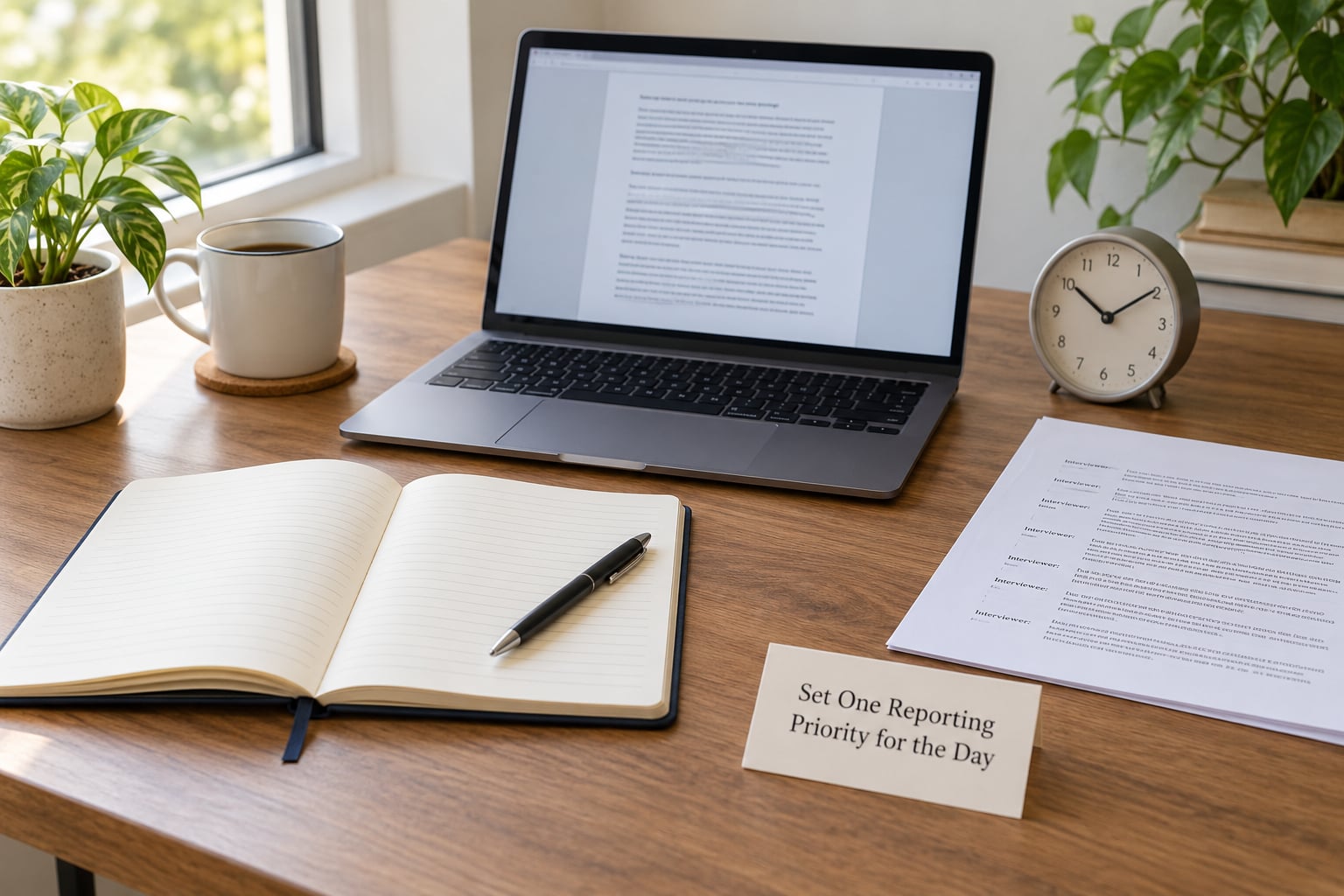
Before the day starts, write one sentence on the day’s note describing the single thing that would move the investigation forward. Not “work on the housing story” but “finish reading the 2019 to 2023 permit records and flag every variance over two units”.
That sentence is your whole ambition for the day. Everything else you accomplish is a bonus, and the bonus does not displace it.
The test at day’s end is simple: did the evidence move? If you spent six hours on the story but cannot name what you now know that you did not know yesterday, the day was busy and not productive.
2. Protect a Deep-Work Block Before Reactive Tasks
The single most common mistake is booking your best hours for other people’s urgency. Put the protected block first, before the news scan and before the inbox, and only then does the reactive day have somewhere to live.
Ninety to 120 minutes is the working range. Shorter than that and you spend the whole session re-entering the story; longer and you produce pages you have to throw away in the morning. Forum threads on r/productivity keep circling the same finding — morning-first deep work is the pattern that survives contact with an actual week, because the rest of the day is already gone by lunchtime.
Three habits protect it:
- Put the block on a shared calendar as a real appointment with a start and an end, not as a vague “focusing this morning”.
- Close every messaging client for the duration. Not muted. Closed.
- Keep one visible list for interruptions. Anything that surfaces during the block gets written down and handled at the next batch window, which is the fix reporters on r/Journalism describe working.
If the block produced a document log entry, new paragraphs, or a written source question, it worked. If it produced a longer to-do list, you were planning instead of reporting.
3. Build Separate Blocks for Research, Reporting, and Review
Different kinds of reporting work need different tools and different standards of done. Running them as one undifferentiated “work block” is why afternoons collapse.
Five phases cover most investigations, and each has a home in the day:
| Reporting phase | Best time of day | Cognitive demand | What it looks like |
|---|---|---|---|
| Pitch and plan | Late afternoon | Low | Drafting the memo, listing the next three calls, deciding what is not worth chasing |
| Research | Mid-morning | Medium | Records chasing, database and open-data work, document reading, spreadsheet analysis |
| Reporting | Early morning | High | Source interviews and calls, where you can control nothing and must be fully present |
| Writing | Afternoon | High | Drafting and revising paragraphs against the outline you built in the morning |
| Edit and verify | End of day | Medium | Pre-publication pass: every claim traced back to its source, every number rechecked |
Give each mode its own tools. Research gets the database and the records portal. Reporting gets the recorder, the notebook and no second screen. Writing gets the draft file and nothing else open.
Research sprawl is the most expensive habit here. One journalist reported cutting forum research time by roughly 80 percent by triaging with topic-specific prompts first, looking for expert opinions and data-backed claims, and only reading in full what survived that filter. That filter belongs in the research block, not scattered across the afternoon.
4. Batch Communication and Administrative Work
Two windows. Morning, right after the news scan, for the day’s urgent triage. Late afternoon, for everything else. Approvals, records-request follow-ups, pitch feedback, scheduling, expense admin.
Inside those windows, work oldest-first and cap them. A window that has no end becomes the entire afternoon.
The rule that makes this stick: nothing gets an out-of-band reply except the named emergency contact. If a colleague messages you mid-block, they wait. Reporters who try to be available for everyone end up available for no one, and the story they are available for never gets written.
5. End With a Shutdown and Recovery Ritual
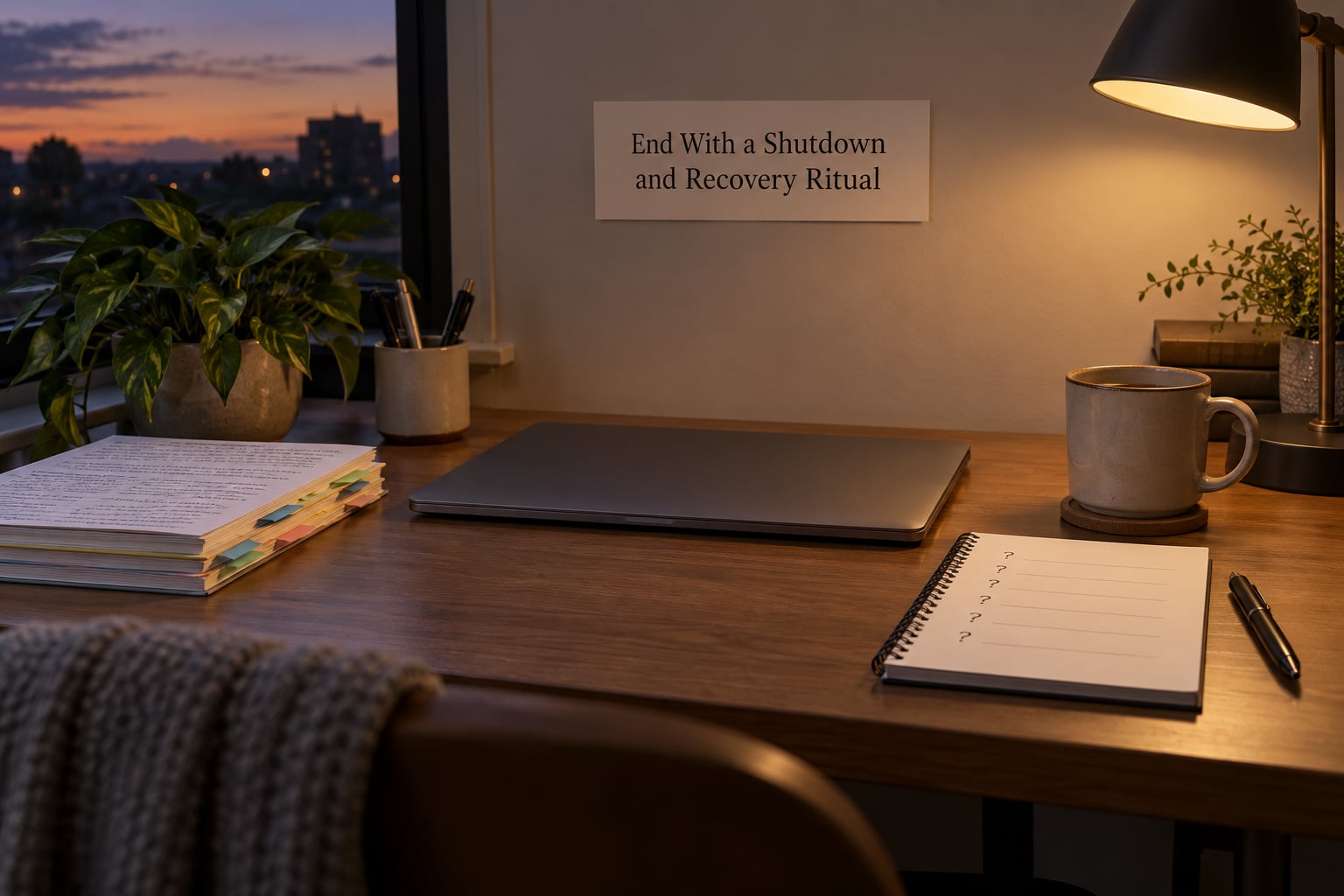
Fifteen minutes, same time every day. Four parts:
- Record open questions. Anything unresolved goes into the story system, not into your head.
- Write tomorrow’s first physical action. “Open the permit database, filter to 2021” beats “work on housing”.
- Update the story system. Source list statuses, document log, what is filed.
- Close. Devices shut at a fixed hour, on a schedule you can hold even on a bad day.
This is not a productivity flourish. On investigations that run for months, the handoff note is the only thing keeping the story coherent when your memory of week six is gone.
Burial matters too. Editors and reporters working long features on empathy-heavy material describe the shutdown ritual as a boundary against work following you home. If your beat involves trauma, decide deliberately what your last ten minutes are — a neutral note, a walk, a completely different subject. The detail is yours, but it should be decided in advance.
Common Mistakes
Treating every hour as interchangeable. Six hours of identical “work” produces less than two hours of deep reporting plus four of calls and admin. Fix: name each block’s job before the day starts, and give it a completion condition.
Scheduling the hard work late. By 4pm most reporters are running on fumes, and the drafting suffers. Fix: put the protected block first in the calendar and defend it like a meeting with a source, because that is what it is.
Confusing busyness with progress. A full inbox and a busy chat log feel like reporting and are usually admin wearing a reporting costume. Fix: end each block by writing what you learned, not what you answered.
Multitasking through interviews. Reading messages during a source call costs you the nuance that made the call worth taking. Fix: phone out of reach, one recorder, one notebook. Tell sources at the start that you may take notes slowly.
Building no recovery margin. A routine with fifteen spare minutes has none, and one interrupted call collapses it. Fix: leave one block a day lighter than your best day. Newsrooms call this a slow day; it is load-bearing, not wasted.
No protocol for a broken day. Breaking news will eat a morning. Fix: when it happens, reschedule rather than abandon. Move the protected block to the next open slot on the calendar before you touch anything else, and write down where it landed. The instinct to “make it up tomorrow” is how a three-week feature becomes a two-week one written badly.
For freelancers and student journalists, the fix is to borrow someone else’s structure. Set one weekly moment to review the reporting block you actually kept versus the one you planned. That ten-minute audit is the only piece of newsroom process you cannot outsource, and it is the piece that teaches you what your hours are really worth.
Frequently Asked Questions
How long should a deep work block be for reporting?
Ninety to 120 minutes is the working range for most reporters. Shorter blocks get spent entirely re-entering the story and re-finding your thread. Longer ones tend to produce passages you cut the next morning. If you only have two hours a day of real capacity, protecting one ninety-minute block every day beats protecting three hours twice a week.
What should I do when breaking news interrupts my routine?
Reschedule rather than abandon. When the interruption lands, the first thing you do is move the protected block to the next open calendar slot and write down where it went, before you touch the breaking story. A story that was scheduled for today and moved to Thursday is delayed. A story that was skipped entirely is gone, and it is usually the one that mattered.
How do I avoid burnout on a long investigation?
Build in a lighter day every week and treat the shutdown ritual as a hard boundary rather than a formality. Long investigations drain you through repetition of the material, not intensity, so rotate sources and tasks to keep some novelty. Write a short progress note each week covering what moved. Seeing forward motion is itself protective, and editors on the beat say the weekly check-in is where stalled stories get caught early.
How do I stop context switching while researching a story?
Separate your modes and give each one its own tools. Research gets the database and the records portal, reporting gets a recorder and a notebook, writing gets the draft file alone. Keep a single visible interruption list so urgent thoughts get parked rather than acted on. Closed chat clients, not muted ones, do most of the work, and the block is protected best when it sits early in the day.
What is the best routine for a freelance or student journalist with no newsroom?
Borrow the structure you would otherwise inherit. Put one priority story on a shared or scheduled calendar so the block is real, keep a source list with statuses, and set one fixed weekly review of which block you actually kept. Without an editor checking in, that ten-minute weekly audit is the only thing that catches a stalled investigation before a deadline does.
Put Your Routine Into Practice
Five actions, in order. Pick one priority story tonight and write tomorrow’s first physical action. Reserve the first ninety-minute block before anything else goes in the calendar. Decide your two communication windows and tell one person which one is the emergency one. Set a shutdown hour and write the handoff note at it. Review once a week which blocks you actually kept.
Do the first one today. The rest follows.