To verify a video using shadows and weather data, you pull still frames, read the sun’s direction and the length of a shadow, and compare both against a simulated sun position for the claimed place and time. Then you check what the frames show — cloud, rain, haze, wind, wet ground — against archived weather observations for that same spot and hour. Both are external ground truth: astronomy and meteorology, not the uploader. A mismatch in either check means the claim is wrong somewhere. It does not, on its own, mean the video is fake.
That last point is where most amateur checks go wrong. Time zone slips and daylight saving mistakes produce the overwhelming majority of false alarms, and plenty of real footage gets called fake over a two-hour offset. The workflow below is built to keep you out of that trap: pin down the claim first, run both checks, then state your confidence and your limits in the open.
Budget about 30 to 60 minutes for a clean single-clip check once you have the coordinates and a date. A first attempt with no known location can take several hours, and sometimes the answer you end up with is “this clip cannot be placed.”
Table of Contents
- What You Need
- Step-by-Step: How to Verify a Video Using Shadows and Weather Data
- Step 1: Preserve and inspect the original video
- Step 2: Establish the claimed location and date
- Step 3: Measure the shadow direction and length
- Step 4: Simulate the sun for the claimed place and time
- Step 5: Compare visible weather with historical data
- Step 6: Record the result and communicate uncertainty
- Common Mistakes
- Frequently Asked Questions
- Conclusion
What You Need
Start with the file itself, not a screenshot. Social platforms strip EXIF, crop the frame and re-encode, which quietly destroys the fastest checks you have.
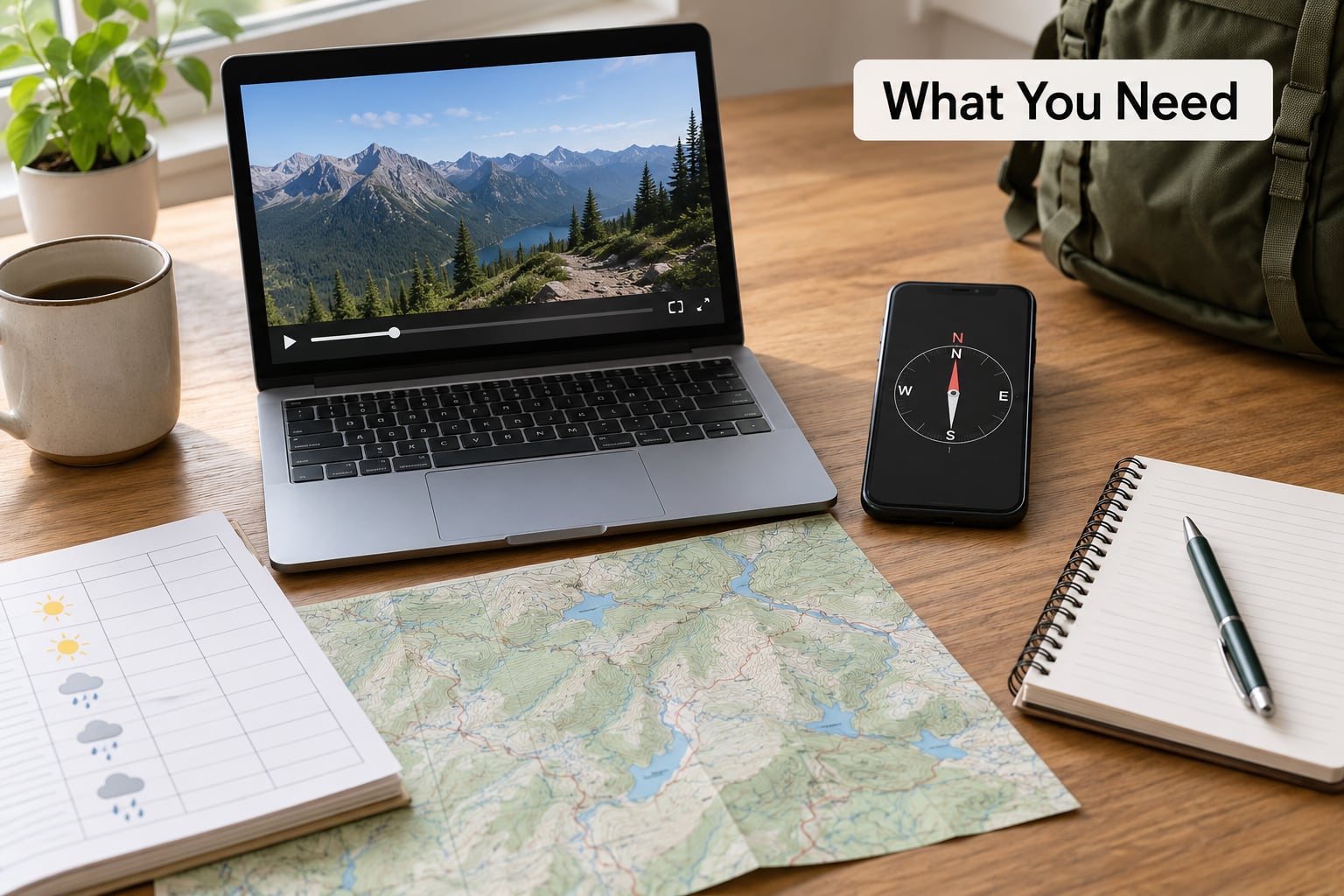
- The original file or the highest-quality stream available, downloaded rather than screen-recorded. Keep the source URL and the exact time you pulled it.
- A frame grabber — VLC, FFmpeg or a still-image extractor — so you can pull clean frames at known points in the clip.
- An EXIF viewer, either a desktop tool like exiftool or a web viewer, to read capture time, device model and GPS tags if they survived.
- A compass and a measuring tool. A phone compass gives you shadow bearing to roughly 5 degrees; a ruler in the frame gives you the shadow length ratio.
- A shadow simulator. SunCalc is the one named across most practitioner toolkits; Shadow Finder, PhotoPills and Stellarium cover the same ground with more control.
- Two historical weather sources. Meteostat for near-surface observations, Ogimet for station-by-station records, and NOAA NCEI for the long archive. Use at least two.
- Satellite and radar archives for the date, if the claim involves a storm, flooding, snow or wildfire.
- A map at the right zoom — Google Earth and Street View for orientation, building geometry and terrain slope.
- A notebook. Every input, every number, every assumption. You will need the trail if the finding goes public.
Step-by-Step: How to Verify a Video Using Shadows and Weather Data
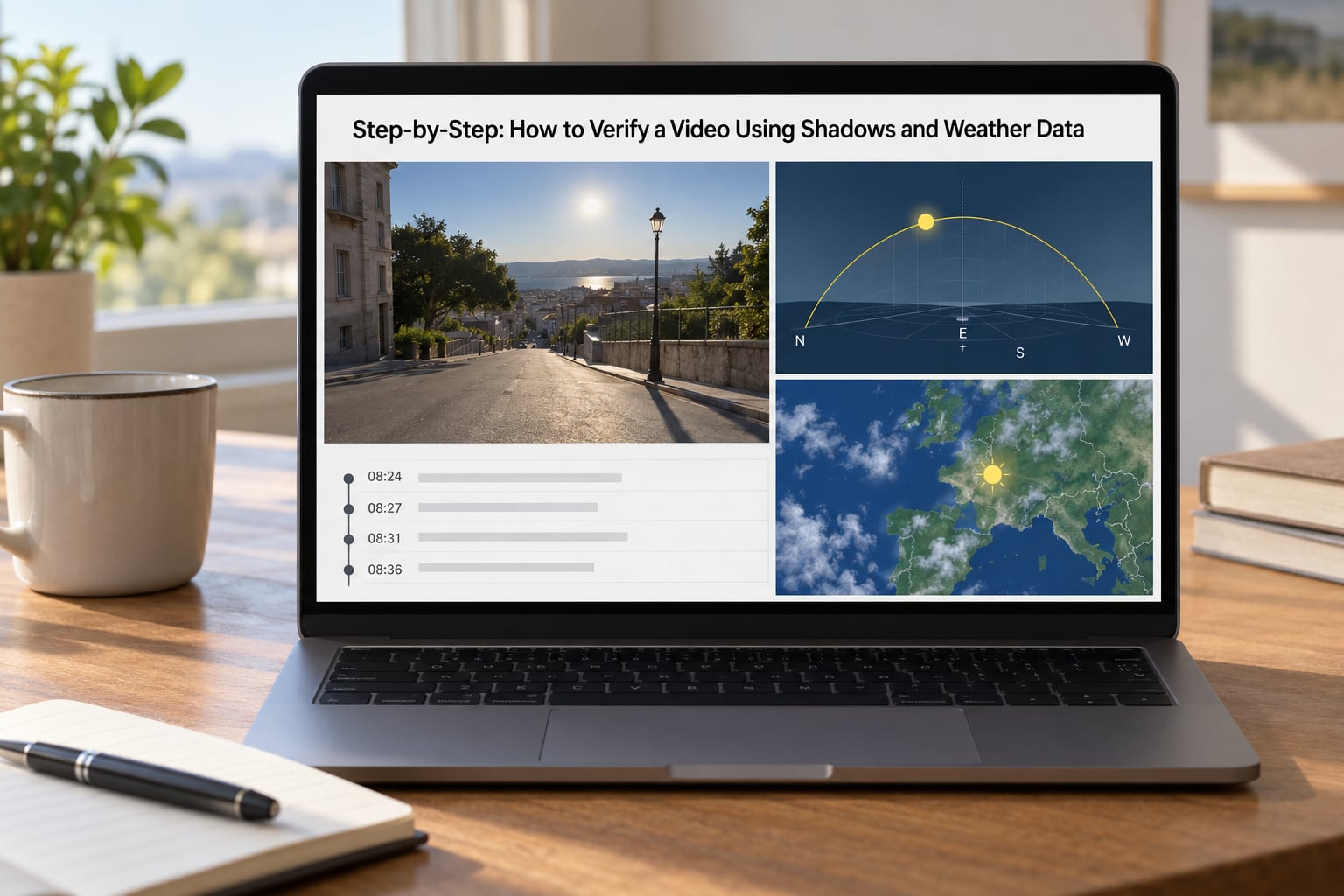
Six short moves, in this order. The order matters: the first two are cheap and everything downstream depends on them.
- Preserve the original, record where it came from, and find the first reliable timestamp.
- Write down the claimed place, date and time in one sentence.
- Measure shadow direction and shadow length from a frame.
- Simulate the sun for the claimed coordinates and time.
- Compare the frames against archived weather observations.
- Publish a verdict with a confidence level and its limits.
Step 1: Preserve and inspect the original video
Save the file before you do anything else, and record the source URL, the account that posted it, and the time you pulled it. Open it in an EXIF viewer and write down whatever is there: capture timestamp, device model, GPS coordinates, software tags.
You will usually find nothing. Platforms strip metadata on upload, so treat an empty EXIF block as normal rather than suspicious. It worked when the tool reports the file was re-encoded, when the video length does not match the platform’s stated duration, or when audio and video drift apart.
Before moving on, find the earliest version that exists. Reverse image search on a frame, or the InVID and WeVerify plugins for video frames, will often turn up the same clip posted weeks or years earlier under a different caption. A clip from 2018 with a new caption is misdated, whatever the shadows say.
How you know it worked: you have the file, the source record, and a first reliable timestamp. If a burned-in timecode strip or a visible clock is present, that timestamp is often better than anything you can infer later — but check it against the daylight, since a clock set to the wrong zone is common on cheap cameras.
Step 2: Establish the claimed location and date
Write the claim as one sentence: “Filmed on the afternoon of 14 March at coordinates 29.76 N, 95.37 W.” The weather and sun checks are only as good as that sentence, and most failed verifications fail here first.
Pull the location claim from the caption, from spoken context in the audio, from signs and shopfronts, from licence plates and road markings, and from any EXIF that survived. Google Street View at the same coordinates tells you the building orientation and the street layout, which matters in step 3.
Also pin the geographic area, not just the point. A storm cell can put heavy rain two kilometres away and leave your location dry. Decide how precise your claim is before you start comparing data.
How you know it worked: one sentence, one coordinate pair, one date, one time with a stated time zone. If you cannot write that sentence, stop here and go find the missing information — no tool on earth can create a claim you do not have.
Step 3: Measure the shadow direction and length
Find a clear vertical object in a frame with an unbroken shadow: a pole, a mast, a person standing on flat ground, a signpost. Read the shadow’s compass bearing with the phone compass laid flat on the ground, and measure the shadow tip to the base to get the length. Divide length by object height and you have the shadow length ratio.
That ratio gives you the sun’s elevation directly: the ratio equals one divided by the tangent of the solar elevation angle. Work an example. A 2.0 metre pole casts a 3.4 metre shadow, a ratio of 1.7. The elevation is 30.5 degrees. A 30 degree sun on that date and latitude occurs in a narrow band of the day, usually within an hour or so of it, and there are two candidate times — morning and afternoon — that the shadow bearing separates.
Direction is the sharper test. Shadows in a single outdoor scene point away from the sun, and every distinct object shadow in the frame should agree. Two shadows crossing at an odd angle, or a shadow that changes bearing across a pan, is one of the strongest physical red flags in video verification.
Before trusting the numbers, correct for what the frame distorts. Wide-angle lenses curve straight lines and bow the ground plane, so measure near frame centre. If the camera sits uphill, the shadow can read longer than it is. If the clip was sped up or slowed, note it: changing playback speed changes the apparent sun movement without changing anything physical.
How you know it worked: you have a bearing in degrees, a shadow length ratio, and an estimated sun elevation, each with an uncertainty of a few degrees. If the sun is barely above the horizon or directly overhead, the measurement is weak — shadow length alone carries very little information near solar noon, and at high latitudes in midsummer it carries almost none.
Step 4: Simulate the sun for the claimed place and time
Now put the same coordinates and the same hour into a shadow simulator and read off the sun’s azimuth and elevation for that moment. If your measured bearing is off by more than 20 degrees from the simulated bearing, and your elevation estimate is off by more than about 10 degrees, the clip’s claim is wrong. Smaller gaps are inside normal measurement error.
How you know it worked: either the simulated sun lands on the observed shadow direction within tolerance, which corroborates the claim, or it does not, which is a contradiction you now have to explain.
Step 5: Compare visible weather with historical data
With the sun settled or ruled out, run the weather comparison. List what the frames actually show, then fetch observations for the same coordinates and hour from at least two archives. Observed station data beat forecasts and reanalysis for this purpose: Meteostat and Ogimet give you what a station actually recorded, NCEI covers the long historical record, and a nearby Weather Underground personal weather station often gives the sharpest local picture.
Compare field by field rather than in general:
- Cloud cover and type. Clear blue sky with a bright rainbow in frame, or a rainbow in overcast rain, is a physical contradiction.
- Precipitation. Rain in the air or falling, standing water, wet reflective asphalt, dripping roofs, all have to agree with each other and with the observation record.
- Haze and visibility. Dry crisp air on a day the record shows heavy smoke or dust, or a hazy horizon on a day of 10 km visibility.
- Wind. Flags, tree crowns, smoke plumes and wind turbines should all point the same way, and roughly match the recorded wind direction and speed.
- Temperature and clothing. Short sleeves and a sweating crowd during a recorded cold snap.
- Seasonal vegetation. Leaf state, blossom and harvest timing against the calendar for that latitude.
- Sun glare and flare. A flare streak that points somewhere other than the simulated sun position.
Night clips need their own pass. Moon shadows follow the moon’s path and give you a second, independent clock. Streetlamp and window light gives you a fixed source whose direction should stay constant across a pan, and any shadow that rotates with the camera rather than the light is a giveaway.
How you know it worked: each field either agrees with the record, or you have a specific contradiction on the record with the date, source and value you compared against. Contradictions from two different archives are far stronger than one from a single source.
Step 6: Record the result and communicate uncertainty
Write the finding in four separated parts, because mixing them is how good checks turn into bad corrections. First, your observations: what you measured, with numbers. Second, the archived data, with source and timestamp. Third, your assumptions: which coordinate, which time zone, which tolerance, what you could not determine. Fourth, the conclusion, with a confidence level and the strongest competing explanation.
Then send the conclusion to the uploader with specific questions before you publish anything. The five that close verifications most often: what device and app was used, was the clip trimmed or re-uploaded, is there an uncut version, is there a second angle or a photo from the same minute, and what time does the camera clock show against a visible reference.
How you know it worked: another person can reproduce your result from your notes without asking you a question. If they cannot, the work is not finished.
Common Mistakes
Almost every public correction built on a shadow check fails the same way. Here are the ones I see most often, with the fix.
Using today’s forecast instead of the historical record. A forecast app answers “what is it like now”, which is the wrong question entirely. Go to an observation archive. If the record and the forecast disagree, the forecast is not evidence.
Getting the time zone or daylight saving wrong. This is the single largest source of false alarms, and a two-hour DST error is enough to move the sun’s azimuth by a large margin. Convert to local standard time before you type anything into a simulator, and state which convention you used in your notes.
Flipping the hemisphere. A shadow pointing the wrong way in Sydney is not evidence of anything. Check the sun’s path across a whole day, not a single frame: it must move in the direction your hemisphere requires.
Measuring from a distorted or altered frame. Wide-angle lenses, digital stabilisation, cropping and re-encoding all shift apparent geometry. A clip that was sped up changes the sun’s apparent motion. Measure on the least processed frame you can find and note any processing.
Treating one mismatch as proof of fabrication. A shadow or weather mismatch shows the claim is wrong. It does not show why. Wrong location, wrong date, wrong time zone, a long-ago clip with a new caption and a genuinely fabricated scene all produce the same mismatch in the first minutes of work.
Relying on one weather source. A single station can be mis-sited, mis-calibrated or simply missing data that day. Cross-check two independent archives before you call a weather contradiction.
Skipping the provenance step. If a reverse search finds the same clip posted earlier, the argument is over regardless of what the shadows do. That check costs two minutes and it is the highest-yield one on this list.
Frequently Asked Questions
How can I check if a video is AI-generated?
Start with light physics. In real footage every shadow in a scene points away from a single light source, and a synthetic scene often does not. Pan a clip slowly and watch whether shadow direction holds steady. Also check reflections, whether text stays legible across frames, and whether background detail holds still when the camera moves. Shadow geometry is the most useful of these for video, because generative models still struggle to keep solar direction consistent across a moving shot.
Can shadows prove when a video was filmed?
Not on their own, but they can narrow the window sharply. The shadow length ratio gives you the sun’s elevation, and the shadow bearing gives you its compass direction. Together they usually pin a frame to a time window of an hour or two on a given date, and two candidate times that morning or afternoon. Paired with a claimed location, that is often enough to confirm or break a date claim.
What if the shadows in a video do not match the claimed time?
Check your own work first: time zone, daylight saving, hemisphere, and whether the camera is wide-angle or the clip was re-encoded. Then check whether a different plausible time or date fits, since a shadow mismatch often means a mislabelled clip rather than a fabricated one. Only after you have ruled out your own error and a reasonable alternative should you treat the mismatch as evidence of deliberate misdating.
How do you verify the weather in a viral video?
List what the frames actually show, then pull station observations for the same coordinates and hour from at least two archives. Meteostat and Ogimet give station records, NOAA NCEI covers the long history, and a nearby personal weather station often resolves local detail. Compare cloud cover, precipitation, visibility, wind and temperature field by field. A contradiction confirmed by two independent sources is what makes a weather claim checkable.
How accurate does the shadow check need to be to be useful?
Aim for a bearing within about 20 degrees and an elevation estimate within about 10 degrees of the simulated values. That is roughly what a phone compass and a rough length measurement deliver. Larger gaps point to a wrong time, place or date. Smaller gaps are inside measurement error and should not be treated as a finding on their own. Near solar noon, or at high latitudes in summer, shadow length carries almost no usable signal, so lean on the bearing or drop the check.
Conclusion
Do five things, in this order. Preserve the original file and write down where it came from. Reduce the claim to one sentence: place, coordinates, date, local time. Pull frames and measure one clean shadow for its bearing and its length ratio, then simulate the sun for that exact moment. Compare what the frames show against two independent weather archives, field by field. And publish the result as observations, data, assumptions and conclusion, each labelled, with a confidence level and the limits of what your evidence can actually establish.
A mismatch tells you the story attached to the video is wrong. Establishing what actually happened is the next job, and it starts with the same five moves.