Search SEC filings by going to EDGAR, the SEC’s public filing database, looking the company up by name, ticker or CIK number, filtering the list by form type and date range, then running EDGAR full-text search for a keyword or quoted phrase across filings back to 2001. Every filing is free, searchable and republishable. That makes them the strongest primary source available to a reporter.
The reason business reporters live in EDGAR is simple. A filing is the one place a company’s board and officers had to put claims in writing, on a fixed schedule, under legal liability. A press release can be spun. A filing cannot be quietly rewritten after the fact without an amendment that says so.
Most of the difficulty is navigation, not judgment. EDGAR’s interface looks like it was designed in 1999, the form codes are cryptic, and a single 10-K runs past two hundred pages. The workflow below is the one that gets from a vague hunch to a defensible document trail in an afternoon.
Table of Contents
- What You Need
- Step-by-Step
- Common Mistakes
- How to search SEC filings for a story
- Frequently Asked Questions
- What is the fastest way to search SEC filings for a story?
- Are SEC filings public record?
- Which SEC filing should I use for company financial information?
- Can I search SEC filings for a private company?
- Are amended SEC filings automatically reliable replacements for the original?
- Can AI read SEC filings?
- Conclusion
What You Need
You need five things, and only one of them is a computer.
- The SEC EDGAR database. Free, public, and the authoritative copy of every filed document. Use it directly rather than a third-party summary when you intend to quote the filing.
- A company name, ticker, or CIK number. The Central Index Key is the company’s permanent identifier and never changes, even after a merger or rebrand. Ticker symbols do change, so CIK is safer for a long project.
- A filing-type filter. Knowing whether you need a 10-K, 10-Q, 8-K, DEF 14A or Form 4 saves you from scrolling through sixty filings to find the four that matter.
- A notes system with columns. Form type, filing date, accession number, page or item number, what you found, what you still need. Spreadsheets beat notebooks for this because you will sort.
- A defined reporting period and story angle. A fiscal year, a date range, a subsidiary, or a named executive. Without one of those, search results turn into noise fast.
Three glossary terms will save you confusion later. Accession number is the unique stamp on every submission, formatted like 0000320193-25-000123, and it is the cleanest way to cite a filing. XBRL is the tagged structured-data format the SEC requires for financial statements, which is what makes the numbers in a filing machine-readable through the SEC’s APIs. CIK is simply the company’s identification number in EDGAR.
Know the coverage limit before you promise an editor a timeline. Electronic full-text search covers filings from 2001 onward. Documents from 1993 to 2000 exist in EDGAR but many are scanned images with uneven text, so keyword search returns nothing for that era even when the documents are technically there. Older still, and you are in paper archives and private databases, which changes the sourcing note in your story.
Step-by-Step
Define the reporting question and company
Turn a broad beat assignment into a question with an answer attached. “Is this company hiding bad news?” is unsearchable. “Did the wording of the data-security risk factor in Item 1A change between the last two 10-K filings?” is answerable with two documents.
Write the question down, then list the specific things that would confirm it. Product names, a subsidiary, a named vendor, an executive, a geographic term, a phrase from a press release the company issued. Those terms become your search strings, and they are almost always better search keys than the company name itself, because every filing contains the company name.
Then pin down the period and the entity. Is this about the parent company or a subsidiary that files separately? Is it about a fiscal year that ended in the past or a quarter that has not closed? Filing date and report period are different things, and confusing them is the single most common way reporters get a story wrong.
Find the company and its CIK
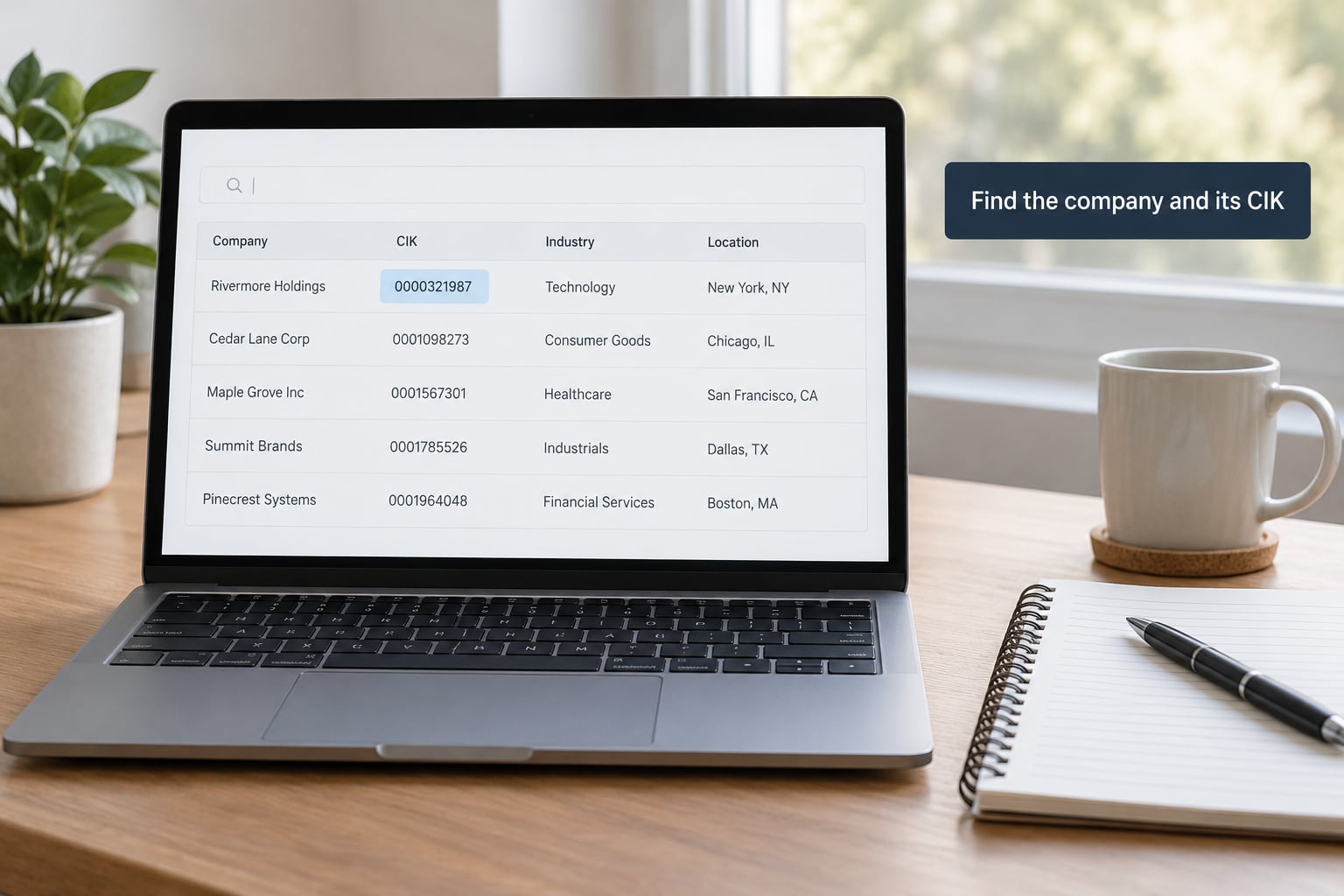
Open the SEC’s EDGAR company search and enter the company name, its ticker, or a CIK if you already have one. The results list shows matching entities with their CIK, state of incorporation, and ticker symbols.
Distinguish similarly named entities carefully. There are several companies called something like “American Growth,” and a search for a common name will return holding companies, shell entities and defunct registrants alongside the one you mean. Check the state of incorporation and the ticker, and read the former names listed on the company page, because a company that filed under a different name for its first ten years will not match a search for the current one.
When you have the right CIK, save the company’s filing page URL. That page is the base for every date-range and form-type filter you will use, and it is also the URL that keeps your document set tied to one entity when you come back to it two weeks later.
Filter for the right filing types
Once you have a company page, filter by form type and date range. This table is the working vocabulary for a reporter:
| Form | Filed when | What is inside | Story use |
|---|---|---|---|
| 10-K | Annual, audited | Business description, risk factors, financials, controls | The annual baseline, and the source for risk-factor drift |
| 10-Q | Quarterly, unaudited | Condensed financials, updated risk factors, legal proceedings | Tracking change between quarters |
| 8-K | Within four business days of a material event | Item number plus exhibits, often a press release or agreement | CEO exits, deals, impairments, auditor changes |
| DEF 14A | Before the annual meeting | Pay, board composition, say-on-pay, shareholder proposals | Executive compensation, related-party deals |
| Form 4 | Within two business days of an insider trade | Transaction codes, share counts, post-trade holdings, plan footnotes | Insider buying or selling, once codes are decoded |
| S-1 and S-1/A | At IPO or resale registration | Registration statement, use of proceeds, underwriter list | Who is selling, and on what terms |
| 13D and 13G | When an owner crosses five percent | Stake size, intent, governance goals | Activist pressure and intent changes |
| 13F | Within 45 days after quarter end | Institutional holdings, filed with a lag | Which funds moved in or out, delayed by weeks |
| CORRESP and UPLOAD | Ongoing | Public comment letters and issuer correspondence with the SEC staff | Signals that the staff has questions the company is answering |
| Form SD | Annual with the 10-K, when applicable | Conflict minerals reporting | Supply chain disclosure; scope depends on filer status |
Two rules keep this filter honest. Filing dates cluster around quarter ends and annual meeting dates, so a narrow date filter can silently exclude the document you want. And 10-K/A, 10-Q/A and NT 10-K filings matter: NT 10-K means a company filed late or in part, and an amendment usually means something in the original was wrong.
Search within the filing and open the right exhibits
Once you are inside a document, use your browser’s find function first and EDGAR full-text search second. Browser find is faster for a document you already have. Full-text search is for hunting across the entire database.
EDGAR full-text search is the tool power users actually reach for, and it is not obvious from the company page. In the search box, quoted phrases return exact matches, which is how you capture distinctive language rather than a spray of loose words. Scoping by date and by form type is what turns a noisy result set into a short list, and you can restrict to a single company’s CIK when you want to trace one thread rather than survey a sector.
Read the exhibit index before you read anything else. This is the mistake that costs reporters hours. Item 9A of a 10-K tells you whether the company’s own controls were effective, but the material detail about a restatement, an investigation or a settlement is usually in Exhibit 31.1 or in a furnished 8-K exhibit. The narrative document points at the evidence; the exhibit holds it.
The same applies to proxy statements. A related-party transaction gets two sentences of description in the DEF 14A body and the actual terms in the accompanying exhibit or the financial statement notes.
Compare disclosures over time
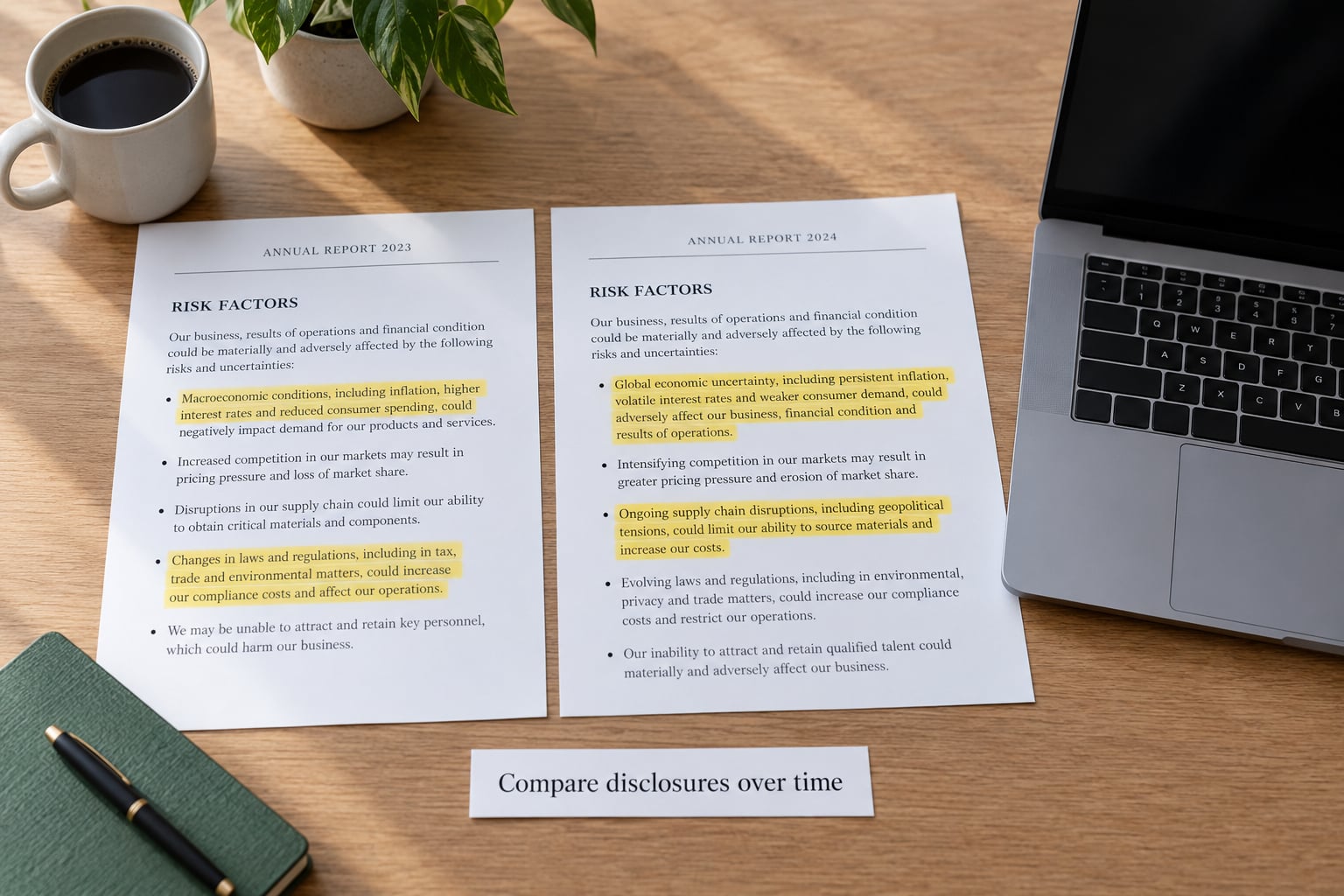
This is where reporting starts, because a single filing is a snapshot and a series is a story. Pull three to five years of the same form type and compare the same section each time.
Risk factors are the richest source. Companies tend to keep standard boilerplate and add language when something worries them, so new sentences in Item 1A are worth reading twice. Also watch for the reverse: a risk factor that quietly disappears between years is a legitimate reporting question on its own, and metrics dropped from a disclosure between periods deserve a call to the company.
Other comparisons that pay off: auditor changes in Item 14 or the audit committee report, going-concern language in the financial statement notes, related-party transaction footnotes, the pay-versus-performance table in the proxy, and the volume of 8-K items per quarter, which often spikes before bad news surfaces elsewhere.
Text comparison tools make this fast. Two copies of the same section in a diff tool will show you added and removed sentences in seconds, and that visual is often convincing enough to build a pitch around on its own.
Verify the fact and document the trail
Confirm every number or claim against the original document, not against a summary, an aggregator, or your own notes from an hour earlier. Record five things for each finding: form type, filing date, accession number, the item number or page where it appears, and a direct quotation.
Then separate what the company stated from what you concluded. “The 10-K discloses a related-party arrangement with an entity owned by the CFO’s brother” is a fact with a citation. “The CFO’s brother got work through the CFO” is your interpretation, and it needs corroboration from outside EDGAR before it runs.
Corroborate with at least one outside source where the story allows: PACER for litigation, the state secretary’s business registry for incorporation details and officer names, OCC BankFind or FDIC BankFind for banks, and court dockets generally. Archive the documents locally with the accession number in the filename so the record survives an EDGAR interface change.
Know what filings cannot prove. A filing cannot show intent, cannot establish that a stated risk actually materialized, and cannot confirm that a disclosed transaction was the only related-party deal. It also cannot reach a private subsidiary that does not file separately, or a private company with no reporting obligation. Write around those gaps rather than papering over them.
Common Mistakes
Most bad filing-based stories fail on process, not perception. Here is the list with the fix attached.
Confusing filing date with report period. A 10-K filed in February covers the fiscal year that ended the prior December or thereabouts. Filtering by filing date and concluding that a quarter’s data describes the current period is a correction you would rather not issue.
Reading only the main document. The exhibit holds the evidence. Open the index first.
Searching one form type. Many stories only become visible across forms: the risk-factor change shows in the 10-K, the disclosure event shows in the 8-K, and the pay detail shows in the proxy. Search at least two.
Treating boilerplate as news. Standard forward-looking language is required of nearly every filer and carries no information on its own. A sentence is only interesting if it is new, removed, or unusually specific.
Ignoring amendments and NT filings. Check for 10-K/A, 10-Q/A, S-1/A and NT 10-K before quoting an original that may have been superseded.
Misreading insider Form 4 activity. A cluster of sales may be a 10b5-1 plan adopted months earlier, or shares withheld for taxes. The transaction codes and the footnote matter: P means open-market purchase, S means open-market sale, F means tax withholding, and M, A and C cover option exercise, grant and conversion. A footnote naming a 10b5-1 plan with an adoption date removes the alarm. This is the most over-reported signal in business coverage.
Trusting AI summaries of filings. Language models are useful for finding candidate sections and summarizing a dense footnote, and unreliable on specifics: accession numbers, page references, and small numbers in tables are exactly where they drift. Any number a model gives you must be checked against the document before it enters a draft.
The habits that pay off are unglamorous. Subscribe to the company’s filing feed instead of checking the page daily. Keep your downloaded copies. Write the citation at the moment you read the sentence, not the night of the deadline. And when a pattern holds up across five filings, that is when you call the company for comment, with the specific document and item number in front of you.
How to search SEC filings for a story
To search SEC filings for a story, start with the company’s own page and its CIK, filter by the form type that matches your question, then run EDGAR full-text search on two or three distinctive terms plus one quoted phrase, scoped to a date range and to relevant form types. Open the exhibit index before reading the narrative, compare the same section across three years, and cite the accession number for every claim you plan to use.
Order matters. Company name finds the entity, distinctive terms find the thread, quoted phrases confirm that language is unusual, and the form filter removes the documents that cannot answer your question. Searching the company name across the whole database mostly returns documents you already have.
One constraint to state plainly whenever you report on this: full-text search covers filings from 2001 onward. For anything older, you are working from image-based documents and may need to read them rather than search them.
Frequently Asked Questions
What is the fastest way to search SEC filings for a story?
Open EDGAR, find the company’s CIK from the company search, and filter the filing list by form type and date range. Then run full-text search on a distinctive term from your question plus a quoted phrase, scoped to that CIK. Open the exhibit index on anything promising, since the narrative document usually only points to the evidence.
Are SEC filings public record?
Yes. Every document filed with the SEC is public and free to read, download and republish from EDGAR, and it carries no copyright restriction. Anyone can quote it with attribution to the form type and filing date. The limits are practical rather than legal: full-text search covers 2001 onward, and material non-public information inside a filing does not become public.
Which SEC filing should I use for company financial information?
Use the most recent 10-K for an audited annual picture, the latest 10-Q for current quarterly figures, and an 8-K when you need a specific event such as an acquisition, a CEO change or an impairment. Check for amendments, since a 10-K/A or 10-Q/A supersedes the original. For comparable numbers across companies, the XBRL structured data is more reliable than reading tables.
Can I search SEC filings for a private company?
Usually not directly. Private companies have no routine obligation to file with the SEC, so their financial information does not appear in EDGAR. You may still find useful records: a private issuer that issued public debt files with the SEC, and state filings, court dockets, bank regulator data and bankruptcy records can carry a great deal about the company. Expect to build the picture from several databases rather than one.
Are amended SEC filings automatically reliable replacements for the original?
An amendment can correct an error, add missing disclosure, or change a number, but it does not remove the original from the record. Read the amendment label and its explanatory note, then compare the amended document with the version you already have. If you published from the original, that difference matters and may need a correction. Keep both copies in your archive.
Can AI read SEC filings?
Yes, with limits. AI tools are good at summarizing a dense footnote, grouping repeated risk-factor language across years, and locating candidate sections in a document you did not want to read line by line. They are unreliable on accession numbers, page references and small figures in tables, which is exactly the material a story depends on. Treat every number as unverified until you have seen it in the original.
Conclusion
If you want to know how to search SEC filings for a story, identify the company and its CIK, pick the form type that can actually answer your question, search the main document and its exhibits, compare the same section across three years, then verify every fact against the original and record the accession number. Start with the current annual filing, then run one full-text search on a term only that company would use.