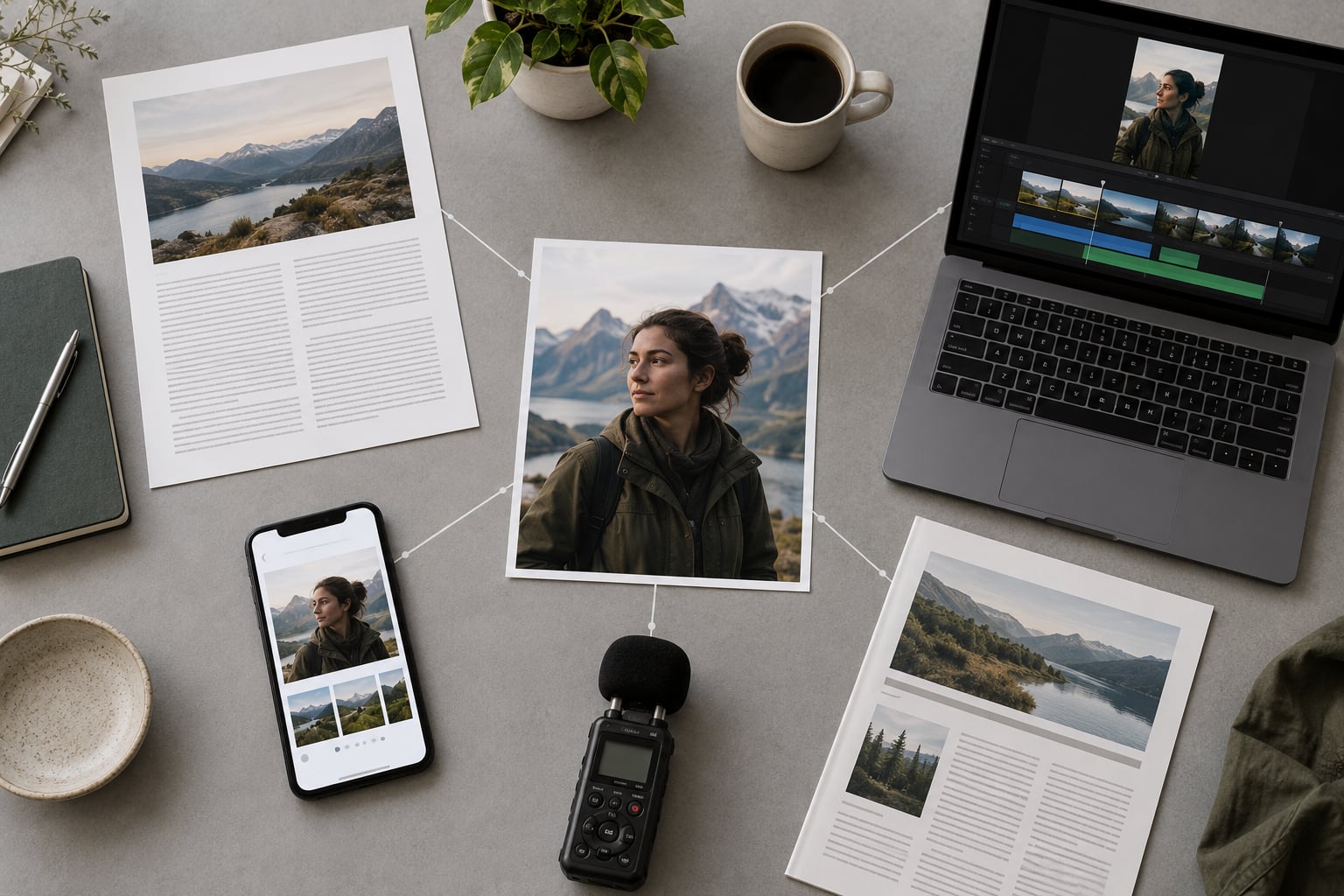
To repurpose one story across formats, you extract the story’s narrative thread once, then rebuild it for each destination audience instead of pasting the same text into new boxes. The reporting is the expensive part, so every format you add after that should cost hours, not a second news cycle. For a newsroom-sized team the whole workflow takes half a day for the first story and gets noticeably faster once the briefs exist.
The mistake most people make is treating repurposing as distribution. It isn’t. Distribution is posting the same words somewhere else. Repurposing is editorial work at a smaller scale, and it goes wrong the moment a short video is just the article read aloud.
Table of Contents
- What You Need
- Step-by-Step: How to Repurpose One Story Across Formats
- Common Mistakes
- Frequently Asked Questions
- How many formats should one news story be repurposed into?
- Should each repurposed version have completely different copy?
- How do newsrooms avoid repeating the same information on social media?
- What should be repurposed first: video, newsletter, or social?
- How do you track whether a repurposed story performed well?
- Can one story be repurposed if the original article is updated?
What You Need
Before you produce anything, gather four things: the source material, the rights to reuse it, a picture of who each audience already is, and the tools to build and schedule.
The reporting, not the published piece
Keep the raw material, because the published article is a lossy version of it. That means interview audio and rough transcripts, the raw dataset and the script that built the chart, photographs with their captions, document scans, and the reporter’s notes with the dead ends still in them. Dead ends are useful, incidentally. A three-slide explainer about what you tried and what failed is far more interesting than a summary of the finding.
Rights and permissions
Written down, per item, before you publish: who owns the photographs, whether the interviewee cleared the audio for reuse, whether the dataset can be republished or only linked, and which quotes were given on background. A clip is still a quote. If a source asked for a week of review time before seeing their words in print, assume they want the same courtesy on a video that runs for six months.
Audience knowledge
For each channel you plan to use, know what readers arrived looking for and what they already know. Newsletter subscribers signed up for your beat. Someone scrolling a feed at 11pm did not. The same finding reads completely differently to those two groups, and the difference is angle, not wording.
Tools
A transcription pass, a clipper with frame-accurate cutting and captions burned in or uploaded, a design tool for charts and social cards, a scheduler, and one shared tracker. Most newsrooms already own versions of all of this inside their existing publishing stack. What they don’t have is the tracker, and that’s the piece that decides whether the workflow survives contact with a busy week.
Step-by-Step: How to Repurpose One Story Across Formats
1. Find the story’s single strongest idea

Write one sentence that contains the claim, the evidence and one human being affected by it. Everything that follows has to be traceable back to that sentence.
A useful test: read your sentence to a colleague who has not read the story. If they can explain why anyone would care, the thread is clear. If it takes you four sentences and a sigh, the thread is not found yet, and no amount of clever repurposing will save it.
Keep the sentence in the tracker. Every format brief gets checked against it, which is what keeps eight outputs from drifting into eight different stories.
2. Inventory sources before you repurpose one story across formats
List everything the story owns, in one place: notes, interviews, documents, photographs, data, video, audio, charts, permissions and the factual details worth double-checking. Add a column for the format each item can feed.
This is the step that saves the second week. When someone asks in month three for a still image and a pull quote, the answer is in the inventory rather than in a panicked search of four cloud folders. Mark anything time-sensitive with a review date, because a two-year-old investigation has a shelf life and a chart of last year’s numbers is worse than no chart.
3. Match formats to audience jobs
Give every output a different job. If two formats have the same job, one of them is redundant and will eat the schedule without adding reach.
A workable set for a single investigation: the article is the full record, the newsletter is the argument with the context that didn’t fit, the vertical video is the one finding a non-reader will remember, the carousel is the chart in a scrollable shape, the audio segment is for people who listen while commuting, and the FAQ page catches the search queries your story already answers in prose.
Write the job in one line per format. “Explain the methodology to someone who distrusts the finding” is a job. “Post about the investigation” is not.
4. Create a format-by-format brief
One brief per format, six fields, filled in before production starts: audience, hook, length, structure, visual treatment, call to action. Add two more and it becomes an operating document: production requirement and owner name.
| Format | Job | Length | What must change | Effort |
|---|---|---|---|---|
| Article | The full record | 1,500-2,500 words | Nothing, it is the source | Reporting days |
| Newsletter | The argument plus context | 400-600 words | New framing, editorial voice, links | 60-90 min |
| Vertical video | Make the finding memorable | 45-90 seconds | Script, captions, aspect ratio, visual hook | 2-3 hours |
| Carousel | Chart you can scroll | 6-9 slides | One idea per slide, alt text per slide | 90 min |
| Audio segment | Listeners commuting | 3-5 minutes | Scripted read or interview edit, transcript | 1-2 hours |
| FAQ page | Capture search demand | 4-6 answers | Questions as written by readers, schema markup | 45 min |
The effort column is the one that gets read twice. It is also how you defend cutting something when the week goes sideways.
5. Adapt the narrative, don’t duplicate it
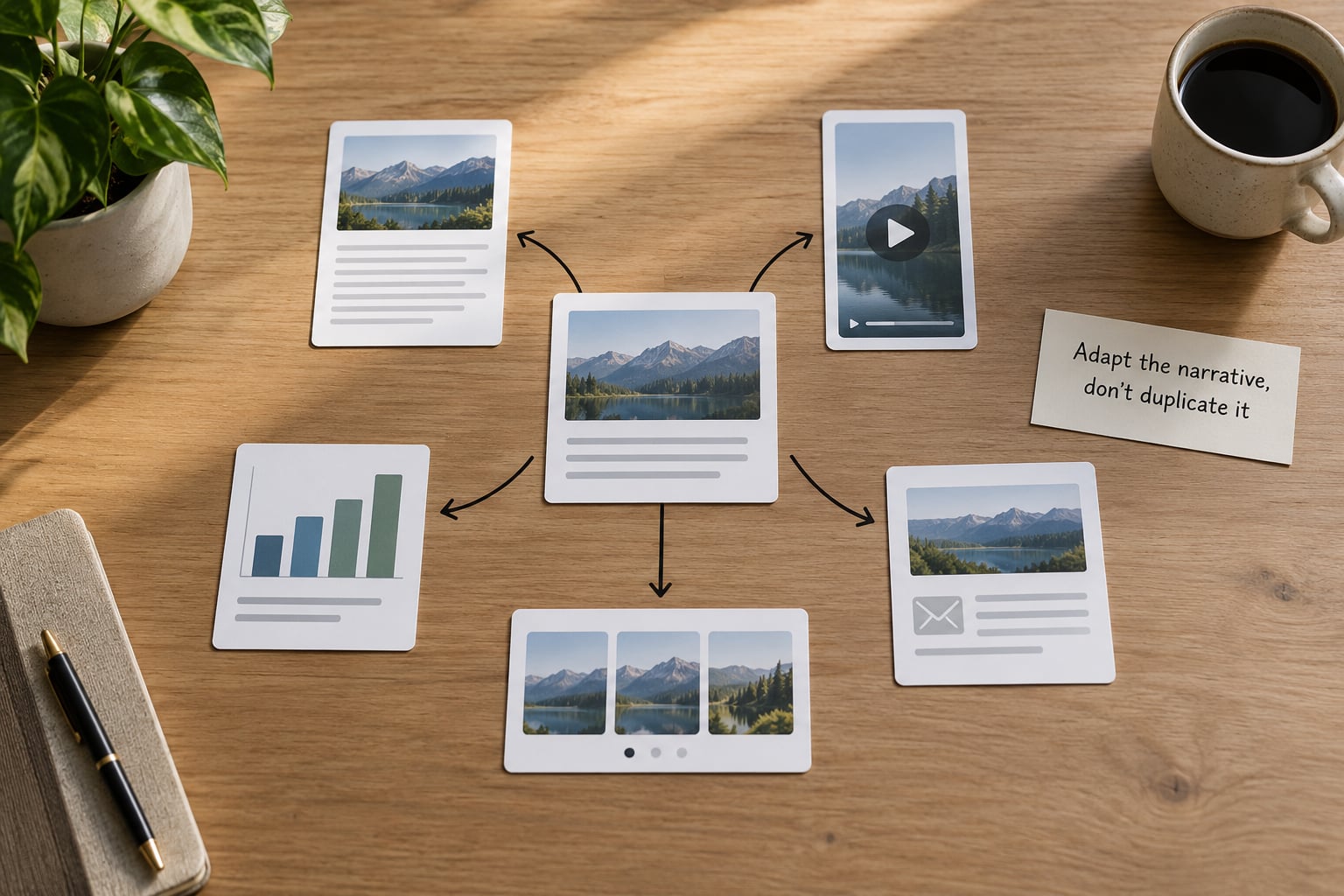
Same facts, different construction. The article argues through evidence in order of discovery. The video leads with the consequence and works backwards. The carousel gives one number per slide and no sentences. The newsletter opens with why it matters to the subscriber personally.
What never changes: the numbers, the names, who said what, and the uncertainty around the finding. A confidence interval or a caveat that survives in the article but disappears in the video is the single most common way a newsroom loses trust with a story, because the video is the version that travels.
Say where it came from every time. A link or a line of attribution in each derivative is not SEO housekeeping, it is credit, and it takes five seconds.
6. Run an accuracy and consistency check
Before any derivative goes out, one person who did not write it runs a fixed pass:
- Names, titles and spellings of every person and organisation
- Every number, with the unit and the date the figure refers to
- Quotations checked against the transcript or the recording
- Links that resolve, and internal links that point somewhere useful
- Timestamps correct in the clip and the caption file
- Image rights, plus alt text on every chart and static image
- Captions or a transcript on every video and audio asset
- A corrections line on the original if anything material has changed
If the story updates later, the derivatives update too, or they come down. A corrected article with an uncorrected clip attached is worse than no clip.
7. Publish in a deliberate sequence
Launch the article first. It is the record, and everything else points back to it. Send the newsletter within a day while the topic is still moving, then the video, then the carousel and audio once you have a week’s worth of audience response to shape them.
Cross-reference rather than duplicate. Each later format links to the original for the full method, so you get the depth without pasting the depth twice.
Tag each derivative with a distinct tracking link and log the results in the same tracker row. Repurposing without a measurement loop is how teams end up producing six formats and learning nothing about which one earned the fifth. Judge each format against the metric that matches its job: watch time for video, open and click rate for the newsletter, saves and shares for the carousel, search impressions for the FAQ page. A view count on all four tells you nothing.
Common Mistakes
Pasting the same copy everywhere. It reads lazy, it wastes a slot, and near-identical pages compete with each other for the same search. Fix: rewrite the angle per format, and if two formats end up with the same job, drop one.
Squeezing a long story into a short format. A 45-second video cannot carry a 2,000-word investigation, and forcing it produces a clip nobody finishes. Fix: pick the one finding the video can actually deliver, and send the rest to the article link.
Cutting the context that made the finding honest. A number without its denominator, or a quote without the question that produced it, becomes misinformation by accident. Fix: paste the caveats into the derivative, not just the original.
Ignoring accessibility. Uncaptioned video, charts with no alt text, PDFs with no document structure. Fix: treat captions, transcripts and alt text as part of producing the format rather than as a cleanup task, because the by-product is free once you build it in.
Unclear ownership. Someone assumed the newsletter was handled, nobody was. Fix: every brief carries one name and one date, and nothing ships without a named approver.
Measuring every version against the same number. Reach on a carousel and read-through on a newsletter are not comparable. Fix: assign one primary metric per format at brief time.
Two smaller habits go a long way. Mark repurposeable material in the tracker when you file it, not after the story runs, because the moment you remember is too late. And publish one format badly on purpose rather than six formats halfway, since the badly published one teaches you something and the other five teach you nothing.
Frequently Asked Questions
How many formats should one news story be repurposed into?
Four to six is the realistic range for a single story, and the number matters less than the jobs those formats do. If two formats share a job, cut one and give the time to the newsletter or the video instead. Six formats done well also create six places for an error to hide, so teams with one producer usually do better with three.
Should each repurposed version have completely different copy?
Different framing, yes. Completely unrelated writing, no. The facts, numbers, quotations and attribution stay identical, because those are the story. What changes is the order, the hook and the depth: the video leads with the consequence, the article builds the evidence, the carousel gives one number per slide. Same spine, different build.
How do newsrooms avoid repeating the same information on social media?
Give each social format a distinct job and stagger them rather than posting the same thread twice in a week. One post is the finding, one is the method, one is the human detail behind it, and each carries a link to the original for the rest. Widen the spacing between posts, and change the visual treatment even when the text is genuinely the same.
What should be repurposed first: video, newsletter, or social?
Newsletter first, in most newsrooms. It reaches people who already trust you, it needs no new production, and a 60-minute draft forces you to find the angle before you spend hours on a video. Publish the article, send the newsletter within a day, then produce video and carousel with a week of audience response in hand.
How do you track whether a repurposed story performed well?
Use one tracker row per story with a row per derivative, a distinct tracking link for each link, and one primary metric chosen at brief time. Match the metric to the job: watch time for video, open and click rate for the newsletter, saves and shares for a carousel, search impressions for an FAQ page. Review after 30 days and record what you learned in the row.
Can one story be repurposed if the original article is updated?
Yes, and you should, because derivative assets stay live long after an update. When you correct an article, check every format built from it and update or pull them the same day. If the change is material, add a corrections note to each derivative too, and tell readers what moved.
Start with the one-sentence version of your next story. Write the claim, the evidence and the person it affects on a single line, build the brief around that line, and only then decide which formats earn a place. Everything after that is easier than picking a story and hoping formats will show up for it.