Reading a scientific paper quickly is not about skimming. It is about reading out of order: title, abstract, figures and captions, conclusion, and only then the parts your questions actually require. Done well, the first pass takes about ten minutes and tells you whether the paper deserves your next hour.
I want to be honest about one thing first. If this is your first paper in a new field, it will be slow, and that is normal. Reading scientific papers quickly is a second-paper skill, not a first-paper one. What changes everything is that you stop starting at the top.
What You Need
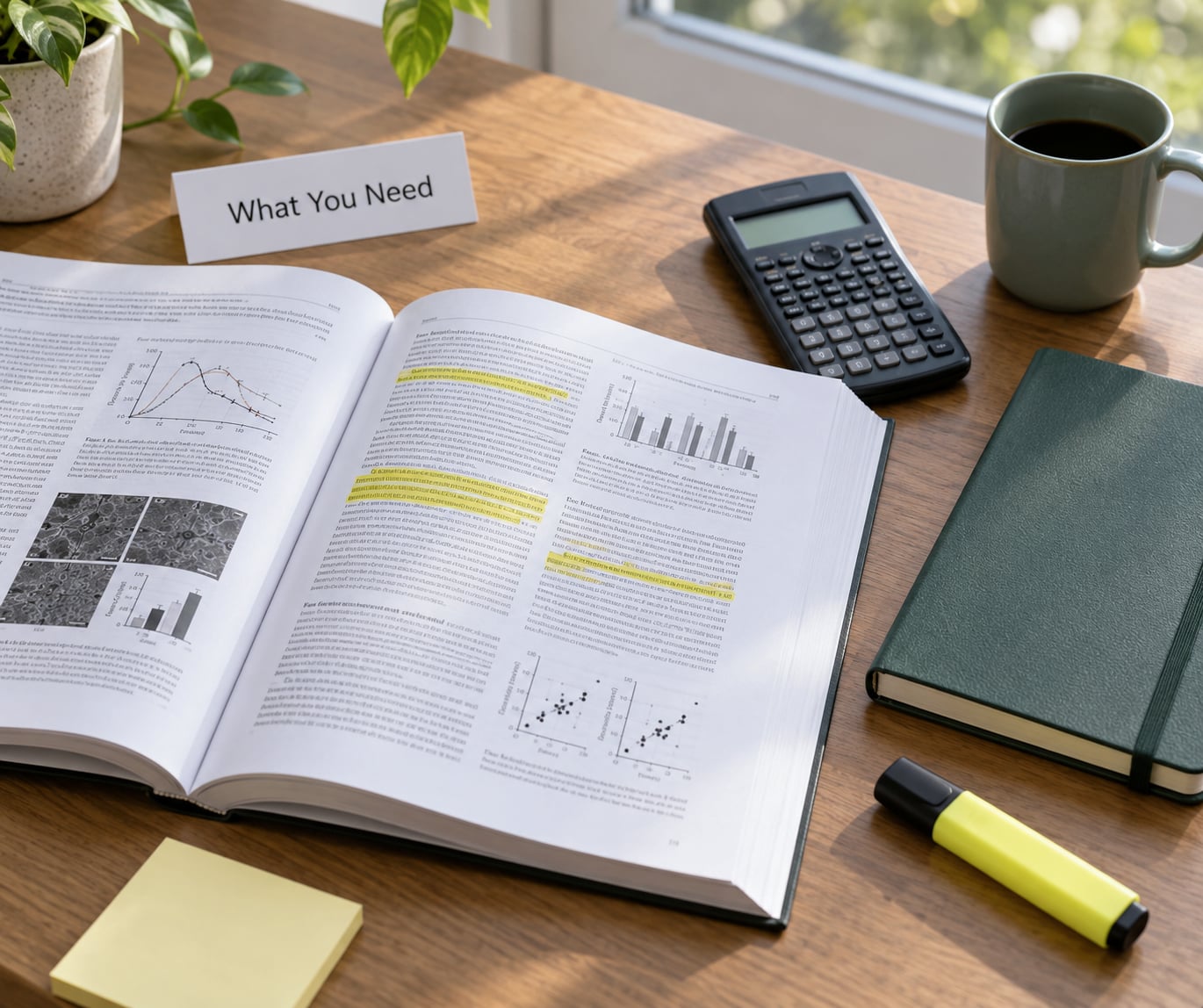
Four things, and three of them are free. You need the paper itself and its abstract, somewhere to take notes, and a way to check numbers. Optional extras help, but none of them will rescue you from a bad reading order.
- The paper and its abstract. Most journals put the abstract on the landing page, so you can read it before deciding whether to download the PDF.
- A fixed note template. One blank page or one row in a spreadsheet per paper, with the same five or six fields every time. Decide the fields now, not while you are halfway through the results.
- A calculator or spreadsheet. Most mistakes in reading a paper are arithmetic mistakes: sample sizes that do not add up, percentages that describe the wrong group, an effect that sounds bigger than the intervals allow.
- A capture system. A reference manager such as Zotero or Mendeley, or even a single folder of PDFs, so figures and claims land somewhere you will find them again.
- Optionally, a preprint archive. PubMed Central, bioRxiv, medRxiv and arXiv all hold full text that you will otherwise hit a paywall for.
- Optionally, an AI assistant. Useful for decoding a single jargon-dense paragraph. Never use it as your citation source, and never cite anything it produces without opening the original paper yourself.
The note template matters more than the apps. When people fall behind on a reading list, the cause is almost never weak reading speed. It is a folder of forty PDFs and no record of which one said what.
Step-by-Step: How to Read a Scientific Paper Quickly
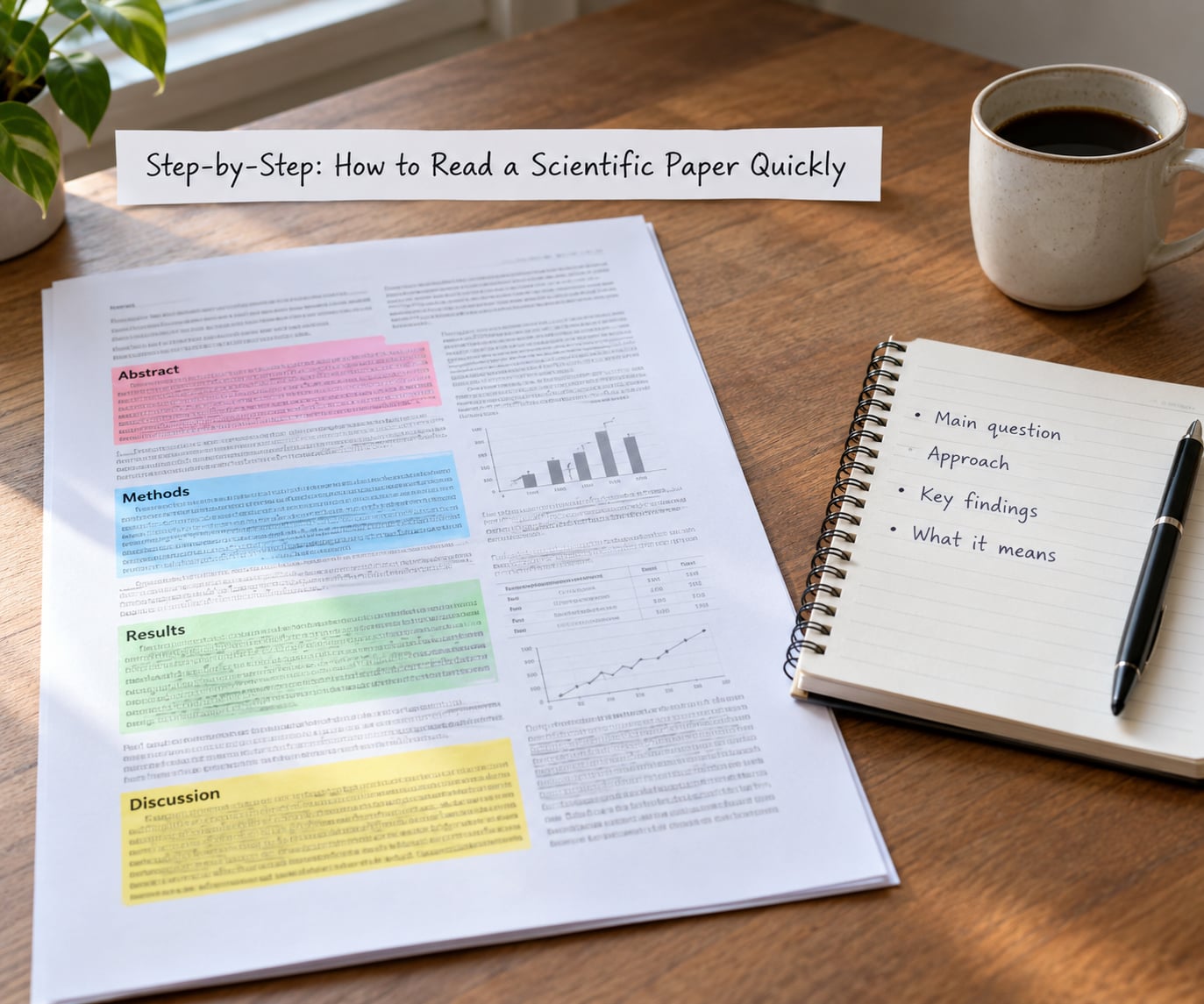
The whole method fits into one short answer, so here it is before the detail. Pass one is a ten-minute triage that decides whether the paper is worth your time. Pass two is a targeted deep dive that opens only the sections your questions require. Most papers die in pass one, and that is a good outcome.
- Read the title, abstract, and conclusion. Three minutes. This gives you the question, the claimed finding, and the authors’ own caveats.
- Map the paper’s structure. Two minutes. Find where methods, results, and discussion begin so you can jump to them later.
- Identify the main claim. Two minutes. One sentence, written down. Everything else in the paper is support or decoration.
- Read the figures and their captions. Three minutes. Captions before axes. The data is the argument; the prose is narration.
- Check the methods against the claim. Two minutes, or as long as it takes. Sample size, controls, measures, and whether the design can support what is claimed.
- Write the two-minute summary and decide. Read it, cite it, or drop it. Dropping is a real outcome, not a failure.
Read the Title, Abstract, and Conclusion First
The title tells you the field and the claimed contribution. The abstract’s first two sentences usually state the problem and the goal; its last two usually state what was found. If those four sentences do not make sense to you, the rest of the paper will not either, and you can stop.
The conclusion is the part most readers skip and most rewarded readers read first. Authors are required to be honest about their own limitations there, and that paragraph is often the fastest route to judging whether a headline claim will hold up.
Skipping the introduction entirely is a legitimate move, with one exception: read its last paragraph, where the specific hypothesis and research question usually sit.
Map the Paper’s Structure
Most journal articles follow IMRAD: Introduction, Methods, Results, Discussion. Each section exists for a different reason, which is why some are worth your time and some are not. The table below tells you what each one contains and when opening it earns its keep.
| Section | What it contains | Read it when | Time cost |
|---|---|---|---|
| Title and authors | The claimed contribution and who is claiming it | Always, first | 30 seconds |
| Abstract | Goal, design, headline result, one or two caveats | Always, and only the first and last two sentences | 1 minute |
| Introduction | Background, prior work, the specific question | Only the final paragraph, for the question | 1 minute |
| Methods | Design, participants, measures, exclusions, analysis | When you are replicating, citing the claim, or the results surprise you | 5-20 minutes |
| Results | What was found, narrated around the figures | After the figures, not before | 5-10 minutes |
| Discussion | Interpretation, limits, future work | For the limitations paragraph, always | 2-3 minutes |
| Conclusion | The authors’ own final word | Always, second | 1 minute |
| References | Citations out | Only to chase a method or a competing result | As needed |
| Supplementary | Extra tables, full instruments, robustness checks | Only when a headline number lives in there | As needed |
Two habits follow from this map. Results are the section where figures carry the argument, so read figures before you read the prose describing them. And methods exists so other researchers can reproduce the work, not so you can enjoy it; that is legitimate permission to defer it.
Find the Main Claim and Supporting Evidence
Most papers make one main claim and several supporting ones, and the abstract’s last two sentences usually hand you the main one. Write it down in a single sentence in your own words. If you cannot, that is a signal the paper is unclear, which is itself a finding worth noting.
Then match claims to evidence one at a time. For each claim, ask which figure or table supports it, and what that figure actually measures. A claim supported by one figure in a supplementary appendix is weaker than a claim supported by the main result, and you cannot see that difference unless you pair them deliberately.
Read long paragraphs by first sentence only. The first sentence states the point; the rest is qualification and citation. This single habit is the biggest speed gain available, and experienced readers use it without thinking about it.
Check Whether the Methods Support the Conclusion
Six questions cover almost every case. How many participants or samples, and is that number stated plainly? Was there a comparison group? How was the main thing measured, with an instrument that could plausibly detect the effect? What was excluded, and how many people or records did the exclusions remove? Which analysis was planned in advance? And does the design support the verb the abstract uses?
That last question catches overclaiming faster than anything else. Observational studies support “associated with” and “predicted”. They rarely support “caused” or “improved”. Randomized trials can sometimes carry a causal verb, but only for what they actually randomized.
Look for Limitations, Uncertainty, and Replicability
Find the effect size, not just the p-value, and find the confidence interval beside it. A result can be statistically significant and practically meaningless, especially in large samples where tiny differences clear the threshold reliably.
Look for what the authors say they could not do: small sample, short follow-up, self-reported data, single site, no control for a plausible confounder. Absence of a limitations paragraph is itself a signal about how the paper was written.
Then check the basics of trust. Is there a conflict of interest statement, and is the funding recorded? Is the data available somewhere a stranger could check it? Was the analysis plan preregistered? Have independent groups replicated it, or is this the only study? For anything you plan to quote or publish, check the paper’s current status on PubPeer and search the journal’s retraction notices, because a paper can be retracted years after publication and citation counts do not update themselves.
One historical case is worth carrying with you. The 1998 Lancet paper linking MMR vaccine and autism passed peer review, was published in a leading journal, and was cited for more than a decade before its retraction. Peer review is a filter, not a guarantee, and it is strongest when paired with replication and open data.
Write a Two-Minute Summary
One template, used every time, so your notes stay comparable across dozens of papers. Question: what did they ask. Design: what they did and with how many. Finding: the main result in one sentence, with the number. Limitation: the one thing that most limits the claim. Use: whether this is worth citing, and for what.
Also capture the figure that carries the result. A screenshot of the key figure saved next to your notes saves you an hour when you write the literature review six weeks later. Capturing while reading is the difference between notes you have and intentions you had.
If a tool cannot summarize the paper into those five fields without inventing detail, the paper is not clear enough to cite. That is a useful outcome too.
Common Mistakes
Most misreadings come from six habits, and each has a simple correction.
- Skipping the methods entirely. The methods belong to other replicators, but you still need the sample size, the comparison group, and the main measure. Search for them instead of reading end to end.
- Reading methods first out of habit. It is the densest, least informative section for most readers. Read it when a specific question pulls you there.
- Treating correlation as causation. Check the study design before you accept the verb. Design sets the ceiling on what a paper can claim.
- Confusing statistical significance with importance. A p-value tells you the result is unlikely under a null assumption. It tells you nothing about size, and it says nothing about whether the effect matters in practice.
- Trusting the abstract alone. Abstracts compress and oversell. Read the limitations paragraph, which is where the honesty lives.
- Ignoring preprint status. A preprint has not been peer reviewed. That is normal and often fine for a literature scan, but it changes how firmly you should state the finding, especially in health-adjacent fields where preprints circulate fast and get quoted as settled.
- Over-reading to feel safe. Skipping an irrelevant paper is correct behaviour, not laziness. On a fifty-paper reading list, the real skill is killing twelve papers in ten minutes each.
- Trusting an AI summary’s citations. These tools are fluent and occasionally wrong about what a paper says, and they can produce references that do not exist. Paste a paragraph in to decode the jargon; open the original before you quote a single number.
Two questions that come up constantly in forums: no, starting with the abstract is not the only valid order. Experienced researchers sometimes start at the discussion to see the limitations first, which works well for a field you already know and badly for a new one. And no, not understanding most of a paper on your first pass is not a sign you are slow. It is a sign you are reading outside your depth, which is where every field starts.
Frequently Asked Questions
How long should it take to read a scientific paper?
Budget about ten minutes for a triage pass on any paper, then 30 to 60 minutes for a full read of one inside your own field. A paper from an unfamiliar field can take two to three hours the first time and fifteen minutes once you know the field. If you are past 90 minutes and still hunting for the main claim, the order of your reading is wrong, not your speed.
How do I read a paper in a subject I don’t understand?
Start with a recent review article in that field, then read the unfamiliar paper against it: the review tells you the vocabulary and the current debate, so unfamiliar methods stop being noise. Use an AI assistant to decode one jargon-dense paragraph at a time, then verify every term in the original. Never ask it for a summary you intend to cite without opening the paper yourself.
Should I read the methods section first?
Almost never, unless you are replicating the study or the results look strange to you. Methods exist so other researchers can reproduce the work. What you need from it is narrow: the sample size, the comparison group, how the main variable was measured, and what was excluded. Search for those four things and move on.
What are ten simple rules for reading a scientific paper?
Read out of order, in two passes with a hard time box on the first. Read the abstract’s first and last two sentences. Treat figures and captions as the real content. Read long paragraphs by first sentence only. Match each claim to the figure supporting it. Write a five-field summary while reading, not after. Check limitations, funding, and retraction status. Stop early when the paper does not serve your purpose.
How can I tell if a scientific study is credible?
Check the sample size and whether a real comparison group exists, then ask whether the design supports the verb used in the abstract. Look for an effect size with a confidence interval, not just a p-value. Find the limitations paragraph. Check the funding and conflict of interest statements, and whether the data is available. Finally, search the paper on PubPeer and the journal’s retraction notices before you quote it anywhere.
How do PhD students read papers?
Most work in two passes: a ten-minute triage to decide whether a paper is relevant, then a targeted read of methods and results against a list of questions written down beforehand. Notes are captured immediately into one fixed template, including a screenshot of the key figure. Papers get read on a daily quota rather than in a panic before a deadline, and a paper that fails triage is dropped without guilt.
Conclusion
Start at the title, read the abstract and the conclusion, look at the figures and their captions, and write down the one claim the paper is making. Then check whether the methods and the sample support that claim before you read anything else in depth. Ten minutes buys you the decision that matters, and speed comes from deciding what not to read.