Writing about risk without scaring readers means reporting the real severity of a hazard, then pairing every threat statement with something the reader can actually do about it. You mark what is solid and what is still contested, warn before graphic detail rather than after it, and never let a headline carry more certainty than the underlying evidence.
Accuracy and reassurance are not opposites. Softening a risk to keep readers comfortable is its own kind of harm, and so is screaming it. The working test is simple: if a story names a hazard, it must also name an action.
I have watched this go wrong in both directions in newsrooms I have worked with. A crime story that led with a rare attack pattern and no context sent a neighbourhood into panic mode for a week. A workplace safety story that hedged every sentence into uselessness failed to warn workers who needed the warning. Both came from the same missing step, and it is fixable.
What You Need Before You Draft
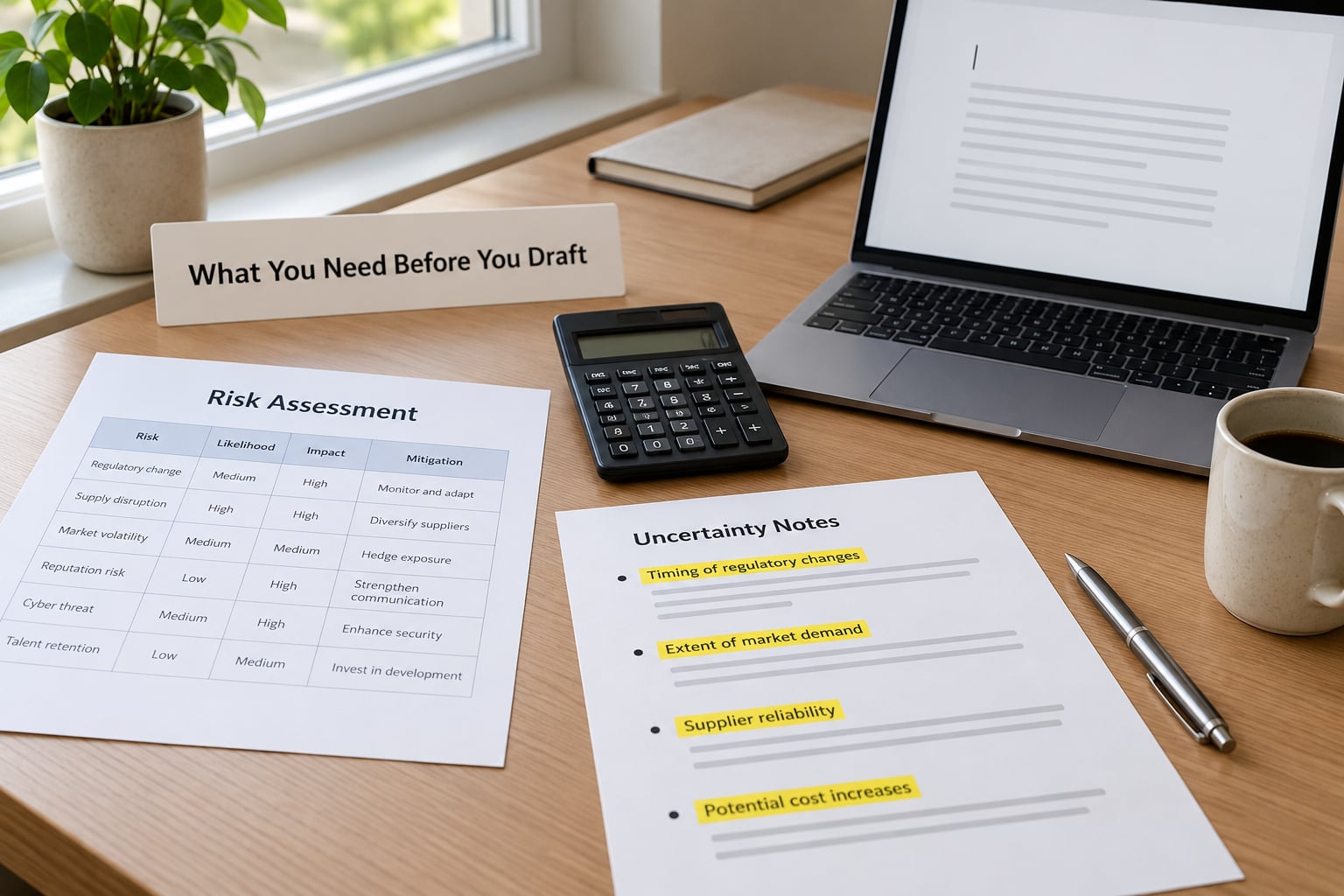
Seven things belong in a working document before you write a single line of risk copy. If any of them is missing, the piece is not ready to draft, because you will end up filling the gap with adjectives.
The source material and its actual strength
Know what kind of evidence you are holding: a peer-reviewed study, a preliminary preprint, a single case report, a survey with a low response rate, or an institutional press release. Each one supports a different amount of language, and the difference is where most over-claiming happens.
The audience and where they will read it
A story read on a desktop by a professional is not the same artefact as the same story pushed to a phone at 7am. Write the version for the surface it will actually appear on. Push alerts carry almost no room for qualification, which is exactly why they carry the most risk.
The hazard, the exposure and the affected population
Who is actually at risk, doing what, where, and for how long? “Residents near the site” is not a population. “About 4,000 people who work within a half-mile of the site during weekday shift hours” is. Precision here does more calming work than any tone adjustment downstream.
The probability figures and their denominators
Get the raw numbers before you get the percentage, because percentages lose their meaning fast. You need the numerator and the denominator in front of you, not a rounded figure someone else calculated.
The base rate for comparison
What happens to people in the absence of this hazard? Without a baseline, a rising case count reads as an emergency even when the rate has been flat for a decade.
What is genuinely uncertain
Write down the open questions now, while you still find them interesting. Once you are 900 words into a draft, uncertainty tends to vanish because it complicates the story. Ask the source directly: what would change your mind? What have you not been able to check?
The actions a reader can take
Before you worry about how alarming the story sounds, find out what a reader can do. Close windows, boil water, update firmware, call a clinic, check a recall database. A story with three verified actions reads very differently from the same facts with none.
How to Write About Risk Without Scaring Readers: Step by Step
How to define the risk in one sentence
Every risk story needs a first sentence that names five things: the hazard, the outcome, the population, the time frame, and the level of certainty. That sounds clinical, and it is, but clinical language is what stops a reader’s imagination filling in the blanks.
Before: “Officials warn of a growing threat in the county.” After: “Air monitors in two districts of Riverton recorded nitrogen dioxide levels above the state standard on nine days in the past month, a level the county attributes to construction traffic that continues through 2026 at the site.”
The second version is longer, which is the trade. It is also the version that survives a reader’s follow-up questions without collapsing. I use a five-part template and fill it in before I write anything else: [hazard] affects [population] in [place], producing [outcome] over [time frame], and current evidence indicates [certainty level].
How to write about risk without scaring readers: separate probability from severity
Likelihood and seriousness are two different axes, and most alarming copy collapses them into one. A rare event with catastrophic consequences and a common event with mild consequences can both be correctly described as moderate risk, and readers cannot tell that unless you draw the axes separately.
So state both, in plain terms. “Rare but severe” and “common but mild” are phrases that belong in body copy, because they tell a reader whether to plan or to relax. When you report only one number, most readers assume the worst of the other.
There is also a coverage asymmetry worth knowing about. In 2014, when a handful of Ebola cases appeared in the United States, US Twitter users generated millions of posts about those cases while the much larger death toll in West Africa drew a tiny fraction of that volume. Risk communication researchers have used that gap ever since as the textbook case of threat emphasis outrunning the actual hazard.
The lesson for a writer is not to suppress the alarming story. It is to ask whether the attention you are spending matches the size of the danger, and to give the quieter, larger risk its share of the copy.
How to explain uncertainty and disputed evidence
Uncertainty is where careful writing goes wrong in both directions: endless hedging that tells a reader nothing, or false confidence that damages your credibility later. The fix is to name the specific unknown rather than spraying qualifiers over the whole story.
Useful phrases for a preliminary finding: “an early analysis”, “in a sample of 40 cases”, “not yet peer-reviewed”, “the authors caution that”. Useful phrases for a genuine dispute: “two studies reached opposite conclusions, and the difference appears to be how each measured exposure”. Useful phrases for what nobody knows: “no agency has published a figure for this yet”.
Attribute uncertainty to a source rather than owning it vaguely. “We do not know” reads like an admission of sloppiness. “The health department said it does not yet have that measurement” reads like competence. This matters more than it sounds, because readers judge a newsroom’s honesty by how it handles the parts it cannot report.
How to add context that changes interpretation
Context is the single strongest de-escalating tool in a risk story, and it is the one most often skipped. Three comparisons do most of the work.
Give the denominator. A 40 percent rise sounds enormous; a rise from 4 cases to 6 in a county of 300,000 is a rounding artefact worth noting without alarming anyone. Give the absolute number alongside any relative change, in the same sentence, so the reader never has to compute it alone.
Give the base rate. Compare the risk against an everyday activity that people already accept. Guidelines for public health risk communication make heavy use of this: a driving risk stated next to a lifetime of ordinary travel often reframes a scary-sounding figure without dismissing it.
Give the exposure of the people actually affected. Vulnerability is not evenly distributed. A hazard that is mild for an average adult can be serious for a child, a worker without protective equipment, or someone with a pre-existing condition, and saying so is neither alarmism nor false reassurance. It is accuracy.
How to write proportionate headlines and alerts
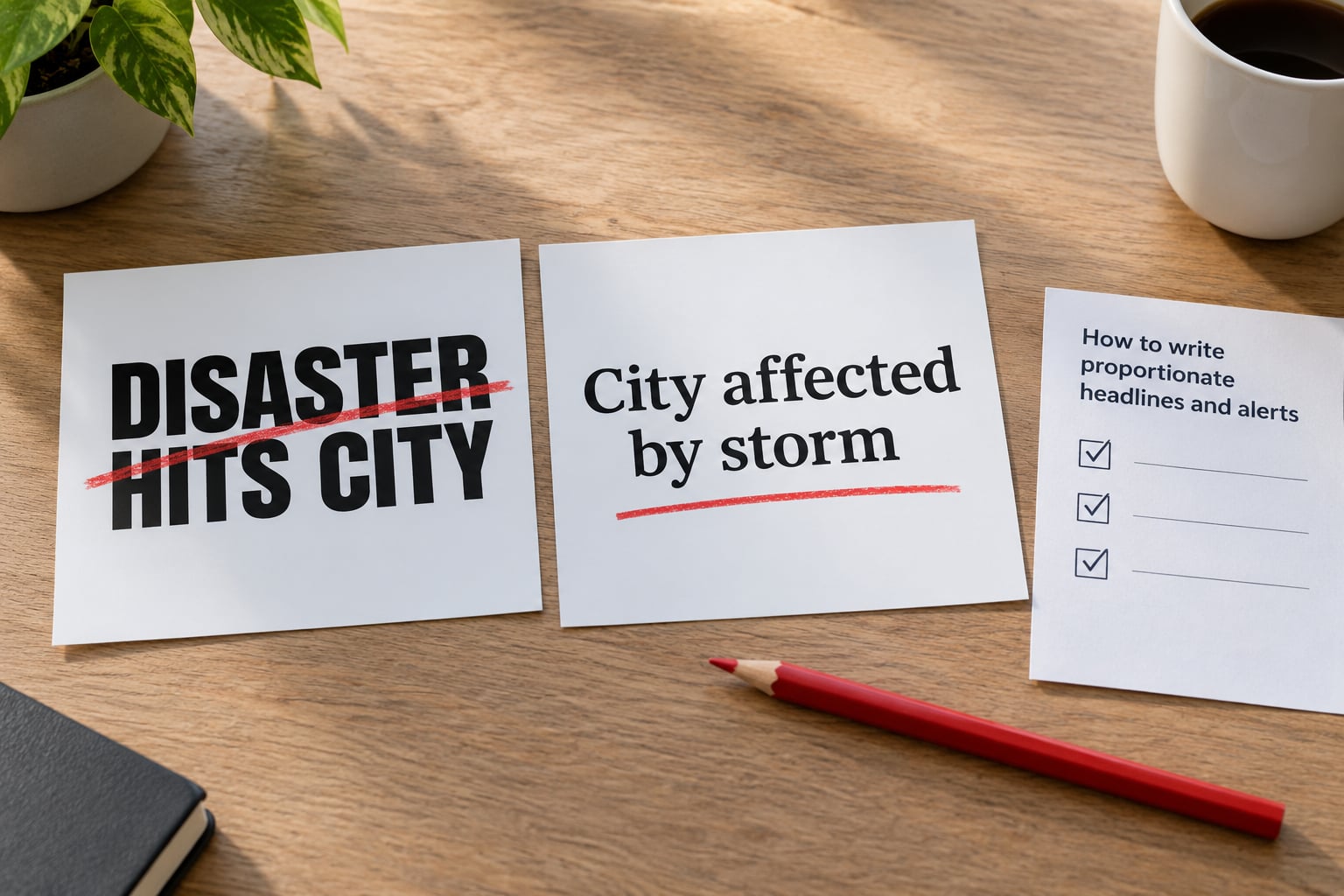
The headline is where most risk copy does its damage, because it is the only part most readers ever consume. Audit it separately from the body, with the body hidden. If the headline could stand alone in a push alert, ask whether it would still be defensible with no follow-up text.
Some pairs that keep identical facts and differ only in threat load:
- “Deadly toxin found in school water” becomes “State finds lead above federal action level in three school buildings”
- “Hackers breach city network” becomes “City network was breached; residents should change passwords, officials say”
- “Flooding could hit 200,000 homes” becomes “Flood maps put 200,000 properties in the worst-case scenario zone” <li"Cancer rates spike near plant" becomes "Screening data shows more cancers detected near plant; link to emissions unproven"
- “Outbreak grows to 200 cases” becomes “Outbreak reaches 200 cases; health officials say the growth rate has slowed”
Nothing was softened in those rewrites. The second version of each is simply more specific, which lowers the reader’s fear without lowering their information.
Compare threat-heavy phrasing against action-balanced phrasing directly. Ask of every sentence which one it is.
Threat-heavy: “A dangerous chemical was detected in the water supply.” Action-balanced: “A chemical used in industrial solvents was detected in the water supply; the city is flushing lines and residents should boil tap water until further notice.”
Threat-heavy: “Cyberattack leaves hospital systems offline.” Action-balanced: “A cyberattack took hospital scheduling systems offline for six hours; patient records were not accessed, according to the hospital.”
Threat-heavy: “Record heat expected this week.” Action-balanced: “Forecast heat index above 105F for three days; cooling centres will open from 10am to 8pm at four libraries.”
Social cards and push alerts deserve their own pass. A card has room for about seven words before the reader decides whether to engage, and an alert has room for about twelve. Fit the action into that space or accept that the alert should carry the action as the headline rather than the threat.
On warnings, keep the mechanics simple: put the content warning above the body, in its own line, not buried inside it. A reader who skims past an inline warning has not been warned. Use a spoiler note only when a specific plot or outcome detail will land badly. Use nothing at all when the subject is distressing in principle but not graphic in practice, because warnings that fire on everything train people to ignore them.
How to give readers useful next steps
A risk story that ends with the danger and no next step leaves the reader with the anxiety and nothing to do with it, which is the mechanism behind most of the fatigue reporting teams complain about. Close instead with what is verifiable and where to check.
Point at named places rather than generic advice. A specific agency page, a recall database, a clinic hotline, a reporting form. Tell the reader what the action accomplishes and what it costs them in time. “Check your county’s air quality site before outdoor exercise” is useful; “stay informed” is not.
Then state what is not yet known. A closing paragraph that says the long-term effects are still under study tells a reader the story may return, which reduces the compulsion to treat the current facts as permanent and final.
If your newsroom measures anything after publication, watch three numbers: unsubscribe rates in the 24 hours after a heavy story, comments that ask for sources you did not publish, and corrections filed later. A spike in any of them is reader harm that no editor felt in the room.
Common Mistakes
Mistaking a percentage change for a level. A jump from 4 cases to 6 is not a 50 percent surge in danger. Report the absolute number in the same breath, and say plainly when a change is small enough to fall within normal variation.
Dropping the denominator. “Twelve deaths” means something different in a city of 40,000 than in a city of four million. If the population is not in the story, readers will supply their own, usually the wrong one.
Letting the vivid case stand in for the average one. A single named victim makes a story memorable and makes the risk feel closer than the data supports. Attribute precisely what is known about that person, keep clinical detail to what a family or legal process requires, and put population context nearby rather than at the end.
Reactive syntax for a solvable problem. “Residents are being exposed to contaminated water” describes something happening to people. “Residents can reduce exposure by boiling tap water” describes something they can do. The second sentence is not softer; it is more useful, and it is the version readers act on.
Hiding behind hedges. When every sentence carries “may”, “could potentially” or “is thought to be”, the reader gets nothing to hold. Replace a hedge with a source: name who believes it and on what evidence.
Over-correcting into false reassurance. This is the failure nobody talks about. Dropping a real danger to protect the audience destroys trust more thoroughly than an alarmist story, because the correction arrives only after someone is harmed. CDC, WHO and EPA risk communication guidance all treat under-communication as a public-health failure in its own right, not as a softer option.
Treating sources as material rather than people. Writers covering contested illnesses have documented cases where standard reporting habits caused real damage to the people interviewed. Ask what physical limits a source has before scheduling, let them decline on the record, and make clear what will be published if they do.
A quick language audit before filing: read the draft aloud and underline every sentence that contains no number, no source and no action. Most of those sentences are doing atmosphere work, and a little atmosphere goes a long way.
Frequently Asked Questions
Can you give me an example of risk communication?
A public health department telling residents that a boil-water advisory is in effect, naming the streets covered, saying how long it will last, explaining why the risk exists and confirming that the water is safe once boiled is risk communication. The ingredients are the hazard, the affected population, the action, the duration and the reason. A tweet saying only that the water is dangerous is a warning, not risk communication.
What is a risk message?
A risk message is a specific piece of communication that names a hazard, describes who is exposed to it, says how likely the harm is, and tells the audience what to do. It differs from a general announcement, which only announces that something happened, and from an advisory, which is the formal issued version of the same content. Without the action, it is a warning.
How do I communicate risk to readers without exaggerating it?
Report the hazard, the population, the time frame and the certainty level in the opening sentence, then give both the absolute number and any percentage change. Add a base rate comparison so the reader has a reference point. Name the source of every figure and mark what is unresolved. Finally, pair the threat with verified next steps so the story hands over agency instead of anxiety.
How do I explain uncertainty in a news story?
Name the specific unknown rather than hedging the whole sentence. Use phrases like an early analysis, in a sample of cases, not yet peer-reviewed, or the authors caution that. Attribute uncertainty to a named person or agency rather than owning it vaguely, and state plainly what would change the conclusion. Readers trust outlets that mark their limits accurately.
What is the difference between relative and absolute risk?
Absolute risk is the raw number of events in a real population, such as six cases recorded. Relative risk is a ratio comparing that group with another, such as a 50 percent increase. Relative figures sound far larger and frequently describe small numbers, so always print the absolute figure in the same sentence. Readers left with only the percentage will over-estimate the danger.
How do I write a headline that is accurate but not alarmist?
Remove every adjective the body copy does not require, and put a number, a place or a source in its place. Compare the headline against the body with the body hidden, and delete anything that could not survive being the whole story. If the headline names a hazard, work out where the protective action goes, since push alerts and social cards leave no room for a second sentence.
Conclusion
There is one editorial test that covers most of this. If a reader finishes the story knowing the seriousness, the likelihood, the uncertainty and the available actions, in that order, the piece is calibrated, however alarming the subject is.
Start on the next risk story with the seven-item working document. Gather the numbers, the denominators, the base rate and the actions before you gather adjectives, and the loudest version of the copy usually turns out to be unnecessary.