
To write a how-it-works piece for a general audience, pick the one question your reader arrives with, answer it in plain language, and walk them through the process one stage at a time. Most of the work is sequencing, not simplification. Budget four to six hours for a piece of 900 to 1,400 words, plus the research that precedes it.
The failure mode is familiar. Someone writes the piece for the twelve people who already understand the subject, and the other ninety-eight bounce. Learning to write a how it works piece for a general audience is mostly about resisting that narrow room.
Table of Contents
- What You Need
- Step-by-Step: How to Write a How It Works Piece for a General Audience
- Start with the reader’s question: how to write a how it works piece for a general audience
- Choose one outcome and map the process
- Explain the essential parts before the details
- Translate technical concepts into plain language
- Show the process with a worked example
- Add context, evidence, and limitations
- Edit for clarity, accuracy, and usefulness
- Common Mistakes
- Frequently Asked Questions
- How long should a how-it-works piece be for a general audience?
- How do I explain a technical topic without using too much jargon?
- Should a how-it-works article use first person or third person?
- How many steps should a how-it-works process include?
- What examples work best when explaining how something works?
- How do I keep a how-it-works piece accurate but still readable?
- Conclusion
What You Need
Seven things, and most of them are decisions rather than equipment. Sorted before you type, they save the rewrite.
- The audience question. The exact words a reader would type or ask a friend to understand what you are about to explain. One question, not three.
- A chosen topic narrow enough to finish. How a payments network clears a transaction is explainable. The future of money is not.
- Reliable source material. At least two people who know the process well, plus primary documents: a policy text, a published study, a specification, a filing, or direct observation.
- Supporting evidence. Numbers that show scale or change, with a named origin for each one.
- An honest read on reader knowledge. What the general audience already assumes, and which of those assumptions are wrong.
- A reading-time budget. How long you are actually willing to hold someone. It decides what you cut later.
- A clear editorial outcome. What the reader can do, decide or understand differently when they finish.
Write the audience question on a sticky note and keep it visible. Every paragraph either serves it or gets cut.
Step-by-Step: How to Write a How It Works Piece for a General Audience
Start with the reader’s question: how to write a how it works piece for a general audience
Begin with the problem a general reader wants solved, not with the history of the field. The reader has a situation and wants to understand it. State plainly in the opening what the piece will explain, then say what the reader needs to know beforehand, which is usually less than you assume and occasionally more.
Setting that baseline honestly matters in both directions. Some readers arrive thinking a phrase means something it does not, and a one-line correction in the opening prevents twenty paragraphs of confusion. Others arrive knowing more than you expected, and pretending otherwise makes the piece condescending.
The opening paragraph of how to write a how it works piece for a general audience should be readable on its own, out of context, because it is what most search engines and AI answer systems lift out first. Forty to sixty words, direct answer, no throat-clearing.
Choose one outcome and map the process
Break the subject into a beginning, a sequence of meaningful actions, and a result. Then do the part most drafts skip: say why each stage matters. A step without a reason becomes trivia, and readers who hit trivia leave.
Working out how to write a how it works piece for a general audience usually stalls here, in the gap between what the expert said and what the reader needs. The fix is a staged outline: three to seven stages, each with a plain-language label, a one-sentence explanation, and one piece of evidence. If a stage will not fit that shape, it may not belong in this piece.
Explain the essential parts before the details
Introduce only the components, people, inputs or decisions a reader needs to grasp the whole system. A short overview comes first, and nuance comes after, never before.
Ask of every noun you plan to use: does the reader need its name to follow what happens next? If the answer is no, describe it instead of naming it. Naming things you have not explained is the single most common way readers get stranded, and it happens most often in pieces written by people who love their subject.
Translate technical concepts into plain language
Replace specialist phrasing with familiar verbs and concrete nouns. Define the terms you cannot avoid on first use, in a single sentence, and use them consistently after that. Repeat yourself. Repetition is not padding when the reader has just met the term three paragraphs ago.
A swap list I keep beside the draft. Each pair costs a five-second read and saves a full rewrite later:
- Not “in the event that a claim is denied” but “if the claim is denied”.
- Not “prior to the commencement of the review” but “before the review starts”.
- Not “a majority of the stakeholders involved” but “most of the people involved”.
- Not “the data are indicative of a downward trend” but “the numbers point the same way: down”.
- Not “please be advised that the deadline has been extended” but “the deadline has moved”.
Keep a visible line between fact and interpretation. “The system flagged 4% of claims last quarter” is a fact. “The system is unfair” is a conclusion, and it belongs to whoever drew it, named as such.
Show the process with a worked example
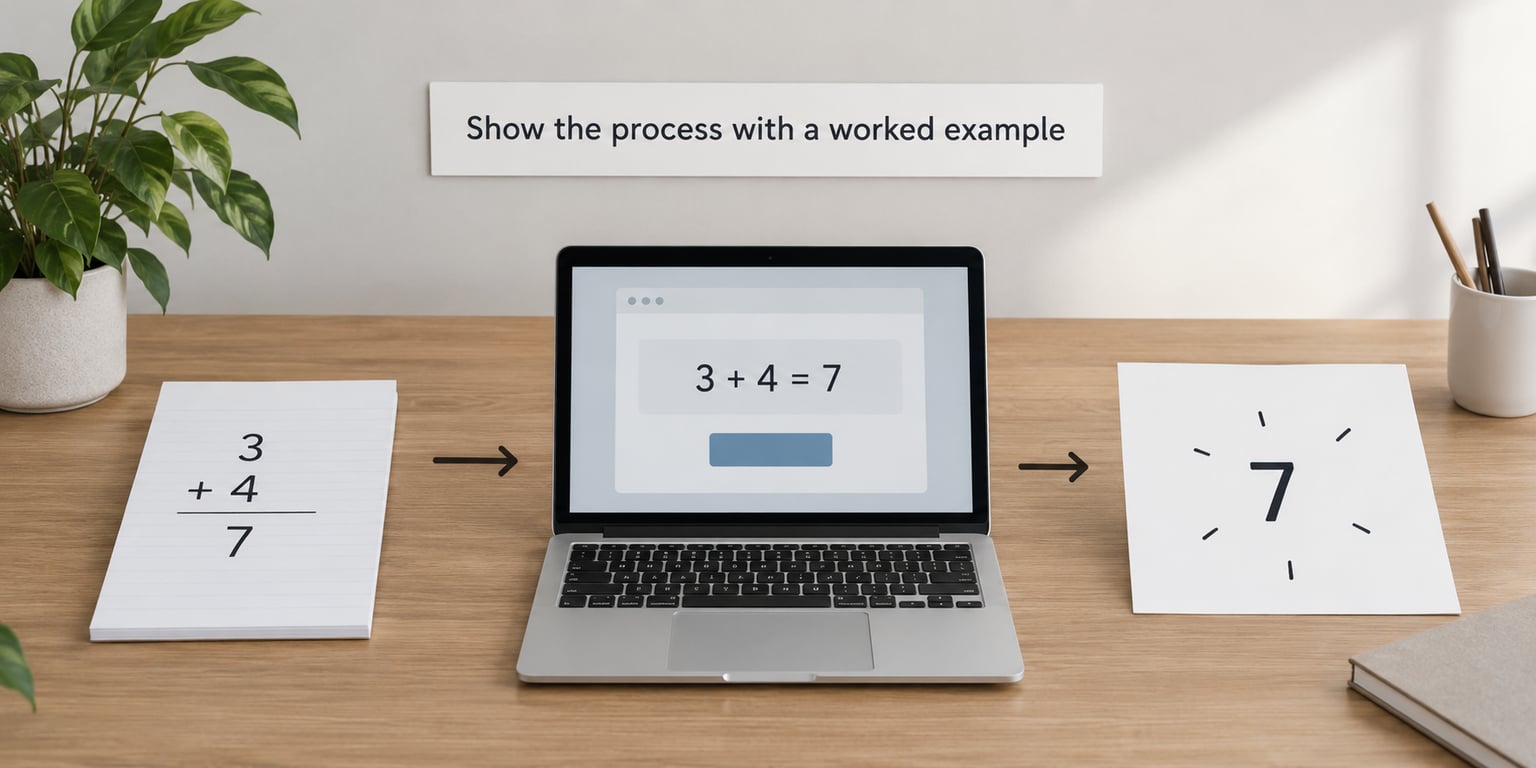
One realistic scenario, carried all the way through, does more work than three paragraphs of description. Say the piece explains how a news app decides which stories appear on your phone: your reading habits go in, they get compared with what similar readers opened, and a ranked list comes out. Walk those three stages with a concrete case, then note the limits, because the app also weighs recency and editorial choices, and one person’s feed is not a prediction.
Preserve the exceptions when you do this. The reader who assumes the process is exact is worse off than the one who was told where it is rough, and honesty here costs a sentence.
Add context, evidence, and limitations
Explain what changes across use cases, cite evidence for the claims that carry weight, acknowledge uncertainty, and say plainly when the described process does not apply. If it only works one way in one setting, that belongs in the piece, not in a footnote.
Attribution is the mechanism. Name the source on first mention and say what they are, so “a senior engineer at the company, who asked not to be named, said the queue is rebuilt every hour” is better than “sources say”. Attribute numbers, documents and contested claims the same way you attribute quotes.
Edit for clarity, accuracy, and usefulness

The final pass is a checklist, not a rewrite. Read the draft against the structure: does the opening answer the reader question, does every section do one job, is each term defined before use, is every significant claim sourced.
Then edit for the ear. Read it aloud and mark anything you stumble over. Long sentences are the usual culprit, along with stacked modifiers and phrases that hide their subject. Working out how to write a how it works piece for a general audience comes down here more than anywhere else, because plain language is an ear test, not a dictionary.
Finish with the editorial outcome. Tell the reader what they now understand that they did not before, in one sentence.
Common Mistakes
Five failures account for most weak pieces, and each has a straightforward fix.
- Opening with background. The first two paragraphs describe how important the topic is. Fix: lead with the reader’s situation, then let the background appear where it becomes necessary.
- Using unexplained jargon. Terms appear because the writer knows them. Fix: write the term, then a five-word gloss, then move on.
- Describing features without purpose. The piece lists what a system has rather than what it does. Fix: for every feature, write the problem it solves. If you cannot, it does not belong.
- Omitting an example. Nine accurate paragraphs of mechanism and no concrete case. Fix: build one worked scenario and cut 15% of the abstraction to make room.
- Hiding the limitations. The process is presented as universal when it is conditional. Fix: a short section on when it does not apply, written before you are attached to the draft.
A few habits help. Read the first paragraph last, so it matches the piece you ended up writing. Keep one page of raw interview quotes beside you, because the direct answer is almost always sitting in them. Ask a colleague outside the field to read only the headings; if the outline alone is not clear, the body will not save it.
One more, borrowed from classroom teaching and worth stealing: the mom-and-uncle test. Give the draft to someone smart who knows nothing about the subject. Where they ask a question, that is a gap in your structure. Where they shrug, that is a paragraph that earns nothing.
Frequently Asked Questions
How long should a how-it-works piece be for a general audience?
Most useful pieces land between 900 and 1,400 words. The range matters far less than the discipline of cutting: every stage you mapped should be present, and every extra stage should go. If you are over 1,500 words, ask whether the piece is really two pieces. Under 700 words, check that you have not skipped a stage the reader needs to follow the rest.
How do I explain a technical topic without using too much jargon?
Gloss each term once, in five words or fewer, at the moment it first appears, then use it consistently. Where you can replace the term with a familiar verb or concrete noun, do that instead. Read the draft aloud and cut anything you stumble over, because your ear catches what your eyes have stopped noticing.
Should a how-it-works article use first person or third person?
Third person is the safer default for newsroom work because it keeps the writer separate from the process being described. First person works well in first-person explainers, internal documentation and instructional content, where the writer is genuinely the guide. Whichever you pick, avoid switching mid-piece, which reads as uncertainty about whose voice this is.
How many steps should a how-it-works process include?
Three to seven. Fewer than three usually means you are describing a single mechanism rather than a process, so the piece belongs under a different heading. More than seven means the reader has to hold too much at once, so group the later stages or split the piece. Each step should get its own labelled section with a plain-language name.
What examples work best when explaining how something works?
One realistic scenario carried through every stage, with real names, dates and quantities in place of placeholders. Everyday analogues help readers feel the shape of a process, but they break down when pushed past two or three sentences, so bring the analogy back to the actual subject quickly.
How do I keep a how-it-works piece accurate but still readable?
Accuracy and readability fight mostly over vocabulary, not over complexity. Keep the causal chain intact and never round a number into vagueness. Then simplify the words, not the mechanism, and separate fact from interpretation by attributing every conclusion to whoever drew it. A named source on first mention costs one clause.
Conclusion
Pick your subject, find the one question a general reader arrives with, and map the stages between question and answer before you write a word of prose. Then work through the sequence in plain language, define each term at first use, and give the reader one concrete case to follow.
Start today by writing a single sentence that says what the subject does and why it matters, in words a stranger would use. If that sentence is hard, the rest of the piece will be harder.