
Preserve the letter and everything around it, reply once in writing with a short neutral acknowledgment, keep the argument off social media, and have a lawyer in your own jurisdiction review it before you take any position. Treat the first 72 hours as triage, not decision-making.
This guide is general information for publishers, not legal advice, and it assumes a US outlet. Rules differ by state and by country: UK defamation law, for instance, runs on a different structure than US state law, and Australian “concerns notices” are their own instrument. Where the answer depends on where you publish and who sent the letter, that is exactly the question to put to a lawyer.
I have watched small newsrooms handle this badly in one specific way: they react fast and decide late. Someone deletes the story at 11pm, someone else posts a defensive thread, and by morning the only thing anyone has on record is an emotional reaction with no facts attached. Speed on preservation is fine. Speed on admission is not.
Table of Contents
- What You Need
- How to Respond to a Legal Threat as a Small Publisher
- Common Mistakes
- Frequently Asked Questions
- Do cease and desist letters require a response?
- How enforceable is a cease and desist letter?
- Is a cease and desist a scare tactic?
- What is the strongest defense against a defamation claim?
- How much does a lawyer cost to review a legal threat?
- What if the threat comes from a government body or police agency?
- Start With a Calm, Documented First Step
What You Need
Before you write a single sentence back, gather five things. None of them take more than an afternoon, and each one changes how the rest of the process goes.
- The original message, exactly as received. The email with full headers, the physical letter or its scan, every attachment, the envelope if it came by post. Not a forward, not a screenshot of the text alone.
- The published material and its history. The live URL, the headline, the byline, the publication timestamp, the publish date, and any archived versions your CMS keeps.
- The underlying records. Reporting notes, source documents, interview recordings and transcripts, the approval trail showing who signed off, and anything the subject has previously said publicly on the record.
- One named responder. A single person who owns the correspondence and speaks for the publication. Everyone else, including well-meaning freelancers, routes messages to that person.
- Contact details for qualified counsel. Media or defamation counsel in your state, plus the phone numbers for free press-freedom hotlines in case budget is the obstacle.
Pull your media liability (errors and omissions) policy at the same time. If your outlet carries E&O coverage, the notification requirements are usually strict, and a late notification can matter more than the claim itself. Coverage usually pays defense costs first, and those costs routinely exceed the policy limit, which is the single most common financial surprise for a small outlet.
Create a single folder for the matter and put everything in it, including internal messages about the threat. Decide now who will read the folder, and who will not. Staff who have not been assigned a role do not need the details of a live threat, both to avoid accidental disclosure and because the tension of knowing damages people who are already worried.
How to Respond to a Legal Threat as a Small Publisher
Work through these six steps in order. The sequence matters more than the speed: each step gives you what the next one needs.
1. Preserve the threat and everything around it
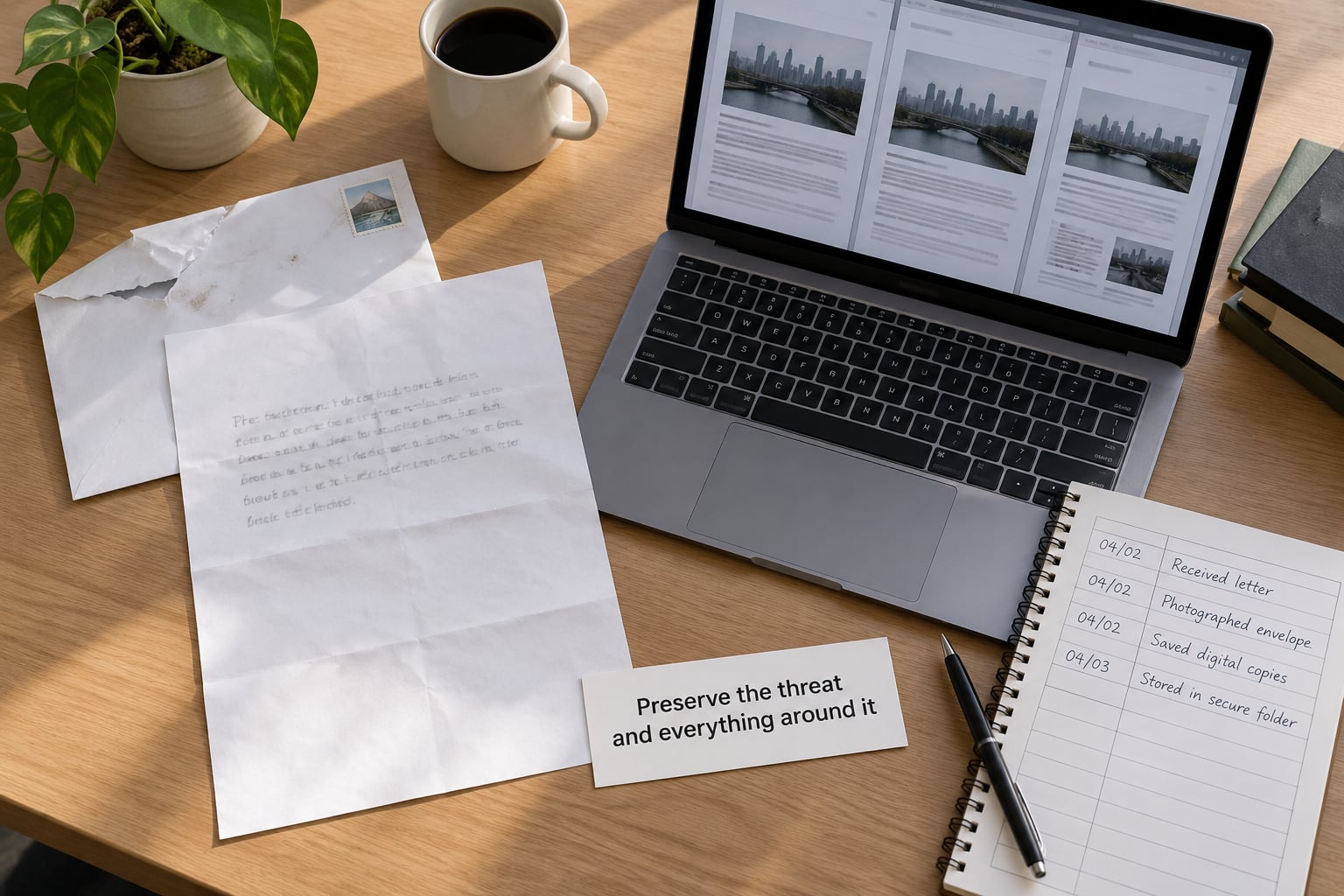
Save the original message with its headers intact and take dated screenshots of anything currently online, including the subject’s own social posts about your reporting. Export your CMS version history for the story, because that shows when it was published and what changed, and when. Nothing should be edited, moved, renamed or deleted, including drafts and internal notes, because a later question about your process will be answered by whatever the system logged at the time.
If the threat names sources, or if there is any chance of a subpoena, send a short litigation-hold notice to yourself and to anyone holding relevant records. That notice tells staff and vendors to stop deleting things like routine email cleanup. It takes ten minutes and it stops your own housekeeping from becoming the weakest point of your defense.
2. Acknowledge receipt without agreeing to the claim
A short, neutral acknowledgment usually buys you time and costs you nothing. It confirms receipt, asks for the specifics you need to evaluate the claim, reserves your rights, and makes no substantive statement. Keep it under a page and keep it free of adjectives.
A workable skeleton:
Dear [name],
We received your letter dated [date] regarding [publication] and the article titled [headline], published [date]. We are reviewing the material you identify and will respond more fully once we have done so.
To that end, please provide the specific statements you allege are defamatory, the individuals or entities you say are identifiable, and the legal basis for each. If your client has not yet been fully identified, please identify them.
This letter is an acknowledgment of receipt only. It is not an admission of liability, an agreement to remove or alter any material, or a waiver of any right or defense, all of which are expressly reserved.
Nothing in your letter has been treated as establishing the accuracy or inaccuracy of any statement, and we do not adopt your characterizations of it.
Sincerely,
[named responder]
Four words to strike from any draft: “sorry,” “we apologize,” “we regret,” “we were wrong.” Add “we are reviewing” if the article is under active editorial review; do not add “we have reviewed and stand by” until a lawyer has read the file and specifically clears that language.
One forum-reported pattern is worth knowing because it explains a lot of what follows: writers who sent something close enough to a formal letter directly to a parent company saw the material removed quickly, which suggests the letter’s existence, not its legal theory, often does the work. Treat the acknowledgment as a controlled instrument, not as something to sharpen at midnight.
3. Identify who sent it and what remedy is requested
Different demands need different responses, and most mistakes come from answering a trademark demand with a defamation argument. Sort the letter into one of these buckets before anything else.
| Threat type | What it usually is | First move |
|---|---|---|
| Defamation or libel | A demand to retract, correct, apologize or pay, before a suit | Preserve, acknowledge, get defamation counsel; check the actual-malice standard for public figures |
| Copyright or DMCA | A takedown request over text, images or footage you used | Verify the licence and the fair-use or public-domain position before removing anything |
| Trademark or right of publicity | A demand to stop using a name, logo or likeness in editorial coverage | Confirm nominative or newsroom use; editorial uses get stronger protection than commercial ones |
| Privacy or right of erasure | A demand to delete material about a private person | Check whether the subject is a public figure and whether the story is a matter of public concern |
| Intimidation with no legal claim | Repeated messages, coordinated pressure, threats to advertisers or staff | Preserve everything, do not engage, report, and treat personal safety as a separate question |
| Government or agency demand | A records request, subpoena or written order rather than a private dispute | Different rules entirely: involve counsel immediately and check reporter’s privilege where it exists |
For a defamation claim, four elements have to line up: a defamatory statement, publication to a third party, fault, and damages. A public figure must prove actual malice, meaning knowledge of falsity or reckless disregard for the truth, the standard set by New York Times Co. v. Sullivan. Knowing which element is weakest is often more useful than arguing about the whole story, and it is the question a lawyer will ask you first.
Also read the letter for what it does not contain. A generic template, a mass-mail domain, no named client, no quoted sentence and no deadline tend to signal low effort or a bulk campaign. That does not mean ignore it, it means move quickly on preservation and get your review scheduled the same day.
4. Check the deadline, the place, and the immediate risk
Write every date in the letter into one list: the response deadline, any “suit may be filed by” date, and any date attached to a court filing or agency order. A court order is a different animal from a letter, because the violation of an order carries its own consequences and you cannot simply ignore it while you wait for advice.
Then note the jurisdiction the letter points to, and your own state of publication, since those are often different and sometimes both matter. If a deadline lands before you can realistically get counsel, send the acknowledgment anyway; a short reply that asks for the specifics is far safer than a missed date with no record that you noticed.
Watch the second-order damage too, because for many small outlets it decides the outcome before the court does. Advertisers and subscribers sometimes react to the fact that a threat was received rather than to anything legal. Decide now who tells major advertisers, and keep that message short and factual, because silence lets someone else write the story for you.
5. Get an independent legal review
Talk to a lawyer who knows media law in your state, or to a general litigator with press experience. Ideally it is someone with no connection to the subject of the story, since independence is part of the value.
Send the file in one pass rather than drip-feeding: the letter, the article, the reporting notes, your E&O policy and notification terms, the archive links, and a one-page timeline. Then ask a short list of questions. What is the strongest early dismissal argument? Does an anti-SLAPP statute apply in this state, and what is its filing deadline? What is our realistic exposure including defense costs? Should we respond at all before the deadline, or only acknowledge?
If money is the barrier, say so plainly and ask for the free route. The Reporters Committee for Freedom of the Press runs a legal hotline for journalists and publishers, the Committee to Protect Journalists assists with urgent threats, the International Women’s Media Foundation and the Freedom of the Press Foundation support newsrooms facing legal pressure, and Reporters Shield provides free defense for investigative outlets hit by abusive suits. State press associations usually maintain referral lists, and a law school’s clinic can handle intake. A nonprofit newsroom can also ask its fiscal sponsor or national funder who already carries legal support for grantees.
Anti-SLAPP statutes are worth asking about because they change the economics. Where a state’s statute applies, a defendant who wins an early dismissal can often recover attorney’s fees from the plaintiff, which converts a nuisance suit into a real deterrent. The statutes differ sharply by state and some states have none, so check the current list on the Media Legal Defence Initiative’s site at medialaw.org rather than trusting a summary you read years ago.
6. Choose a measured response and write down why
Your options, roughly in order of how much they cost you in exposure:
- No response beyond the acknowledgment. Appropriate when the letter is boilerplate and you have no appetite for litigation. Send the acknowledgment, then stop.
- A clarification or correction. Adding context or a note, without conceding falsity, often removes the accusation of harm. Cheap, fast, and reversible.
- An edit or takedown. Last resort for legal exposure, or for material you already know is shaky. Unpublishing without a note can read as an admission.
- A negotiated resolution. Right of reply, a jointly agreed statement, or a removal with a published note. Usually the outcome that costs a small outlet least.
- A formal written response setting out your position. Work with counsel; do not draft it alone.
- Filing first. An anti-SLAPP motion, or a declaratory judgment action asking a court to rule that your coverage is not defamatory. Powerful, expensive, and rarely where a two-person newsroom should start.
Record the decision in writing regardless of which you choose: what you decided, why, who decided, what advice you relied on, and the date you will revisit it. This takes ten minutes and it is what stops a frightened newsroom from relitigating the same decision every week for a year.
There is a genuine argument that some threats are useful. A letter from a careful litigant forces their claims into the open, where you can publish your own account of the dispute and put the sender’s assertions on the record. That is a reason to answer clearly once you have advice, not a reason to fire off an angry reply.
Common Mistakes
These are the errors I see repeated, roughly in order of how much damage they do.
- Deleting the article first. It destroys the version, date and approval trail, and it reads as an admission. Correct response: preserve everything, including the page as it currently stands.
- Arguing in the comments or on social media. Every reply is a statement on the record, made by whoever is tired and angry at midnight. Correct response: a two-sentence holding line that says the matter is under legal review, then silence.
- Accidentally admitting liability. “We apologize for any confusion” is an admission of fault dressed as courtesy. Correct response: reserve rights in the acknowledgment and say nothing substantive until reviewed.
- Answering the wrong claim. Arguing truth over a trademark demand wastes the only deadline that mattered. Correct response: classify the threat first, using the table above.
- Ignoring the deadline. Silence can be read as consent, or it can simply give the sender the timetable they wanted. Correct response: acknowledge by the date even if you have no position yet.
- Counter-threatening. A reply threatening back usually escalates and can cost you fees. Correct response: reserve rights, mention your willingness to resolve without litigation, send nothing adversarial.
- Letting several people reply. Two staff answering the same letter produce two accounts of your position. Correct response: one named responder, everyone else forwards.
- Failing to notify the insurer. Late notice can void coverage that would otherwise have paid the defense. Correct response: read the policy’s notification clause the day the letter arrives.
- Letting the letter define you publicly. Subscribers and advertisers hear about the threat from someone else, framed as damaging news. Correct response: a brief factual statement to your biggest commercial relationships.
One thing under-discussed is the cost to the people doing the work. A two-person newsroom handling a live threat eats hours it does not have, and that strain is what pushes people into bad decisions. Say out loud who is carrying the matter and for how long, and rotate if it can continue past a week.
Frequently Asked Questions
Do cease and desist letters require a response?
Usually not legally, but a written acknowledgment within the stated deadline is the safest default. It confirms receipt, asks the sender to identify the specific statements at issue and the client they act for, and reserves your rights without admitting anything. Missing a deadline can be used against you later, and silence leaves you with no record that you took the matter seriously. Have a lawyer in your jurisdiction review any response before it goes out.
How enforceable is a cease and desist letter?
On its own, essentially not. It is a private letter, not a court order, and a judge will not enforce it. What matters is what it signals: that a suit may be filed, and in some claims what it signals starts a clock you care about. A demand can also mark the start of the period for a limitations defense, which is why you should not wait months. If what you received came from a court or an agency rather than a lawyer, that is a different instrument entirely and needs counsel today.
Is a cease and desist a scare tactic?
Sometimes, and the two cases look different once you read it. Bulk templates, a mass-mail domain, no quoted sentence, no named client and no deadline usually indicate low effort. A letter that quotes the exact words, attaches records, names a legal theory and sets a specific date has usually been through a lawyer and needs a real answer. Either way, effort level changes your urgency, not your duty to preserve the records and respond calmly. Give the same letter to counsel and let them judge it.
What is the strongest defense against a defamation claim?
For most publishers, an early dismissal, and the reason to want one is cost rather than victory. A strong answer challenges a required element: that the statement was not defamatory, that it was not published to a third party, that the subject is not defamed, or that there is no harm. If the subject is a public figure, they must show actual malice, knowledge of falsity or reckless disregard for the truth, the standard from New York Times Co. v. Sullivan. Where an anti-SLAPP statute applies, winning early can also recover the plaintiff’s attorney fees.
How much does a lawyer cost to review a legal threat?
Less than a suit, and most outlets never get to the suit. The figures that reach small publishers are the defense bills, where costs routinely exceed the limits of the policy that was supposed to cover them. Before paying anything privately, check whether you carry media liability insurance and read its notification clause, then call the free hotlines run by the Reporters Committee for Freedom of the Press and the Committee to Protect Journalists. Nonprofit outlets can also ask their funder or fiscal sponsor, who often already have a panel in place.
What if the threat comes from a government body or police agency?
Treat it as a different category and move faster. A records demand or subpoena is not a dispute between two private parties, and it may carry statutory deadlines, penalties for non-response and rules about journalists that do not apply in private litigation. Where a reporter’s privilege or shield law exists in your state it may protect your material, but the scope varies widely and some states have none. Do not produce documents, and do not respond substantively, until a lawyer has reviewed the request.
Start With a Calm, Documented First Step
You can do five things today, and none of them commit you to a position. Save the letter with its headers and take dated screenshots of the live article. List every deadline in it. Name one person to own the correspondence and tell everyone else to forward to them. Check your media liability policy and its notification clause. Then send the short acknowledgment above, or call the RCFP hotline if you are not sure whether to send anything yet.
Take the substantive decision only after someone qualified has read the file. In a two-person newsroom, that step is what separates a difficult month from a case that consumes the newsroom. If you have the budget, put pre-publication review for accountability stories on your calendar now, because the cheapest response to a legal threat is the standards you had before the letter arrived.