
Fact-checking AI generated text means verifying every factual claim against a source you found yourself, not against the model’s tone and not against an AI detector score. Break the output into single checkable claims, confirm the cited source really exists, read it, and see whether it says what the claim says.
That sounds slow until you notice what you are actually guarding against. These models generate text that reads well rather than text that has been verified, so a fabricated study, a wrong population or a misattributed quote arrives in the same clean formatting as a true one. Plausible-sounding specificity, not broken grammar, is the failure mode that gets past an editor in a hurry.
The other half of the job is separate, and mixing the two is where most arguments get stuck. Whether a passage was written by AI is a question about authorship. Whether its claims are true is a question about evidence. You can publish a human-written lie and an AI-written truth, and a detector score settles neither question.
This workflow is built for newsrooms, but the same five stages work for a student essay, a marketing audit or an internal memo. I have updated it for 2026, and the tools and detector accuracy data change faster than the method does, so the stages matter more than any product name.
Table of Contents
- What You Need
- How to Fact Check AI Generated Text Step by Step
- Common Mistakes
- Frequently Asked Questions
- Can an AI detector tell whether text was written by AI?
- Is there a 100% accurate AI detector?
- What is the fastest way to fact check an AI-generated statistic?
- How do I verify a quotation attributed to a real person?
- Should I remove an AI-generated claim if I cannot confirm it?
- Should a newsroom disclose that it used AI during fact checking?
- Conclusion
What You Need

Before you check anything, get four things in place. Skipping this setup is why verification feels like guesswork: you end up checking whatever you happen to remember noticing.
- The text itself, plus its prompt. Keep the prompt and any links the tool gave you. A claim with a stated source is far easier to check than an unsourced assertion, and the prompt often tells you what kind of output you should expect.
- A one-line-per-claim log. A spreadsheet with columns for the claim, the source you checked, the date you checked it, the verdict and the person who checked it. This is the audit trail that lets an editor review your work in minutes instead of redoing it.
- Route to the original source. For academic work, Google Scholar, Crossref and PubMed. For legal and regulatory claims, the official statute text, agency filing or court docket. For local claims, the council minutes, the budget document, the press release itself.
- Named tools for non-text claims. Reverse image search and TinEye for images, metadata inspection and C2PA checks for provenance, and a quotation search in quotes for anything attributed to a person.
You also need judgment about audience and consequence. A rounding error in a social post is a different problem from a wrong number in a health or safety explainer, and the verification depth should follow the harm, not the length of the document.
How to Fact Check AI Generated Text Step by Step
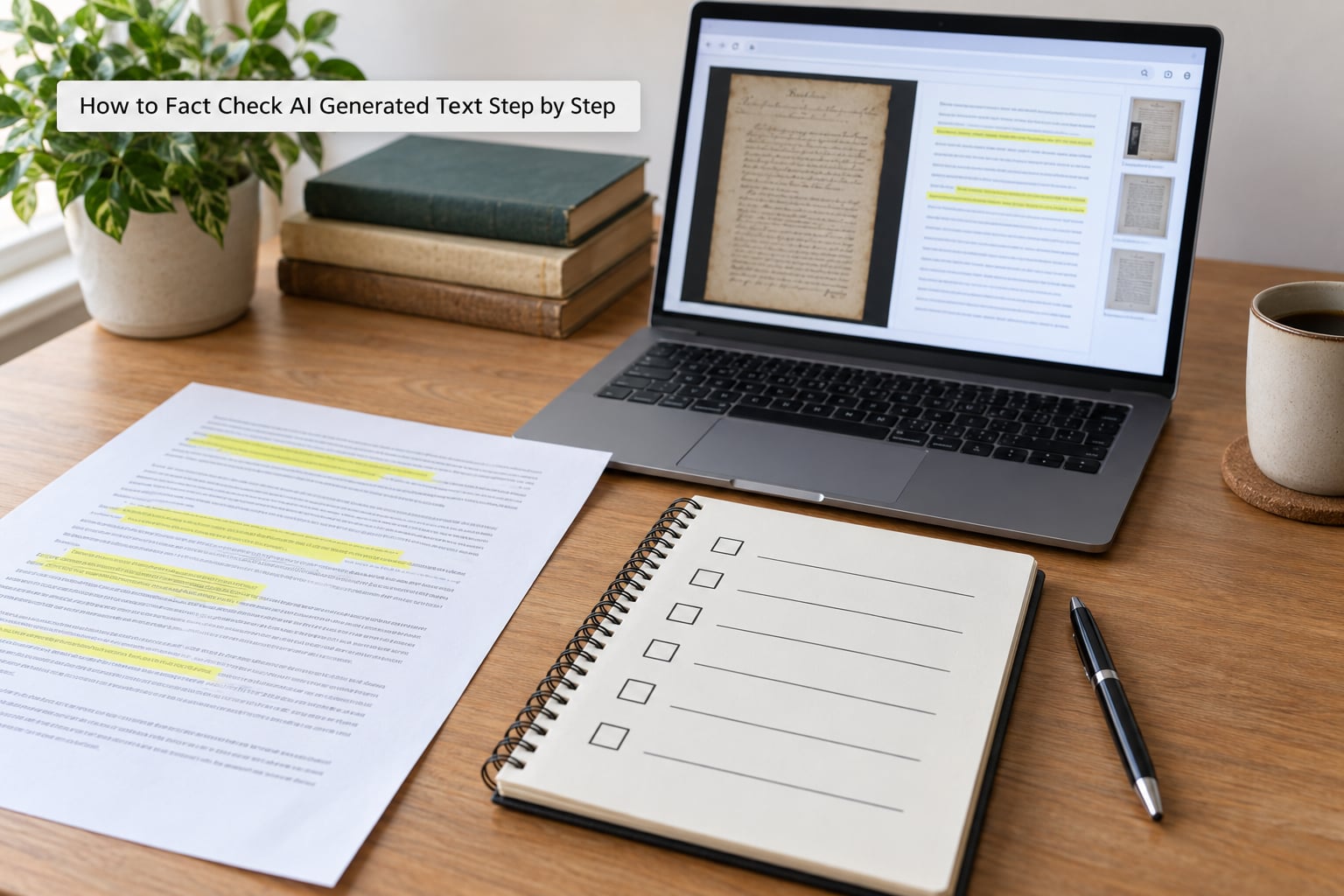
Each stage has a success check. If a stage fails, you stop there rather than pushing the claim downstream to a verdict it has not earned.
Identify the Claims That Need Checking
Start by breaking the passage into claims that can be individually tested. Researchers call this fractionation, and it is the single highest-value step, because a paragraph that reads as one unit hides three or four separate assertions with different evidence needs.
Sort what you find into four buckets: checkable facts, opinions and framing, predictions, and claims about a source that itself needs checking. Only the first bucket is verifiable in the strict sense. The second is a judgment call you can make yourself, and pretending a prediction is a fact is a category error.
Then rank by risk rather than by order. A number that would change someone’s decision, a quotation attributed to a named person, a legal or medical claim, and a claim about a specific population or jurisdiction all go to the front. Trivia about a well-documented historical fact can wait.
Success check: you have a numbered list of single-sentence claims, each with a risk ranking, and no sentence contains two facts.
Trace the Claims to Reliable Sources
Now find out whether the source exists at all, outside the model. This is lateral reading, and the instruction is simple: leave the tab. Instead of reading the AI output more carefully, open new tabs and go find the thing itself, because the question is not who is behind this information but who can confirm it.
For an academic citation, paste the title into Google Scholar and search by DOI in Crossref. If the DOI does not resolve, the reference is fabricated and the check takes seconds. For a statistic, find the original dataset or press release rather than a news article repeating it. For a quotation, search the sentence in quotes and check the interview, transcript or filing it came from.
Two source habits are worth naming. Search snippets and AI summaries are not sources, because both compress and sometimes distort. And a real URL only proves the page exists, not that it says what the claim says; that is the next stage.
Success check: every claim you intend to keep has a primary source URL, a document title and a date in your log.
Check the Evidence Against the Claim
This is the stage most guides skip, and it is where a real citation ends up supporting something false. Walters and Wilder’s 2023 study in Scientific Reports examined the references ChatGPT produced and found fabricated entries alongside real papers that had no connection to the claim attached to them. A reference that resolves is the beginning of verification, not the end of it.
Four mismatches account for most of the damage I have seen in drafts:
- Real number, changed meaning. The figure is accurate but the metric, period, unit or baseline has shifted. A study’s absolute count becomes a percentage somewhere in the rewrite, or a per-capita figure becomes a total.
- Wrong population or jurisdiction. The claim holds for one group, state, age bracket or product version, and the rewrite generalises it to everyone. AI models love smoothing away qualifiers because qualifiers read as clutter.
- Correlation stated as causation. Two things moved together in the source; the draft says one caused the other. Watch for “because of,” “drives” and “leads to” where the original said “associated with.”
- Hedging language stripped. Words like “may,” “in some cases,” “preliminary” and “the authors suggest” disappear in summarising, which turns a cautious finding into a settled one.
Read the source with the claim in front of you and match the exact wording and scope. If the source says “among adults over 65 in the trial cohort” and your sentence says “among adults,” the sentence is wrong even though the study is excellent.
Success check: you can quote the sentence in the source that supports the claim, and the qualifiers match.
Test for Misleading or Fabricated Details
Some fabrications leave no trace to find, so use independent methods rather than more careful reading. A search you wrote yourself, without the model’s phrasing in it, is a genuine test; re-asking the model is not. If a detail is invented, there is usually nothing coherent to find, and a query built from the underlying fact, not the sentence, will come up empty.
Recompute anything arithmetic. Percentages, per-capita figures and year-over-year changes are cheap to check in a spreadsheet and surprisingly often wrong by a decimal place or a base. For quotations, search the phrase in quotes and confirm the person, the occasion and the exact wording.
For images, run a reverse image search or TinEye, look at the earliest appearance rather than the repost, and inspect metadata for inconsistent capture details. C2PA provenance data is useful when present, but its absence tells you nothing, so fall back on where the file first appeared. For audio and video, listen for cadence breaks and background noise that does not match the scene, and check the reporter’s own interview or scene footage before trusting a clip.
Success check: every specific detail in the passage is either traced to a source or removed from the passage.
Document and Report the Verification Result
Write the result down while you still have the tabs open. Each claim gets one of five states: verified, partly verified, unsupported, contradicted, or unresolved because the source could not be obtained. Unresolved is a legitimate outcome and should be recorded as one, not quietly dropped.
Those states map to four publication verdicts:
- KEEP when the claim is verified, wording matches the source.
- QUALIFY when the underlying fact is right but the scope or certainty needs restoring. Add the population, the date, the limitation or the “may.”
- REPLACE when the claim is wrong but a verifiable version exists, such as the correct number or the correct jurisdiction.
- DELETE when nothing supports it and nothing replaces it. This is the honest outcome for a fabricated citation.
Unresolved claims do not get published as fact. Either find the evidence, rewrite the claim as what is actually known, or cut it.
Success check: an editor can read your log and reach the same verdict without repeating the work.
Common Mistakes
Treating a detector score as evidence. A detector estimates authorship probability; it does not check a single fact. Users in writing and marketing forums report the same recurring pattern: detectors flag human-written work, and text about technical or expert topics scores as high-probability AI, which adds noise rather than signal. The practical community rule is worth adopting as a decision rule rather than a shrug: run two detectors, and if they conflict, treat the result as no evidence either way. If two tools agree, you still have a weak signal, not a finding.
Asking the same model to certify its own citation. This comes up constantly and it verifies nothing. The system is being asked to grade its own homework with the same failure mode still in place, and a confident confirmation is exactly the output you are trying to avoid.
Using a weak source hierarchy. A blog post citing another blog post citing a press release is three removes from the record. Go up until you hit the study, the filing, the transcript or the dataset.
Stripping context. Reading for the fact and ignoring the limitations is the most common editorial error in AI-assisted drafts. Keep the caveats that change the meaning, and put them in the sentence rather than in a footnote nobody reads.
Checking trivia first. Verification competes with deadline, so it gets spent on whatever is easiest. Rank by harm instead, and time-box the routine: roughly ten minutes for a low-risk draft, longer when the subject is medical, legal, financial or safety related. Newsrooms reporting on AI-generated misinformation in the field should escalate to the image, audio and video checks described above, since a text audit will not catch a doctored clip.
Frequently Asked Questions
Can an AI detector tell whether text was written by AI?
No detector is reliable enough to prove authorship, and most are not reliable enough to accuse anyone. They estimate the probability that a passage was generated, they disagree with each other, and they flag human writing often enough to cause real harm in classrooms and workplaces. Treat any score as triage for a human decision, never as a verdict, and never as evidence about the facts in the text.
Is there a 100% accurate AI detector?
No. Accuracy varies by model generation, language, domain and how human the text was edited afterwards, and published research on detector performance has been mixed for years. The realistic use is a prompt to read more carefully, not a measurement. If a decision depends on whether a submission was AI-generated, that is an academic integrity process with human review built in, not a number from a website.
What is the fastest way to fact check an AI-generated statistic?
Find the original source rather than the retelling, then read the line that contains the figure. Match the number against the unit, the period, the population and the baseline in your sentence, because that is where statistics get corrupted. If a percentage appears, recompute it from the raw counts in a spreadsheet. Ten minutes using the primary source beats an hour of reading summaries.
How do I verify a quotation attributed to a real person?
Search the phrase in quotes first, which catches recycled or invented quotes quickly. Then confirm the person, the date and the setting against the original interview, transcript, filing or recording. If the quote appears only in other AI output and nowhere in a transcript, treat it as fabricated. Partial matches, where the words are real but the order or emphasis is not, are common and need the full passage to confirm.
Should I remove an AI-generated claim if I cannot confirm it?
Yes, unless you can rewrite it as what is actually known and source that instead. Unverifiable means unsupported, and publishing it makes you responsible for a claim you have not checked. The exception is a claim you can attribute honestly as a claim, such as reporting that a company said something you have on the record. Everything else either gets evidence attached or comes out before publication.
Should a newsroom disclose that it used AI during fact checking?
Disclose AI assistance whenever a reader could reasonably assume a human performed that work, and always under your own publication policy for AI in reporting. Disclosure does not replace verification. A model can help you build a list of claims to check or find the original filing, but the checking, the sourcing and the decision to publish stay with a named person, and the record of what was checked should be kept.
Conclusion
Start with the first action only: write the passage’s claims out as separate, numbered lines and rank them by how much harm a wrong one would do. Everything after that gets faster, because you stop reading the whole document and start working a short list.
Verification depends on evidence you found outside the model and on your judgment about what the evidence actually supports. No detector score settles either question, and a link that resolves proves a page exists, not that it backs the sentence next to it.
Before you publish, four checks: every claim has a primary source and a date in the log, the wording matches the source’s scope, every claim has a KEEP, QUALIFY, REPLACE or DELETE verdict, and a named person is accountable for the record. Confidence is not evidence, and a real citation can still support a false claim.