
To write an AI policy for a newsroom, appoint one named owner, inventory the AI tools staff already use, sort every use case into permitted, restricted or prohibited, then write short rules that say who signs off and when AI involvement must be disclosed. A working policy fits on two pages and gets reviewed every quarter. The hard part is not the drafting. It is getting journalists to trust that the document describes their actual working day.
That trust problem is measurable. In a HEC Montréal study of more than 400 journalists, reported by Digital Content Next, 36% did not know whether their organisation had an AI policy at all. Meanwhile the Reuters Institute found 75% of media organisations already use AI somewhere in news gathering, production or distribution. Use is arriving faster than policy. The gap is the whole job.
The rest of this guide is the drafting method itself: what to gather first, the decisions your document has to make, the rules that belong in each section, and the rollout that stops the policy from becoming an intranet PDF nobody opens.
Table of Contents
- What You Need
- How to Write an AI Policy for a Newsroom
- Common Mistakes
- Frequently Asked Questions
- Who should approve an AI policy for a newsroom?
- Can journalists use generative AI for research and writing?
- When should a newsroom disclose AI-generated content?
- How should a newsroom protect confidential data when using AI tools?
- How often should a newsroom AI policy be reviewed?
- What should a newsroom do after an AI-related publishing error?
- Conclusion
What You Need

Before a single clause gets written, five things need to be on the table. Skipping them is how policies end up arguing with the newsroom instead of guiding it.
A named owner. One person, with a job title, who answers questions about AI and can approve exceptions. Not a committee. Committees meet quarterly; reporters need an answer on Thursday. Digital Content Next describes the resource-constrained version of this as a simple governance model built around a clear approval process with editor sign-off for all AI use. That works at any size.
The existing rulebook. Pull together what you already have: the ethics code, source-protection and confidentiality rules, corrections policy, disclosure of funding and conflicts, records retention schedule, and any vendor or data-processing agreements. A newsroom AI policy that contradicts the confidentiality section of your style guide will lose every argument in a hallway.
An honest tool inventory. Ask staff, without blame, what they already use: transcription, translation, headline drafts, archive search, image generation, meeting summaries, code for graphics, research assistants. Ollie Williams, editor at Cabin Radio in Yellowknife, describes AI experimentation happening off the side of his desk in a newsroom of four people. That is the normal condition of the industry right now. Write the policy around it rather than pretending it is not happening.
Real examples, including bad ones. Collect three stories where AI helped and two where it went wrong, with the decision log to hand. Concrete cases settle arguments about rules in a way that abstract principles never do.
Named benchmarks. The Associated Press says material produced by AI should be vetted as carefully as material from any other source. The Financial Times records all newsroom experimentation, including third-party providers, in an internal register. The BBC and CBC/Radio-Canada publish guidelines staff can read. Borrowing from these is faster than starting from a blank page, and readers trust an outlet that is candid about where its rules came from.
How to Write an AI Policy for a Newsroom
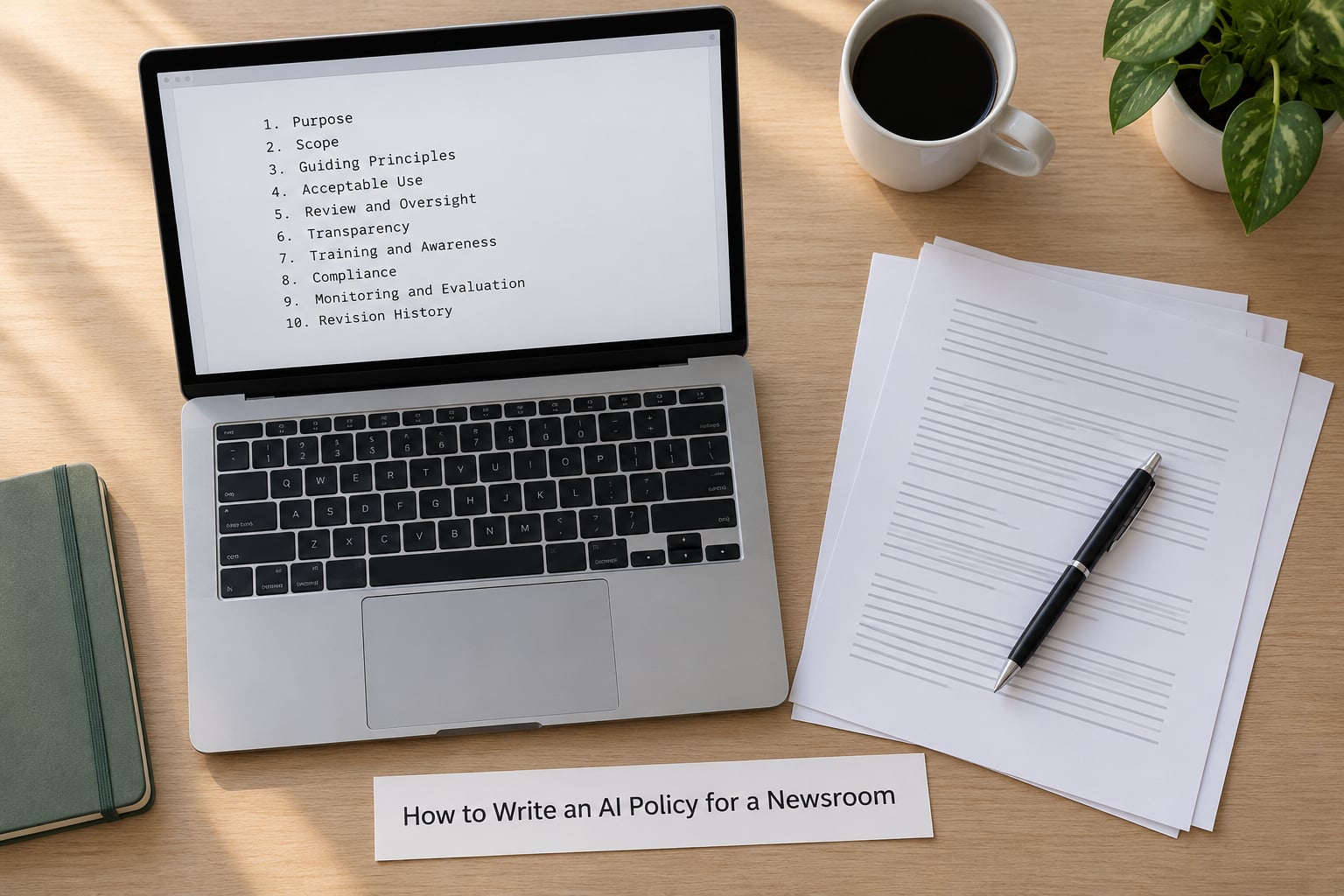
The method below runs in six moves. Each one closes a decision your staff will otherwise make alone, badly, at 6pm on deadline.
Set the policy’s scope and decision-makers
Start by naming exactly what the document governs: which systems, which people, which stages of the workflow, which outputs. Generative text assistants are only the start. Include transcription and translation, summarisation, research and source discovery, archive retrieval, headline and social copy, SEO metadata, data analysis and graphics, recommendation and personalisation, image and video generation, and any autonomous tool that can take multi-step action on its own.
That last category needs its own clause. An AI agent is software that plans and executes several steps rather than answering one prompt, so it can act without a person deciding each move. Different rules apply, and the distinction is moving fast in 2026. Define it in one sentence at the top of the policy so nobody argues about the definition mid-incident.
Then name the people. One policy owner. One named backup. Whoever approves exceptions, which may be the same person. Whoever staff escalate a source-protection worry to, which should be a human being reachable during shift hours, not an address in an HR inbox.
Write clear principles for responsible use
Principles earn their place only if they change behaviour. Pair each one with a sentence describing what a reporter actually does differently.
- Human accountability. A named person is responsible for every published item, including anything an assistant drafted or an agent assembled.
- Verification before publication. Every factual claim an assistant produced is checked against a primary source, the same as any claim from an anonymous tip.
- Transparency. When AI involvement would change how a reader should judge the work, say so.
- Fairness and source diversity. Assistants do not replace reporting, and a machine’s summary of a community does not stand in for that community’s own voices.
- Privacy and confidentiality. Source identity, unpublished material, embargoed content and personal data stay out of third-party tools.
- Copyright and licensing. Inputs and outputs are checked against terms of service and third-party rights.
- Accessibility. Alt text, captions and transcripts are still produced by a person who is accountable for them.
- No deceptive synthetic media. AI-generated or AI-altered images of real events are never published without a prominent label.
Nicole MacIntyre, editor-in-chief at the Toronto Star, puts the durable skill plainly: curiosity, critical thinking, strong judgment and commitment to truth. Write that into the policy as the standard any tool must serve, not as an alternative to it.
Separate permitted, restricted and prohibited uses
Staff do not want a philosophical debate at 5pm. They want to look up their task and see the answer. A three-level framework gives them that.
| Use case | Level | Rule |
|---|---|---|
| Brainstorming angles, formatting notes, summarising documents the reporter already has rights to | Permitted | No approval needed, no disclosure needed |
| Transcription, translation, proofreading, headline and dek drafts, archive search, social copy, first-pass data exploration | Restricted | Editor sign-off, logged in the register |
| Research summaries that shape which sources get contacted, graphics code, images of real people or real events | Restricted | Editor sign-off plus a second reviewer |
| Any autonomous agent given credentials, publication rights or access to the CMS | Restricted | Security review plus written owner approval before deployment |
| Fabricating, paraphrasing or inventing quotes, sources or documents | Prohibited | Always, with no exceptions for deadline |
| Publishing synthetic images or audio of real people, places or events without a visible label | Prohibited | Absolute |
| Uploading source identities, embargoed material, personal data or unfiled documents to a public tool | Prohibited | Absolute, regardless of deadline |
| Writing AI output into a byline, quote or attribution as if a human produced it | Prohibited | Absolute |
Two design notes. First, write the prohibited list short and absolute; ambiguity there gets negotiated at the worst possible moment. Second, say plainly which approved tools are on the internal list, and what happens to anything not on it. An unlisted tool with a newsroom email pasted into it is the most common way confidential material leaks.
Set rules for disclosure, verification and source protection
Disclosure gets muddled with accuracy, and separating the two is one of the most useful things a policy can do. Accuracy is always required. Disclosure is conditional: it is required when AI involvement would help a reader evaluate how the work was produced.
The JulyTimes policy puts it as material AI assistance should be disclosed when it would help readers evaluate how the work was produced. That is a workable trigger. Turn it into a rule staff can apply without calling anyone, and add a short internal register so editors can see what happened on pieces that never get a reader-facing note.
A sample sentence for internal reporting: This story used an AI tool to transcribe two interviews; a human reviewed the transcript against the audio before publication. For reader-facing disclosure: Portions of this article were drafted with AI assistance and reviewed by a named editor.
Source protection gets its own subsection, and it should be the strictest part of the document. Confidential sources, embargoed material, unpublished drafts, internal personnel files and anything covered by a non-disclosure agreement stay out of third-party systems. Where an approved tool can hold sensitive material, say under what terms and for how long, and name the retention window. If your policy cannot answer “where does the data go”, it is not finished.
A pre-publication checklist that fits on a sticky note: every AI-assisted passage checked against a primary source; every generated image labelled; every translated passage read back by a fluent speaker; every quote confirmed in the original recording or transcript; assistant suggestions logged; disclosure line added where the trigger applies.
Create an approval, training and review process
A policy nobody can operate is a press release. Three mechanisms make yours real.
A lightweight approval form. Six fields is enough: tool, purpose, data involved, risk level, reviewer, outcome. Keep it in the same system staff already use, and set a response deadline, such as one working day. Approval that arrives after the story runs is not approval.
Training on verification, not prompting. Ninety minutes on how assistants fail: confident fabrications, invented citations, source lists that resolve to nothing, translation that flattens meaning, and bias entering the chain of reasoning rather than only the output. Prompt craft matters less than knowing when to distrust the tool. Some teams pair this with an onboarding analogy that lands well: adopting a new assistant feels closer to onboarding a junior editor, newsroom rules included, with the standing instruction not to fabricate facts.
A fixed review cadence. Quarterly for the operational questions, and a full rewrite whenever a model release materially changes capability, a material incident occurs, or the approved tool list changes. Date every version and keep the archive. A living document that never gets a new date is not living.
You also need the enforcement and remediation half, which is where most policies stop. State what happens on a first breach (retrain, log, editor follows up), a repeat breach (formal written warning), and a serious breach such as fabricating a quote or exposing a source (immediate removal of the material, suspension of tool access, and referral to the existing conduct process). Then decide what to do about the use already happening. A 30-day amnesty: staff disclose current AI use, the newsroom logs it, nothing is punished, and the inventory feeds the next version of the policy. That amnesty expires, and everyone knows it.
Match the depth to the newsroom
A four-person newsroom does not need a committee and a policy manual. It needs a page that a freelancer can read in five minutes.
| Newsroom size | Governance | Document |
|---|---|---|
| National broadcaster or wire service | Named AI policy owner, legal and standards review, security review of tools, internal register, scheduled audits, union or staff-representative input | Living document of several pages with numbered clauses, an approved tool list and a decision log |
| Regional or mid-size outlet | Editor-in-chief as owner, one standards editor as backup, quarterly review, vendor terms checked | Two to four pages, permitted and prohibited tables, one-page quick reference for desks |
| Small independent or freelance collective | Editor sign-off on every restricted use, mandatory editor sign-off as the default rather than the exception | One page: permitted list, prohibited list, sign-off rule, disclosure sentence, named contact |
Whichever row you are in, publish it where staff actually work, link it from the style guide, and mention it in onboarding. The 36% unaware figure is a communication failure as much as a drafting one.
Common Mistakes
Writing principles with no verbs. “We value accuracy and transparency” cannot be followed. Replace it with: every fact an assistant produced is verified against a primary source before publication, and material AI involvement is disclosed in a note.
Banning every tool. Blanket bans fail quietly because staff keep using the tools and nobody logs it. Ban specific dangerous uses, license specific tools, and leave a route to approval for everything else.
Confusing disclosure with accuracy. Teams treat a disclosure note as a substitute for checking the work. It is not one. Verification is unconditional; disclosure is conditional on whether a reader would want to know.
Ignoring vendors and data retention. The policy says protect sources, but nothing says where data goes once it is inside a third-party system. Name the approved tools, check their terms and data-processing terms, and state a retention window.
Handing the policy to a committee. Diffuse ownership reads as nobody’s job. One named owner with a named backup, given a real share of their time, outperforms a group email chain every time.
Writing it once. Tools change faster than most review cycles. Version it, date it, set the next review before you publish, and schedule the rewrite for the next material model release.
Ignoring the uses already underway. Grandfathering without a log leaves you with an inventory you never asked for. Run the amnesty window, capture the list, then write the rules against reality.
Forgetting the readers. Some of the best material on disclosure never reaches a newsroom desk because it lives in a product document. Put your threshold in the policy, and tell the audience about it once, plainly. Trust is the asset the whole document protects.
Frequently Asked Questions
Who should approve an AI policy for a newsroom?
The editor-in-chief should approve the final document, supported by standards or legal review and security review of any approved tool. Day-to-day ownership goes to one named person with a named backup, so reporters get an answer the same day rather than the next committee cycle. For smaller outlets the editor-in-chief can hold all three roles.
Can journalists use generative AI for research and writing?
Most newsrooms permit it, with limits. Brainstorming, formatting and summarising documents staff already hold are usually allowed without approval. Translation, transcription, headline drafts, research summaries and graphics code need editor sign-off and a log entry. Fabricating quotes, sources or documents, and undisclosed synthetic images of real events, are banned outright.
When should a newsroom disclose AI-generated content?
Disclose whenever AI involvement would help a reader judge how the work was produced, such as an AI-generated image of a real event or an AI-assisted draft published without substantial human writing. Routine spelling checks and formatting do not require a note, and a translation pass does not count as AI assistance on its own.
How should a newsroom protect confidential data when using AI tools?
Keep confidential sources, embargoed material, unpublished drafts and personal data out of tools that are not on the internal approved list. For approved tools, state the terms, the retention window and who can access the data. Require vendor data-processing terms to be checked before approval, and treat a source-protection failure as a serious breach under the enforcement clause.
How often should a newsroom AI policy be reviewed?
Review operational details quarterly, and rewrite the full document whenever a model release materially changes capability, a material incident happens, or the approved tool list changes. Date every version and keep the archived copies so you can show how a decision was made at the time. A policy with no next review date has already gone stale.
What should a newsroom do after an AI-related publishing error?
Correct the record promptly and visibly, then log the incident with what tool was used, which check was missed and which clause was breached. Share the case with staff so the same mistake is not repeated, and feed it into the next policy revision. For a serious breach, follow your existing conduct process, including removing the material and suspending tool access.
Conclusion
Five actions, in order: appoint one owner with a named backup, run an honest inventory of the tools staff already use, sort every use case into permitted, restricted or prohibited, draft the permitted-use and disclosure rules, and book a review session with editors, legal or standards staff, security, and someone who represents your audience. Test the draft on one real newsroom project before you adopt it formally.
Every newsroom is already living with this. The difference between the ones that manage it and the ones that improvise is a document people believe applies to them.