To verify audio recordings, you layer cheap checks first and expensive ones last: preserve the original file and hash it, read its metadata, inspect the waveform and spectrogram for cuts, confirm the source through an independent channel, and only then draw a conclusion. No single tool gives you a verdict.
Most audio disputes are not solved by clever software. They are solved by discipline: keeping the original untouched, writing down where it came from, and refusing to publish until an outside source confirms the story the recording tells.
This guide is written for journalists, editors, researchers and anyone who has to act on a clip they did not record themselves. The basic version takes fifteen minutes with free tools. Anything that could end up in court, an HR process or a headline gets the full treatment, including a professional examiner.
Table of Contents
- What You Need
- Step-by-Step
- Step 1: Preserve and Identify the Original Recording
- Step 2: Inspect the File and Audio Properties
- Step 3: Analyze the Waveform and Listen for Editing Clues
- Step 4: Check Provenance and Compare With Independent Sources
- Step 5: Use Specialized Forensics When Stakes Are High
- Step 6: Document the Findings and Set the Confidence Level
- Common Mistakes
- Frequently Asked Questions
- Is metadata proof that an audio recording is authentic?
- How can I tell if an audio file has been edited or spliced?
- Can AI voice clone detectors prove a recording is fake?
- How do you confirm the speaker is who they claim to be?
- How do you authenticate an audio recording in court?
- How much audio does a detector need to give a useful result?
- Conclusion
What You Need
Before you inspect anything, gather four things: the original file, a set of inspection tools, a written record of the recording’s history, and at least one independent source to compare it against. Without the fourth item you are describing a file, not verifying a claim.
- The original file. Not a link to a post, not a re-saved copy from your downloads folder. Get the file from the person or device that captured it, and never edit it.
- A working copy. All analysis happens on the copy. The original gets opened only to copy it, never to save over it.
- Free inspection tools. FFmpeg’s
ffprobeand ExifTool for metadata, Audacity or ocenaudio for waveforms, and Sonic Visualiser or Spectroid for spectrograms. All run on a normal laptop. - A hash tool.
sha256sumon Linux and macOS,Get-FileHashin PowerShell. This is what makes the copy provably identical to the original. - The provenance record. Who made the recording, on what device, where, when, who else had access to the file, and every transfer since.
- Reference material. Longer recordings from the same source and device, a transcript, surrounding video, call logs, or a witness who was present.
One distinction matters more than any other here, and newsrooms keep getting it wrong. Audio quality is not audio authenticity. A low-quality phone recording can be completely untouched, and a crisp studio clip can be assembled from a dozen pieces. Forum threads mix these two up constantly, and the confusion leads people to trust a clean-sounding file simply because it sounds clean.
Separately, there is a question most guides blur: authenticity asks whether the audio is genuine and unaltered. Identity asks whether the voice belongs to the person it is claimed to be. A scammer playing a genuine recording of someone else fails the second test. A synthetic voice reading a real script fails the first. You need to know which question you are answering before you start.
| Tool | Cost | What it establishes |
|---|---|---|
| ExifTool | Free, open source | Embedded tags, device make and model, encoder software, dates |
| ffprobe | Free, open source | Container, codec, sample rate, bitrate, channel layout, duration |
| Audacity / ocenaudio | Free | Waveform shape, level jumps, silence gaps, obvious cuts |
| Sonic Visualiser / Spectroid | Free | Spectral content, cut edges, encoder fingerprints |
| sha256sum / Get-FileHash | Free, built in | File integrity — that a copy matches the original byte for byte |
| Commercial AI-audio detectors | Paid or freemium | A synthetic-speech probability score, useful as one input among many |
Step-by-Step
Step 1: Preserve and Identify the Original Recording
Preserve the original before you do anything else, because every format conversion and every save rewrites parts of the file you may need later. Ask for the source device or the original upload, copy the file, and stop touching the source.
Then hash both files. The hash is a fixed-length fingerprint: if the copy and the original produce the same value, the copy is byte-for-byte identical to what you received. This is the technique forum users reach for first when someone asks whether a copy was altered in transit, and it is the foundation of any chain of custody you may need to show later.
sha256sum recording.wav
shasum -a 256 recording.wav
Get-FileHash -Algorithm SHA256 recording.wav
Write the hash value into your log before you start analysis. Re-run it at the end. If it has changed, you overwrote something, and your results are no longer defensible.
How you know it worked: you have the file, you have a hash, and you have a written note of who gave it to you and when.
Step 2: Inspect the File and Audio Properties
Inspect the file properties to see what the file says about itself, while treating every field as a claim rather than proof. Metadata answers the question “what recorder made this?” surprisingly often, and it also tells you whether the file has been through a messaging app at least once.
exiftool -a -G1 -s recording.mp3
ffprobe -hide_banner recording.mp3
Read the fields in this order, because each one has a different evidential weight:
- Device make and model. Many phones and recorders write this. It answers the question forum users keep asking: what hardware produced this file.
- Software and encoder tag. A file tagged with a desktop editor name, or with an encoder associated with a platform rather than a device, suggests it passed through software after capture.
- Duration and sample rate. A phone-voicemail clip at 8 kHz mono has a different explanation than a 48 kHz stereo file, and both are normal for what they are.
- Creation and modification dates. Dates that precede the claimed recording, or that sit hours apart from when the source says the audio happened, are worth chasing.
- Missing fields. A file with no device information at all has usually been through a messenger, a social platform or a re-encode. That absence weakens every other field.
Metadata gets stripped by ordinary software, sometimes silently and sometimes on purpose. A file with no tags is not proof of fabrication, and a file with convincing tags is not proof of authenticity. It is a starting point that tells you which other checks to prioritise.
How you know it worked: you can say, with specifics, what the file claims about its origin, and you know which claims are unsupported.
Step 3: Analyze the Waveform and Listen for Editing Clues
Analyze the waveform and listen closely to catch edits that metadata will never record. Load the working copy into a waveform editor, zoom out to see the whole file, then zoom in around anything that catches your eye.
Listen for editing clues, then confirm each one visually. A genuine continuous recording has a noise floor that stays roughly steady, so when the hiss drops by 10 dB in the middle of a take, something was pasted in from a cleaner source. Abrupt level changes between two otherwise identical takes, a suspiciously clean join between sentences, background ambience that changes character mid-clip, and a repeated phrase with identical room tone both point the same way. Also listen for missing breaths and mouth noise, which modern synthesis tends to leave out, and for speech with no accompanying movement of air or chair creak.
Use the zoomed waveform as a map. A cut usually shows as a near-vertical edge, an unnaturally short gap, or a block boundary that does not line up with the speaker’s rhythm. Silence that begins and ends abruptly in the middle of a sentence is worth investigating even when the join sounds clean.
How you know it worked: you have either a list of specific observations with timestamps, or a clean listening pass with nothing flagged. Both are useful. The second is a finding, not a failure.
Step 4: Check Provenance and Compare With Independent Sources
Check provenance by matching the recording against the stated source, and treat the file as unproven until an outside record agrees with it. Ask who captured it, on what device, at what location, and who handled it afterwards.
Then compare the recording with independent material:
- Other recordings from the same source and device. Room acoustics, handling noise and microphone placement should match. A different room tells you the clip came from somewhere else.
- A transcript. Speech-to-text output that contradicts your reading of the audio usually means either noise or manipulation. Check which.
- Surrounding footage. Video of the same event lines up audio with visible events, which dates and places a clip independently of the file’s own claims.
- Call logs, messages, platform logs. These establish that a call or upload happened, and when.
- Other people present. A witness who confirms the speaker and the occasion is worth more than any detector score.
Confirm the speaker through a known channel when identity is the real question. Call the person back on a number you already had, or ask a question only they would know the answer to. On platforms used for scams, ask a known channel rather than continuing a conversation in the channel that raised the concern.
How you know it worked: at least one source outside the file itself corroborates the claim the recording makes.
Step 5: Use Specialized Forensics When Stakes Are High
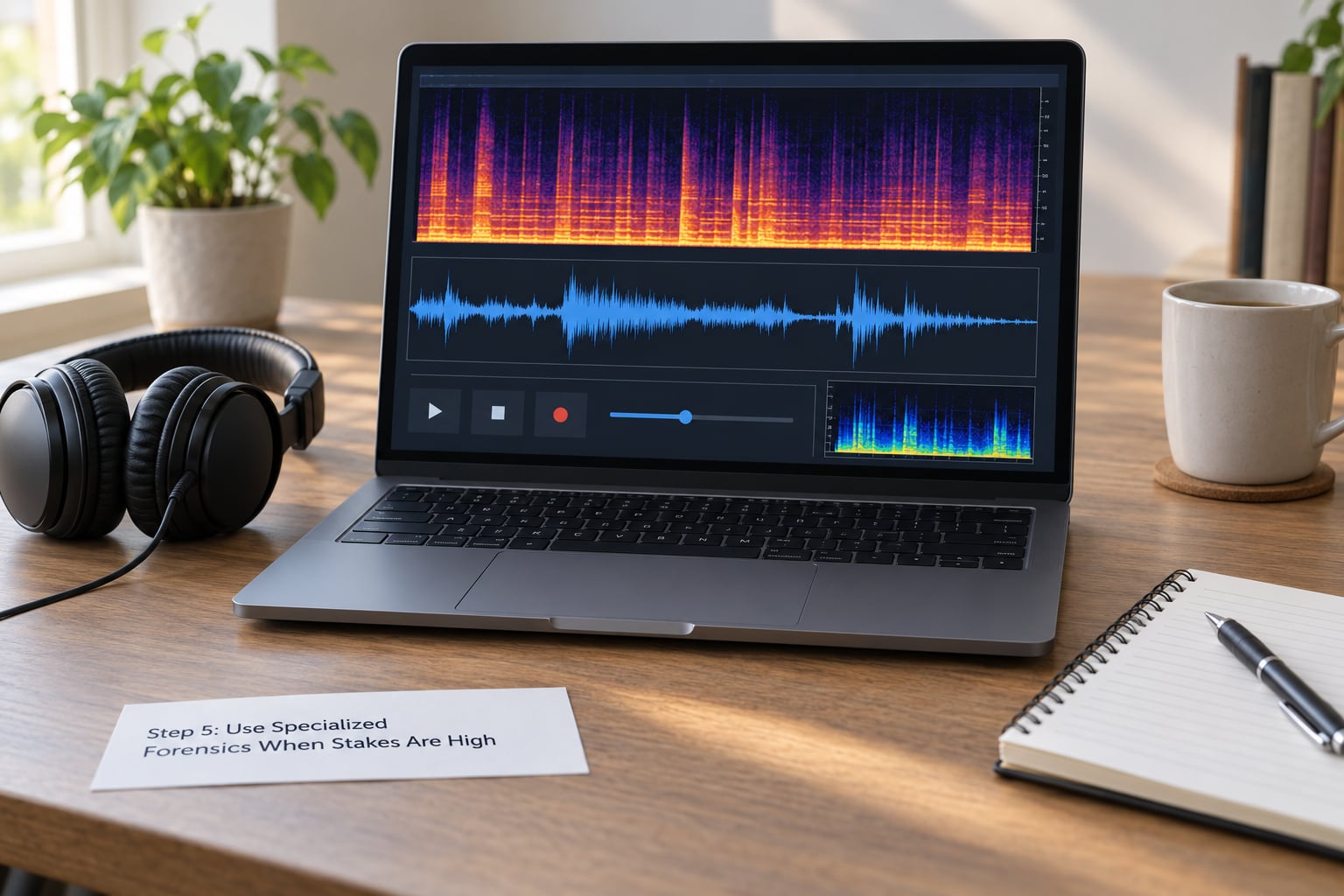
Use audio forensic analysis when the outcome matters enough that a wrong call has real consequences, such as a criminal case, a disciplinary hearing, an insurance claim or a safety-critical report. At that point you want spectral analysis and a documented opinion from a qualified examiner, not a weekend of waveform hunting.
The techniques a professional applies include spectral analysis of background sounds for consistency across the whole file, phase relationship analysis between channels where two microphones captured the same moment, checks for embedded metadata and watermarks such as those generated by some speech tools, and comparison against an exemplar sample of the claimed speaker’s genuine voice recorded on comparable equipment.
Run commercial AI-voice detectors as one input, never as the answer. They can score segments of a file as more or less likely to be synthetic, which is genuinely useful for triage, and they carry real limits: their accuracy falls with compression, short clips, heavy background noise and unfamiliar accents. Vendor percentages are meaningless without a disclosed test set, threshold, codec and language mix.
Also separate enhancement from authentication. Cleaning up noise, levelling volume or removing background hum changes a recording to make it easier to hear, and it makes the file unusable as evidence in most proceedings. Do it on a copy, and never publish an enhanced version as though it were the original.
How you know it worked: you have a written opinion with stated methods, limits and confidence, ideally from someone who can be cross-examined on it.
Step 6: Document the Findings and Set the Confidence Level
Document your findings as a dated record of methods, observations and limits, because an undocumented check is worth almost nothing later. Log the file name, hash, source, tools used with versions, what you observed with timestamps, what you could not check, and who corroborated.
Then state one of four classifications, and make sure your wording matches it:
| Signal | What it can support | What it cannot prove |
|---|---|---|
| File hash | A copy is identical to the file you received | That the file was unaltered before it reached you |
| Device metadata | The claimed hardware and software touched the file | Authenticity — tags are easy to strip or write |
| Timeline fields | A rough sequence of creation and modification | The real time an event was recorded |
| Waveform discontinuities | A cut, join or level change exists somewhere | Whether the removed part changed the meaning |
| Spectrogram analysis | Inconsistencies in background or encoder signature | Intent, or who made the edit |
| AI detector score | A reason to pause, re-check or escalate | That the audio is synthetic, or that a person lied |
| Exemplar voice comparison | Similarity or difference against known speech | Identity on its own, without expert interpretation |
| Independent corroboration | The claim holds with outside evidence | Certainty — it is the strongest signal available |
Use plain classifications: verified, consistent with available evidence, inconclusive, or likely altered. Stating “inconclusive” is a real result. Experienced reviewers treat it as the honest answer rather than a failure to find something.
How you know it worked: someone else could repeat your process and reach the same conclusion.
Common Mistakes
The common mistakes in audio verification are almost all about trusting one signal too much or skipping the boring work. Each has a straightforward correction.
Trusting metadata blindly
Tags are writable and get stripped by every messenger app. Use them to generate questions, never to close them. The correction is simple: metadata narrows the search, provenance confirms it.
Judging authenticity by audio quality
A clean recording is not an untouched one, and this is the most common confusion in forums and comment threads. Judge authenticity from file history and corroboration, and treat quality as a separate property you may report on.
Editing the only copy
Enhancing or trimming the original destroys the evidence and, in many proceedings, its admissibility. Work on copies, keep the original hashed and untouched, and label any enhanced version clearly as enhanced.
Using an uncalibrated detector
A score from a commercial AI-audio tool means nothing on its own, especially on a short, compressed or noisy clip. Run it as one layer among several, ask for the threshold and test set behind the percentage, and never make a public accusation on one result.
Skipping chain of custody
If you cannot say who held the file and when, you cannot say it is unaltered. Log every transfer with a date and a name, and hash at each hand-off.
Publishing before independent corroboration
The detector says clean, you publish, and the claim collapses an hour later. Hold the item until a source outside the file confirms the speaker, the place and the time. A hold costs hours; a retraction costs trust you may not get back.
Confusing authenticity with identity
A genuine voice can belong to someone else, and a synthetic voice can be a legitimate accessibility tool. Decide which question you are answering and report the answer to that question only.
Two operating rules cover most of the rest. Pause and verify, never block and accuse — the standard practice among experienced reviewers. And when a check cannot be completed, say so in the piece rather than leaving it implied, because readers can handle a qualified answer far better than a confident error.
Frequently Asked Questions
Is metadata proof that an audio recording is authentic?
No. Embedded metadata shows what device and software touched a file, but any editor or messaging app can write or strip those tags. Treat a device model or encoder name as a lead worth following, not a conclusion. Metadata strengthens a case when provenance independently confirms it, and it disappears almost entirely once a file passes through a chat or social platform.
How can I tell if an audio file has been edited or spliced?
Open the file in a waveform editor and zoom in. Look for near-vertical edges, unnaturally short gaps, abrupt level changes, a noise floor that shifts mid-file, background ambience that changes character, or a repeated phrase with identical room tone. Then confirm each one in a spectrogram and by listening closely. Findings become meaningful only when the visual and the audio evidence agree.
Can AI voice clone detectors prove a recording is fake?
No. Detectors return a probability score that shifts with clip length, codec, background noise and accent, and vendor accuracy figures are difficult to interpret without a disclosed test set and threshold. A score can justify pausing, re-checking or escalating to an examiner. It cannot establish intent, and it should never be the sole basis for accusing a person or rejecting evidence.
How do you confirm the speaker is who they claim to be?
Verify identity through a channel you already trusted before the recording arrived, not the one that delivered it. Call a known number, ask a question only the real person would answer, or compare the clip with an earlier known recording of the same person on comparable equipment. Speaker comparison produces a similarity result that needs an expert to interpret, so escalate rather than deciding it yourself.
How do you authenticate an audio recording in court?
Courts generally require the person with knowledge to testify that the recording is what they claim it to be, supported by an unbroken record of handling, the original file, and often testimony from a forensic audio examiner. Rules on consent, hearsay and best evidence vary by jurisdiction, so this is a process description rather than legal advice. A qualified local attorney should handle any case where the recording matters.
How much audio does a detector need to give a useful result?
Longer, cleaner excerpts give more reliable segment-level scores than short clips, and heavily compressed or low-sample-rate material weakens confidence further. Provide at least thirty seconds of clean speech from the same speaker and conditions whenever you can, and keep the original quality rather than a re-encoded copy. If only a few seconds exist, say so alongside the score rather than reporting it unqualified.
Conclusion
If you do one thing before anything else, preserve the original file and hash it. From there, document where it came from, read its metadata and properties, inspect the waveform and spectrogram for edits, corroborate the claim through an independent source, and state plainly what your evidence cannot show.
Verification is a documented process rather than a tool verdict. The reporters who get this right are rarely the ones with the newest detector — they are the ones who kept the original, wrote down the chain, and were willing to publish a qualified answer instead of a confident guess.
Updated for October 2026. Detection tools change quickly and accuracy figures age badly, so treat any vendor percentage older than a year as a starting point rather than a fact.