
Covering misinformation without spreading it means reporting a false or misleading claim in a way that foregrounds the evidence against it instead of repeating the claim as the story’s hook. Verify first, decide whether the claim deserves coverage at all, then write so the true version is the part people remember. It takes discipline rather than extra time, and the difference shows up in how a debunk is shared.
The seven moves below are the whole playbook. They are in the order that keeps you from making things worse.
- Capture the claim exactly as it was made, before you react to it.
- Trace it back to whoever first asserted it and to the underlying evidence.
- Run the cover, monitor or ignore test on reach, harm and behaviour change.
- Label it accurately: false, misleading, unsupported or contextually misleading.
- Put the fact in the headline, the evidence above the fold, the claim below it.
- Give the people who repeat it a sentence they can use without endorsing it.
- Schedule the correction path before you publish, not after.
Table of Contents
- What You Need Before You Report a Viral or Misleading Claim
- Step-by-Step: How to Cover Misinformation Without Spreading It
- Start with the claim, not the outrage
- Verify the evidence first: how to cover misinformation without repeating it
- Check whether the claim is misleading in context
- Write headlines and social copy that report rather than repeat
- Include source context and the strongest contrary evidence
- Publish with a clear correction path
- Monitor reach and update the record
- Common Mistakes That Amplify the Claim You Meant to Debunk
- Frequently Asked Questions
- Should a news outlet report a false claim at all?
- How do you avoid spreading misinformation in your own reporting?
- How do you uncover misinformation before it is published?
- Why does misinformation spread so easily online?
- How should a journalist handle an anonymous source who may be spreading misinformation?
- What is the difference between misinformation and disinformation?
- Conclusion
What You Need Before You Report a Viral or Misleading Claim
You need four things lined up before you write a word: the claim itself preserved verbatim, the primary evidence behind it, the people who made it, and a place to log what you could and could not establish. Skip any one of those and the story drifts toward the version of events that is loudest rather than the one that is true.
The first thing to sort out is vocabulary, because newsrooms use these words loosely and the sloppiness shows up in print. Here is the working set most fact-checking desks use.
| Term | What it means | Reporting consequence |
|---|---|---|
| Misinformation | False or misleading information shared without intent to deceive | Most common; correct gently, lead with the facts |
| Disinformation | False information created and spread deliberately to cause harm | Investigate the actor and motive, not only the claim |
| Malinformation | Genuine information weaponised to harm someone, such as a private detail | Legal and ethical review before publication |
| Misleading framing | A true detail presented so the implication is false | Label the framing, do not repeat it as a fact |
| Deepfake | Synthetic video or audio of a real person saying or doing something they did not | Verify with a specialist before publication |
| Cheap fake | Real footage, wrong date, wrong place or wrong caption | Reverse image search usually settles it |
| Prebunking | Warning people about a manipulation technique before they meet it | Useful for voter or health misinformation |
| Tipping point | The threshold where a claim does enough harm to be worth covering | The basis of your triage decision |
The second thing you need is a decision rule, because the trap most reporters fall into is that silence reads as censorship and publication reads as endorsement. Neither is true, but you cannot prove that without a standard you wrote down beforehand. Claire Wardle’s tipping point idea is the most usable version: a claim is worth covering when it is spreading fast, when it could cause real harm, and when people are changing their behaviour because of it.
| Decision | Use it when | What you do |
|---|---|---|
| Cover | High reach plus credible harm, and people are changing behaviour | Full story with evidence, sourcing notes and a correction path |
| Monitor | Moderate reach, low immediate harm, or the source chain is unclear | Log it, check it weekly, publish only if it escalates |
| Ignore | Low reach, no plausible harm, or it only circulates inside a closed group | Say nothing publicly; staff still see the log entry |
Coverage buys a false claim things it would never have earned on its own: a link, a headline, a thumbnail that gets screenshotted, and a search result that lives for years. Treat that distribution as the scarce resource you are spending, and spend it where it buys something back.
Step-by-Step: How to Cover Misinformation Without Spreading It
Start with the claim, not the outrage
Capture the claim verbatim before you decide anything about it. Screenshot the post as it stands, keep the exact wording, the account that made it, the date and the time, and note whether it has already been edited or deleted. An hour later the wording will have changed and you will be arguing with a version nobody else can see.
Then separate two things that get merged too early: the specific allegation someone made, and the public reaction to it. The allegation may be checkable in an afternoon. The reaction is its own story about what people already believe, and it deserves its own reporting rather than being smuggled into the fact-check as colour.
Write down what you actually believe right now, with a confidence level. Most viral claims sit in one of four buckets on arrival: factually wrong, wrong about a detail, right but outdated, or right but framed to imply something false. Knowing which bucket at the start keeps a later correction from rewriting your original story.
Verify the evidence first: how to cover misinformation without repeating it
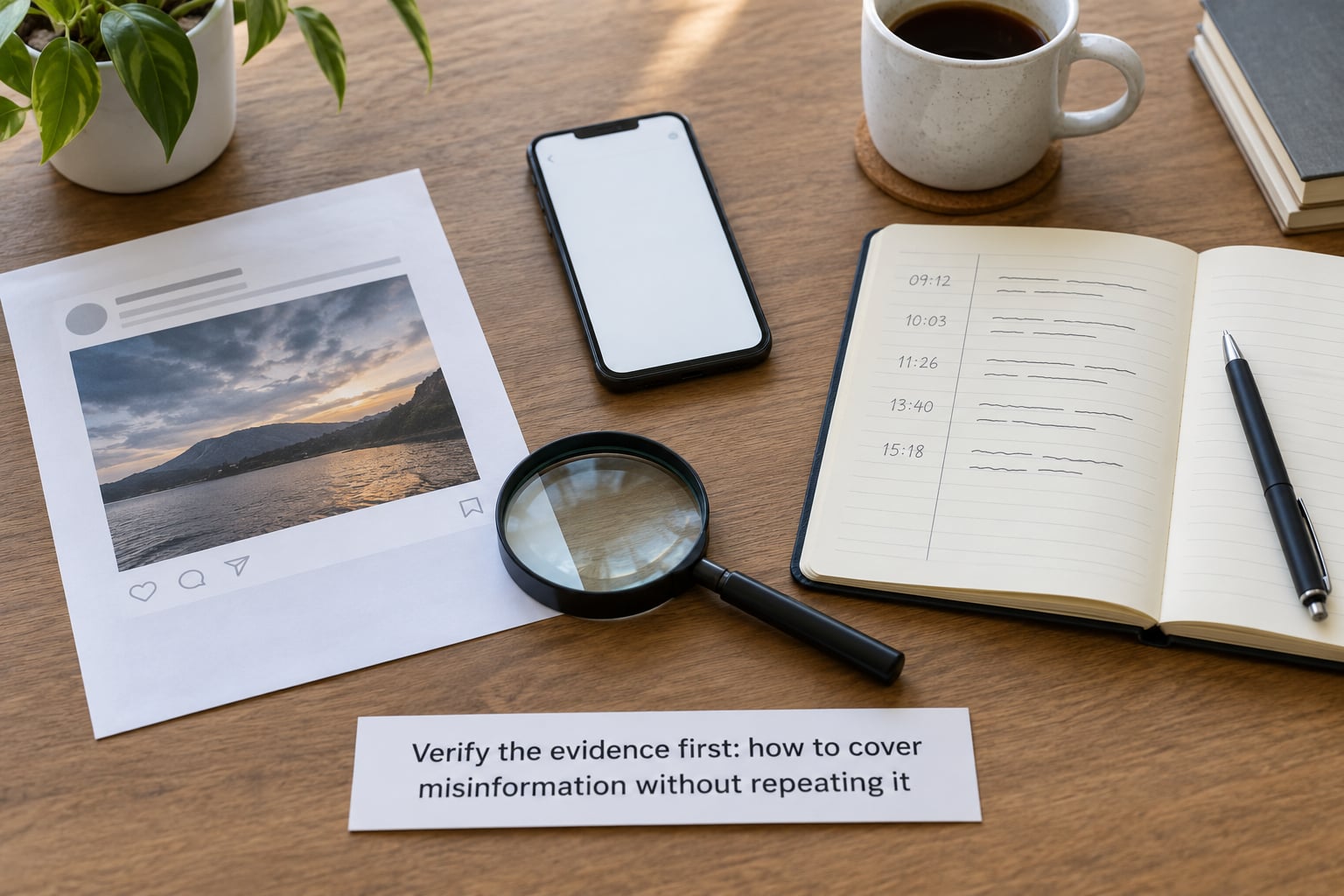
Verification means finding the original, not the loudest version of it. Search the claim’s exact phrase to find who said it first, then work outward through the accounts reposting it until you hit a primary source: the document, the dataset, the court filing, the named official, the original video. Most chains of “sources” end at a screenshot of a screenshot, and knowing that is often the whole story.
Inspect dates and context on whatever you find. A real quote from a real person said three years ago about a different subject is not a false statement, which means it needs a context note rather than a debunk. Check whether the number was accurate when it was written, whether the person had the authority to speak on the subject, and whether the footage shows what the caption claims rather than what the location suggests.
Get independent confirmation before you publish. Two sources who both trace back to the same press release are one source. Ask yourself what would have to be true for the claim to be false, then look for evidence that would satisfy that. When you cannot establish something, write down that you cannot establish it and say so in the story.
Record the state of the evidence in a shared log as you go: what you checked, what you found, when, and who confirmed it. That log becomes the story’s sourcing note, and it is the reason you can defend the piece six months later when the same claim resurfaces under a different name.
Check whether the claim is misleading in context
Most claims that survive a first check are not outright fabrications. They are technically true statements wrapped so the reader draws a false conclusion, which means the label in your headline does more work than the fact-check itself.
Work through five categories and pick the one that fits. False means the central factual assertion is untrue. Misleading means a real fact is presented so the implication is wrong. Unsupported means nobody has produced evidence either way, so the honest sentence is that no one can show it. Technically true means every checkable detail checks out. Contextually misleading means the claim is accurate for one group, place or period and is being applied far beyond that.
Once you have the category, say it in the language of the story rather than in the language of the rubric. “The claim conflates a proposal with a decision” beats “misleading context” every time, because it tells the reader what went wrong without making them translate.
The payoff is credibility. Audiences can tell the difference between an outlet that labels carefully and one that shouts at everything, and a precise label is usually what earns a newsroom the right to be believed on the next story.
Write headlines and social copy that report rather than repeat
The headline is the biggest amplification decision you make, and it is usually made last, in a hurry, by the person most invested in getting it clicked. Take it away from that person. If a reader who saw only your headline would come away believing the claim might be true, the headline is wrong even if the body is excellent.
Lead with the established fact. Attribute the claim to the person who made it in the same breath you mention it, and never write the claim’s most memorable wording in your own voice. Avoid the construction that implies the claim is legitimate, such as putting a politician’s denial or an unproven allegation in the subject position where it reads like a fact. Avoid false balance too: giving a documented falsehood equal airtime with the evidence that refutes it does not even-handedness, it just repeats the falsehood louder.
Social copy needs the same treatment. Do not quote the claim in the card or the thread opener. Show the finding instead. Do not use the false claim as a search-friendly keyword, because you are buying yourself a permanent funnel into people looking for evidence that it is true.
| Instead of | Write | Why |
|---|---|---|
| Experts say the vaccine causes infertility | No evidence supports the infertility claim, and regulators reviewed the data | The reader meets the finding first |
| Did officials really halt the programme? | Officials did not halt the programme; the email describes a review | Answers the question instead of teasing it |
| The leaked files prove X | The files describe an earlier draft, not the current version | Kills the conspiracy implication |
Include source context and the strongest contrary evidence
Ask who benefits if the claim stays in circulation. In most cases the answer is a person or an organisation with something to gain from the belief rather than from the fact, and naming that motive is standard reporting, not editorialising, as long as you show your evidence for it.
Then find the strongest case against your own conclusion. If a genuine expert disagrees with your reading, say who and why. The instinct to leave dissent out protects you from a bad comment and costs you the reader’s trust the first time they notice. Readers who spot a hidden objection assume the omission was deliberate.
Uncertainty belongs in the story too. Say plainly what remains unresolved and what would settle it. That single sentence does more to protect you later than any wording in the piece, because it tells readers which parts of the story you stand behind and which ones you are still reporting on.
Where a claim targets a specific community, talk to people in that community before you publish. Voter procedure misinformation works by leaving people who believe they cannot vote; health misinformation works by steering people away from care. Talking to the people actually affected tells you which consequence is real, and it usually reshapes the lede.
Publish with a clear correction path
Decide your correction mechanics before publication, not after someone complains. Know who can approve a correction, how long it takes, what gets appended to the story, and whether you flag it with a dated note at the top or a line at the end. Newsrooms that argue about this mid-crisis lose a day and often choose silence.
Put a working contact route on the piece. A plain email address for tips and challenges, monitored by a person, invites exactly the evidence you would otherwise miss. Public figures and institutions will complain; readers with documents will not. Both land in the same inbox and you need the second group.
Choose between three tools deliberately. A correction fixes something wrong. A clarification adds missing context that changes the meaning. A context note explains that earlier coverage turned out to be incomplete. Mixing them up is how a correction ends up reading like an apology for something that was always accurate.
Monitor reach and update the record
After publication, watch for two things: whether the story is being copied or distorted, and whether new evidence arrives. Set a reminder at one week, one month and three months. Long-tail traffic on a debunk tends to peak late, when somebody searching for the original claim finally lands on your page.
If a screenshot of your story circulates without the surrounding evidence, that is a signal to publish a short standalone item, not a longer one. The people seeing the cropped version have not read your story and will not read a second one, so put the correction where the crop was circulating.
Measure belief change, not just clicks. Debunking research suggests corrections work best when they are short, specific and repeated rather than long and thorough, and the version readers engage with is usually the one they can retell. If your headline cannot be retellable in one sentence by someone who disagrees with you, rewrite it.
Common Mistakes That Amplify the Claim You Meant to Debunk
Most newsroom failures here are not ethical lapses. They are craft errors, which is good news, because craft errors get fixed with a rule.
Putting the claim in the lede. A debunk that opens with the false claim gives it the most memorable position on the page. Open with what is actually established, and put the claim in the fourth paragraph with attribution.
Treating five outlets repeating a claim as five sources. This is the failure several fact-checkers describe as the source chain: outlet A cites B, B cites C, C cites a screenshot, and by the end of the day four bylines support one anonymous assertion. Map the chain, find the origin, and say in the story that everyone downstream of it was citing the same upstream source.
Making the debunk louder than the fact. A headline built around the falsehood, a thumbnail of the post, and a thread opener quoting the claim will outperform your careful paragraph. Post the evidence first and let the debunk follow.
Publishing a partial truth as a debunk. If you cannot establish the central claim either way, that is a story about what is unknown, and the honest version is shorter than the one you were tempted to write.
Correcting people who were not trying to deceive. Most people repeating a false claim believe it and do not know it is false. Correct the claim, never the person, and if you interview someone who holds the belief, give them room to describe how they arrived there. Audiences punish contempt far more reliably than they reward accuracy.
Trusting the feed as a source. The most polarised accounts get amplified by ranking systems, so whoever is loudest on the platform is often least representative. Go to the document, the official record, the named person. Forums make the same point about readers: the version that travels furthest is often the one nobody checked.
Three review habits help more than any single rule. A second editor reads the headline alone and has to reconstruct what the reader will believe. Every “according to” gets clicked through to its source before the story locks. And the story is read once with the claim’s wording covered up, so you can see whether the piece stands on the evidence rather than on the controversy.
Frequently Asked Questions
Should a news outlet report a false claim at all?
Yes, when the claim is spreading fast, could cause real harm, and is changing how people behave. Report it with the evidence first, the claim attributed and below the fold, and a correction path attached. If reach is low and no plausible harm exists, log it and stay quiet rather than handing it distribution it never earned on its own.
How do you avoid spreading misinformation in your own reporting?
Treat every claim that reaches you as unverified until you find its origin. Work back to the primary document or the named person who said it, confirm independently, label the claim accurately, and put the established fact in the headline. Avoid quoting the claim in social copy, and never use it as a search keyword, because that builds a permanent funnel toward people looking for proof it is true.
How do you uncover misinformation before it is published?
Start with the exact phrase from the claim and work outward through reposts until you reach whoever said it first, then read the underlying document, dataset or filing. Check the date, the speaker’s authority and the original footage. Two articles citing the same press release count as one source, so confirm with a source that has no upstream link to the others.
Why does misinformation spread so easily online?
False claims are usually more emotive and more novel than the accurate versions, and platforms rank what people engage with rather than what is true. Repetition alone makes a claim feel familiar, so a story that repeats a falsehood while correcting it still increases its reach. That is the mechanism a newsroom is fighting when it decides how many times, and in what wording, to repeat a claim.
How should a journalist handle an anonymous source who may be spreading misinformation?
Treat the source as a source, not a channel, and never launder a claim through anonymity that you would not print attributed. Establish what they have directly observed versus what they have heard, ask what would contradict them, and record how you verified each element. If the claim cannot be confirmed, say in the story that it is unconfirmed rather than implying it is established.
What is the difference between misinformation and disinformation?
Misinformation is false or misleading information shared without intent to deceive, which covers most cases a newsroom will meet. Disinformation is false information created and spread deliberately to cause harm. The distinction matters editorially because disinformation points at an actor and a motive, so the reporting shifts from checking the claim to investigating who built it.
Conclusion
Investigate the claim without amplifying it. Every story about a falsehood hands that falsehood reach, so spend that reach on something worth having: evidence, context and a correction path.
If you do one thing on your next assignment, write the triage decision down before you write anything else. Cover, monitor or ignore, with the reason attached. That single habit is what turns this playbook from advice a newsroom borrows into one it keeps.