You can record a phone interview legally by asking the other person for clear permission, announcing the recording, and following the consent rules that apply where they are sitting. Federal law sets a one-party baseline, but roughly a dozen US states require everyone on the call to agree. When the two of you are in different states, the stricter rule tends to win.
That is the whole short answer, and the long answer is mostly about paperwork habits rather than equipment. Most reporters get into trouble not because the audio is bad but because nobody can show, six months later, that the source agreed to be recorded. A consent trail you can reconstruct is the actual product here.
This is general information about how consent rules are usually framed in the United States, written for working journalists and media professionals. It is not legal advice, and recording law changes. If your newsroom has counsel, ask them. If a specific call carries real risk, pay for an hour with a qualified attorney in the relevant state.
Table of Contents
- What You Need
- How to Record a Phone Interview Legally
- Common Mistakes
- Frequently Asked Questions
- Can I legally record a phone interview with my phone?
- Do I need written permission or just verbal consent?
- What if I accidentally start recording?
- Can someone change their mind after agreeing to be recorded?
- Are phone interviews recorded differently from podcasts?
- Which location’s laws matter for a remote interview?
- Conclusion
What You Need
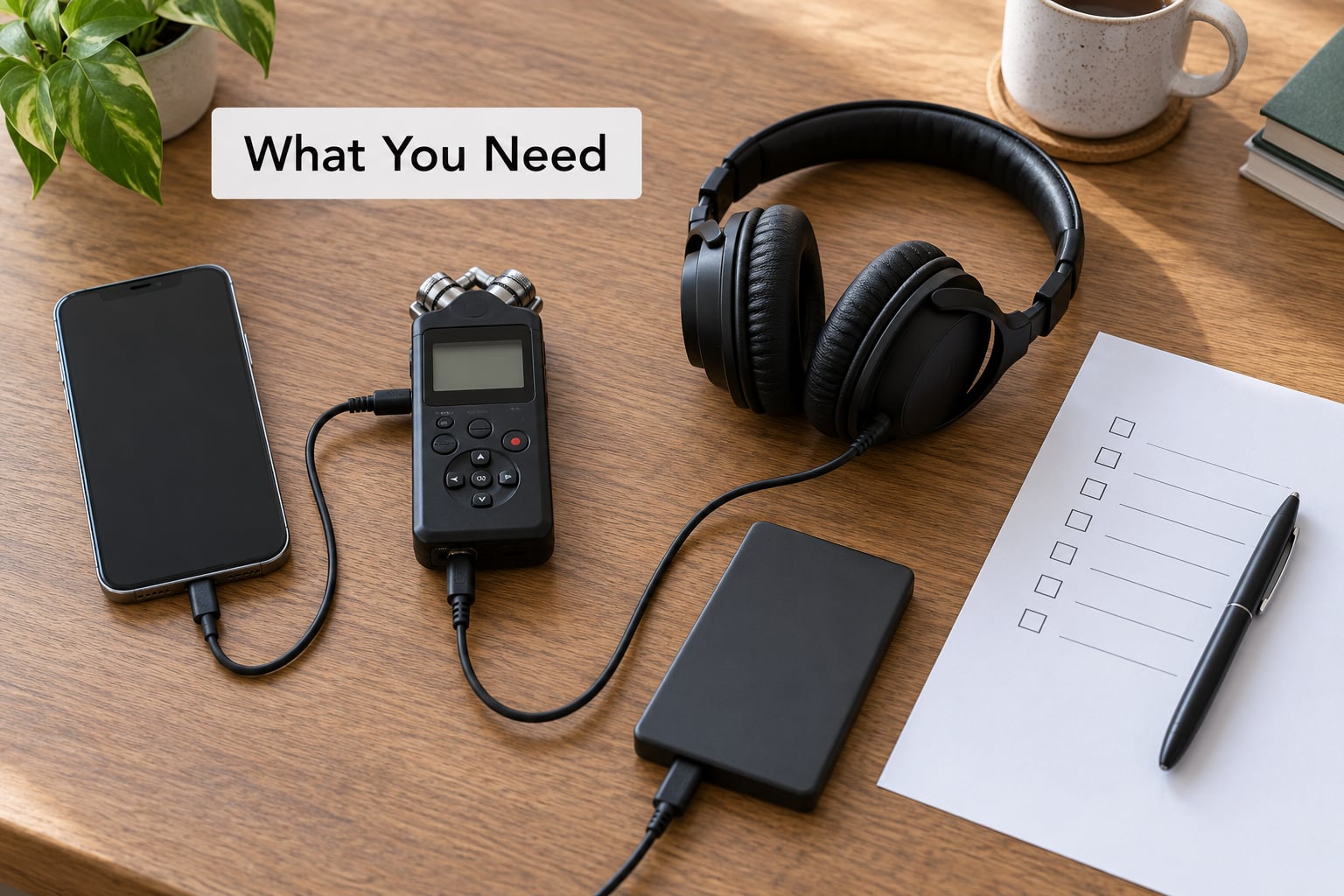
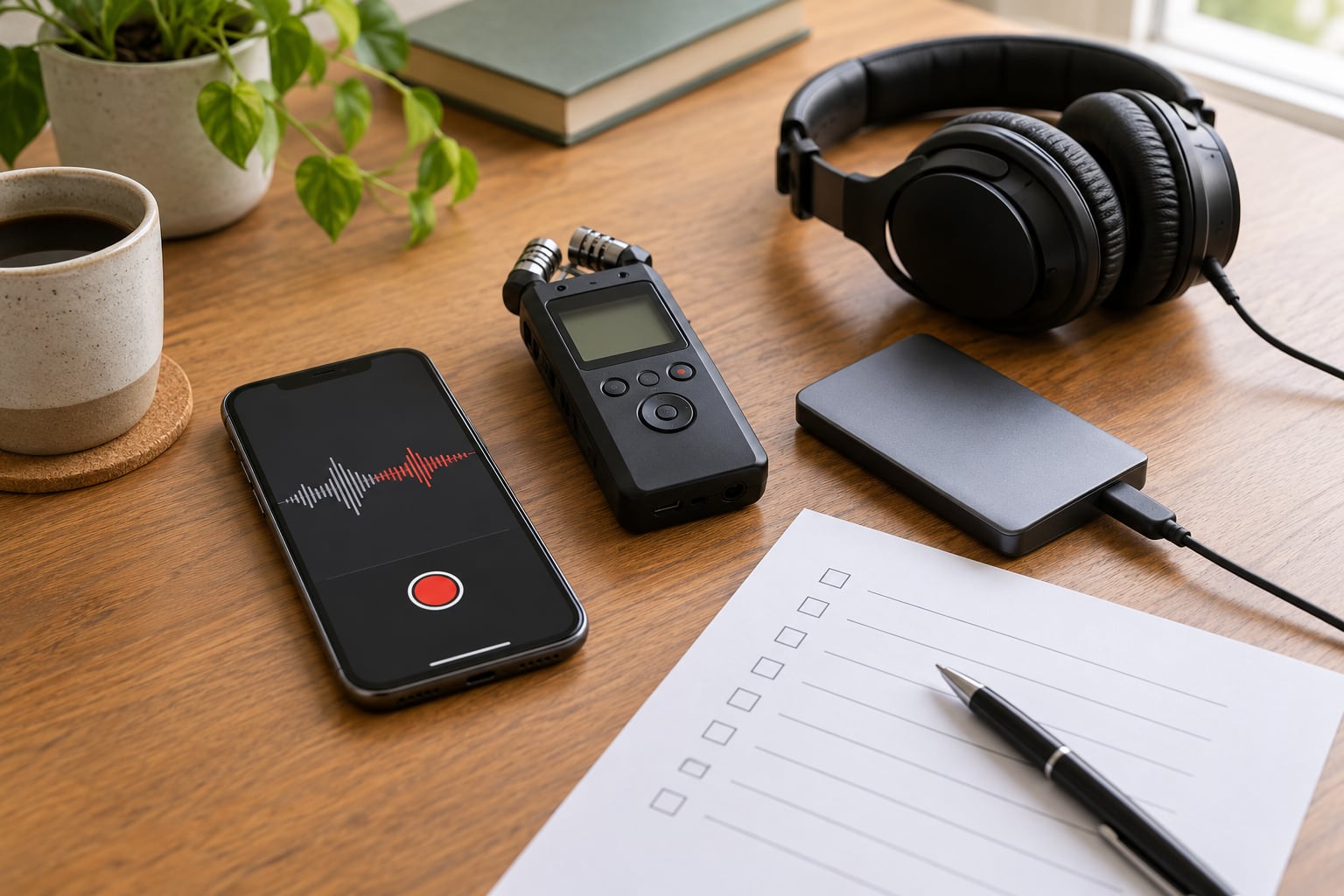
Before you dial, you need five things lined up: a recorder, a working microphone path, storage with room to spare, a written consent process, and a way to document who agreed to what.
- A reliable recorder. The stock voice memo app on your phone is enough for most interviews. A separate phone on speakerphone is a good backup when the call platform blocks recording.
- Headphones or a tested speakerphone. You need to hear the source clearly enough to catch a quiet answer or a name you will need to spell correctly later.
- Storage and a backup location. Check free space before the call, not during it. Know where the second copy goes before you start.
- A consent or release process. Even a one-paragraph template you paste into your notebook counts. So does a release form your outlet already uses.
- A contact sheet. One page per interview: date, time, participant names, where each person was physically located, and the consent status.
One thing to separate early: permission is not the same as legal consent. Saying “sure, go ahead” is permission. Legal consent is permission that is informed, given freely, and documented in a way that shows what the person was agreeing to. The gap between those two words is where most disputes live.
How to Record a Phone Interview Legally
Recording law in the US splits into two families. One-party consent states let you record a conversation you are part of without asking first. All-party consent states, sometimes called two-party consent states, require the agreement of everyone whose voice is captured before the recording starts.
The part that trips people up is location. The rule that matters is the one where the other person is, not where you are calling from. A reporter in Boston talking to a source in Los Angeles is working inside California’s rule, and reporters in New York regularly relearn that the hard way. When in doubt, treat the call as an all-party call and get consent. It costs you one sentence.
Step 1: Check the applicable recording rules
Ask three questions before the call: where is the other person physically located, is this a live call or is the platform capturing the audio itself, and does your newsroom or contract add rules on top of the statute.
In plain terms, one-party consent generally means that as long as you are a participant in the conversation, you can record it without asking the other person first. All-party consent generally means every participant has to consent before the recording begins, not after you realise mid-call that nobody told you it was required.
For cross-border interviews, check the participant’s current state or country rather than assuming your own local rules travel with the call. A list of all-party consent states changes as legislatures meet, and it has changed repeatedly over the past few years. States commonly identified as all-party include California, Florida, Illinois, Maryland, Massachusetts, Montana, New Hampshire, Oregon, Pennsylvania, Washington and Connecticut, among others. Treat that as a starting point as of 2026 and confirm the current classification before you rely on it, because a single state moving categories changes your obligation on that call.
Note the platform question too. Many conferencing tools record on the server side. If the service records the call and you did not obtain consent, the same consent question exists, and the file may sit outside your control.
Step 2: Get clear permission before recording
Consent has to be informed. That means the person understands that a recording is happening, roughly what it is for, and who will have access to it.
A disclosure that works in about ten seconds: “Before we start, I want to record this call so I can get your quotes right and avoid transcription errors. The recording stays with me and my editor, and you can ask me to stop or delete any part of it. Is that okay with you?”
Variations exist for different situations. For a background conversation: “This one’s on background, so the recording is for my notes only and I won’t publish anything from it without checking with you first.” For a source who is nervous: “I can turn the recorder off for this stretch, but then I’m relying on handwritten notes, which is less accurate for you.” For a formal institutional interview, follow whatever release that organisation requires.
Two details matter more than people expect. First, record the consent itself: start the recorder, make the disclosure, get the yes, then begin the real conversation. Audio of an agreement at minute zero is the cleanest evidence you will ever have. Second, a verbal yes usually satisfies the consent requirement, but a separate written release may still be needed for publication, archival use, editing, or material that touches sensitive personal information.
Keep the release with the audio. A signed PDF sitting in a separate inbox is not the same as a folder holding both the form and the file.
Step 3: Prepare the recording setup
Get this done in the two minutes before the call, not during it.
- Confirm free storage. Long interviews hit the limit faster than you expect.
- Charge the device, or plug it in.
- Turn on Do Not Disturb so a text alert does not stop the recording or pull you out of the conversation.
- Do a ten-second level test. Speak, listen back, adjust the microphone side you intend to use.
- Use headphones if the source’s audio is unclear or you are recording in a shared space.
- Start the recorder before the sensitive questions, not after.
On iPhone, Voice Memos records continuously and saves to the app’s list; on Samsung devices the built-in Voice Recorder sits in the standard app folder and has added Interview Mode on many models. Menus and options move between versions, so check your own device rather than a screenshot from a blog post written for a different release.
If the call platform blocks recording on the same device, put the call on speakerphone and record from a second phone or a dedicated recorder. Several journalists do this routinely. The audio quality is slightly worse and the consent position is completely clear.
Step 4: Monitor and document the conversation
Stay loosely aware of the recording the whole call. Ten seconds of attention at the start, then a check every fifteen minutes, is usually enough.
Keep the microphone stable and pointed at whoever is speaking. If a source hands you a document and starts reading a phone number aloud, decide whether you need it. Recording more personal detail than the story requires is the kind of thing that makes a source disappear after publication.
Fill in the contact sheet as you go: date, start time, each participant, their location, and the exact consent status, including anything that changed mid-call. If someone says “don’t record this part,” write down where in the timeline it happened.
If a dropout or an interruption happens, do not edit around it silently. Note the time in your log. A documented gap is a technical note, while a silent gap looks like tampering.
Step 5: Save, back up, and retain the recording securely
The recording is evidence, so treat the first file like a master.
Make a second copy the same day, somewhere access-controlled. Transfer to newsroom storage that requires a login rather than a shared personal cloud folder, and keep the file encrypted at rest. Restrict access to the staff who genuinely need the audio, and log who has requested it.
Preserve the original with its metadata intact. Renaming files and stripping dates makes it harder to prove when something was recorded. When you produce a working copy for editing, keep it separate and name it clearly so nobody confuses the two.
Then either write a transcript or keep an edit log: which timestamps became quotes, what was cut, and why. Keep the material only as long as your retention policy and the consent you obtained both allow, then delete what you no longer have a reason to hold. Do not send unencrypted audio through public file-sharing links, especially when the interview touches a source’s identity or workplace.
Common Mistakes
These are the errors that show up again and again, and each one has a simple fix.
Assuming silence equals consent. Nobody objecting during the call does not mean they agreed in an all-party state. Some people simply do not interrupt. Fix: make the disclosure, ask for an explicit yes, and record the answer.
Relying on a signed release alone. A paper release may cover publication rights without touching the consent requirement for the recording itself. Fix: get the spoken disclosure on audio as well as any form.
Recording before announcing it. Starting the recorder during small talk and mentioning it later is a consent problem dressed up as a formality. Fix: disclose first, then record, and let the first five seconds be the disclosure itself.
Using a call the terms of service prohibit. Some workplace numbers and conferencing services forbid recording by their own policies, independent of the law. Fix: read the terms before you rely on a borrowed phone or a company account.
Confusing the participant’s location with yours. Your state’s rules do not travel to their side of the call. Fix: ask where they are, and write it on the contact sheet.
Editing the only audio file. Cutting a file in place destroys the original and removes your ability to prove what was actually said. Fix: preserve the source, edit a copy.
Publishing sensitive detail the story did not need. Legal is a floor, not a ceiling. A home address, a family detail, or an unverified accusation captured on tape can harm a source even when the recording itself was lawful.
Two editorial habits help more than any script. Mark on the recording, live, where off-the-record material begins, so you are not hunting for it later. And tell the source what happens to the file: who stores it, how long, and what you will delete. Sources who know tend to talk more freely, which is the opposite of what people fear when they ask about the recorder.
Frequently Asked Questions
Can I legally record a phone interview with my phone?
Usually yes. Federal law generally requires the consent of one party, and you are a party, so recording a call you take part in is permitted at the federal level. The complication is state law. If the other person is in an all-party consent state, you need their agreement before you start. Announce the recording, get a clear yes, and keep that agreement on the audio.
Do I need written permission or just verbal consent?
For the consent requirement itself, verbal consent given on the recording is usually enough, and capturing it in the audio is the strongest evidence. A separate written release may still be required by your outlet, by the organisation you are interviewing, or by the platform for publication, archival use or sensitive material. Check your newsroom policy and the source’s employer rules before you publish.
What if I accidentally start recording?
Stop the recording immediately, tell the other person what happened, and offer to delete the file. Then delete it if they ask. An accidental few seconds of audio captured in a state that requires all-party consent is not automatically a criminal case, but you cannot rely on it later as evidence, and continuing to record after someone asks you to stop is a very different situation. Document what happened and when.
Can someone change their mind after agreeing to be recorded?
Yes. Consent can be withdrawn, and continued participation after a clear request to stop is not treated as consent by every court. If a source asks you to stop recording mid-interview, stop, note the time in your log, and tell them what you will do with the portion already captured. Ask whether they want it deleted. Publishing withdrawn material is an ethical failure even when the law would allow it.
Are phone interviews recorded differently from podcasts?
The consent rules are largely the same. The differences are contractual and editorial: a podcast usually carries a release, a distribution agreement and sometimes a commercial use clause, while a news interview often relies on an outlet policy and the applicable statute. Remote podcast guests raise the same location question, so check where the guest is before you hit record and before you ask them to sign anything.
Which location’s laws matter for a remote interview?
The location of the person being recorded is the one that matters most, not yours. When participants are in different states, the safer approach is to follow the stricter rule. For international calls, local law abroad may apply to the participant regardless of where you are, and data protection rules such as the GDPR add notice and storage obligations on top. Confirm the current position with qualified counsel before an interview that carries real exposure.
Conclusion
Find out where the person is, ask them clearly and on the record, test the audio before the sensitive part starts, and keep the original file safe with the consent attached to it. That sequence takes a few minutes and it is the difference between a usable interview and one you cannot publish.
Recording rules shift as states and countries change their statutes, so treat any summary, including this one, as a starting point rather than a final word. When a call matters enough that getting it wrong would cost you a source or a job, buy an hour of qualified local counsel or ask your newsroom’s lawyer. They will tell you in five minutes what a search cannot.