Moderation burnout is the exhaustion that builds when one person becomes the standing filter for everybody else’s hostility. It is not caused by a busy week. It comes from three compounding problems: a queue that never empties, decisions that are always arguable, and steady exposure to words written to make you angry. The fix is structural, not motivational.
That last sentence is the whole argument of this guide. Anyone can cope for another six weeks by trying harder. The moderators who stay functional for years have stopped treating the comment section as an emergency that happens to them, and started running it as a queue with hours, rules and a stop signal.
Everything below applies whether you moderate a subreddit, a Discord server, a brand’s social replies or the comment queue under a news story. If your work involves reading other people’s words on someone else’s behalf, the workflow transfers almost unchanged.
A note before we start: I moderate comment queues as part of the job, and the numbers in the routine below are the ones that stuck, not aspirational ones. Take what fits your situation and change the rest.
Table of Contents
- What You Need
- How to Moderate Comments Without Burning Out: Step-by-Step
- Common Mistakes
- Frequently Asked Questions
- How many hours a week should I spend moderating comments?
- How do I cope with moderation burnout when I cannot quit?
- What self-care practices actually help a burned-out moderator?
- Should I quit moderating a community I am burned out running?
- How do I handle repeated bad-faith comments without getting angry?
- How do I tell if my moderation changes are working?
What You Need
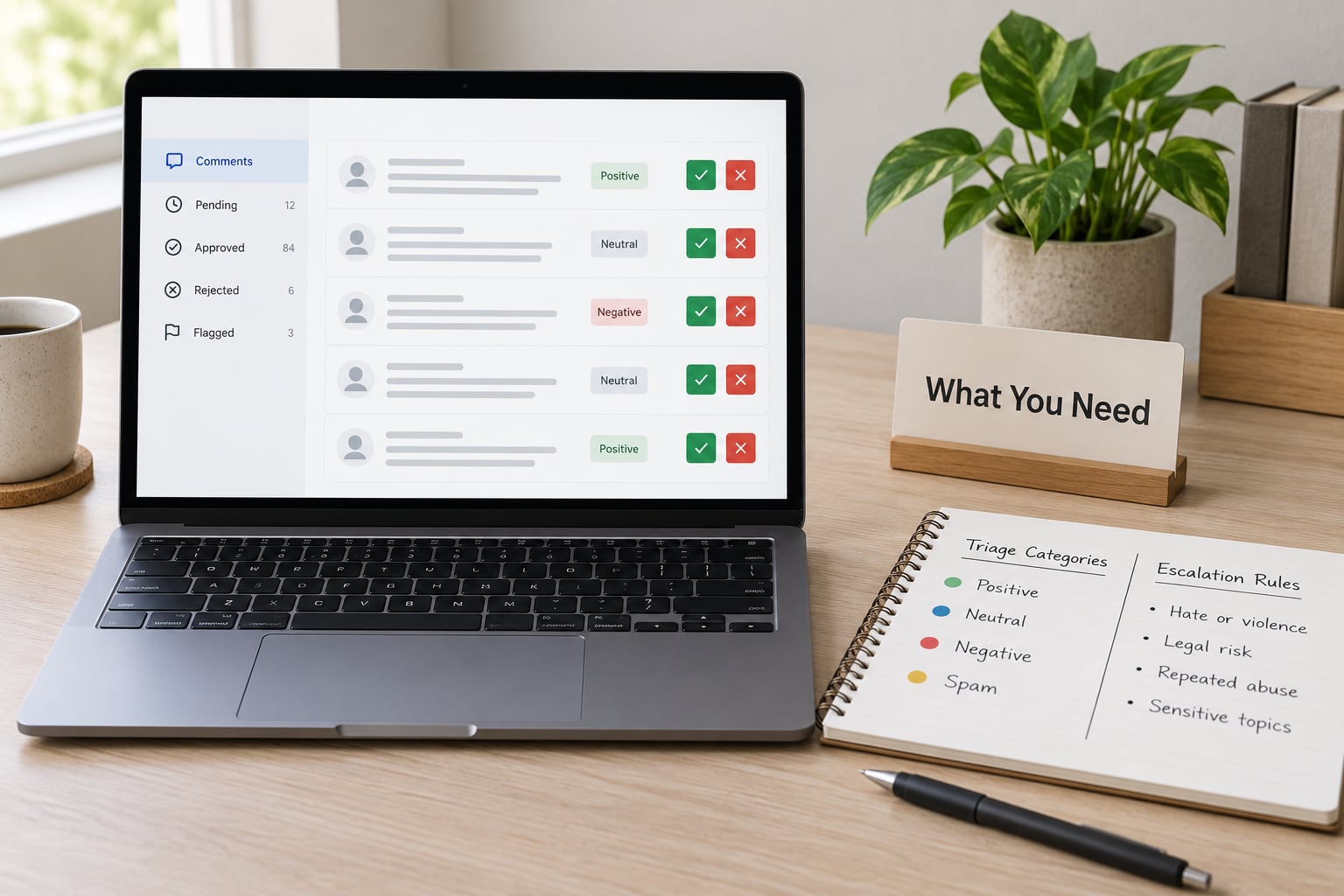
You need six things in place before the next queue opens, and all of them take an afternoon to write down.
- A written severity ladder. What gets removed, what gets held for review, what gets escalated, and what gets left alone. In that order.
- One reporting channel. A single form or modmail inbox. Every report lands in the same place with a timestamp.
- A named escalation contact. An editor, a safety lead or a second moderator. Someone who can act when a decision is above your pay grade.
- Response time limits. For example: threats within the hour, everything else within 24 hours.
- Filters and holds already configured. Keyword filters, link filters, new-account holds, rate limits.
- A schedule written down somewhere you can see it. Days, time windows, rough word count per week.
The item people skip is the severity ladder. Without one, every decision becomes a fresh judgment call, and fresh judgment calls are what actually exhaust people. A written rule ends the debate in under a minute, because the decision was already made before the comment arrived.
Before you build any of it, be honest about whether the problem is workload or exposure. A high-volume queue and a low-volume queue of vicious replies are different problems. One is fixed by batching. The other is fixed by tooling and by talking to someone.
How do you know you are already burned out?
Six or more of these apply to you, and the problem is real rather than a bad week.
- You check the queue first thing when you wake up, before email.
- You re-read a comment you already deleted, sometimes several times.
- You can name the exact thread that ruined your evening.
- You resent the members you moderate.
- You feel relief when someone else handles the queue.
- You have started drafting replies in your head to people who have not commented yet.
- You cannot remember the last time you read a comment without bracing for it.
None of this is a character flaw. Compassion fatigue is the erosion that happens when empathy is spent repeatedly without recovery, and it is well documented in people whose work involves absorbing distress as a job. If the symptoms above persist for weeks rather than days, that is a conversation with a professional, not a scheduling problem.
How to Moderate Comments Without Burning Out: Step-by-Step
Set a Time Boundary Before You Open the Queue
Decide in advance when moderation happens and how long it lasts, then treat the end of the window as real. A queue checked between meetings and at bedtime is not bounded work, it is ambient dread.
Pick a weekly budget before you pick a daily one. Six hours spread across four short windows is far easier to sustain than two long ones, and shorter windows mean fewer decisions in a row, which means fewer decisions made on autopilot.
Create Simple Rules for Routine Decisions
Write rules that resolve the categories you actually see, in language a stranger could apply without asking you. The list usually runs to seven or eight categories: factual disagreement, criticism of the work, spam, harassment, threats, self-harm content, legal notices, and everything else.
Agreement does not need a rule. Disagreement never needs a response. If a comment would not change what you published and does not cross a line, leave it alone.
Here is the mapping I keep on the wall. The script column is the part people ask for most, so it is written to be copied.
| Comment type | Default action | Script you can reuse |
|---|---|---|
| Factual disagreement | Leave, pin if useful | “Good catch. I’ve corrected the wording in the original.” |
| Criticism of the work | Leave | No reply needed. Reply only if a real error is identified. |
| Spam or referral links | Remove, filter | “Removed as promotional. Reposting is fine without the link.” |
| Harassment or slurs | Remove, warn, ban | “Removed for personal comments. Second one is a longer removal.” |
| Credible threat | Escalate immediately | “Escalated to the duty editor. We’ll follow up by email.” |
| Self-harm disclosure | Keep visible, resource reply | “Sending this to someone who can help right now.” Then the contact. |
| Legal threat | Escalate, do not engage | “Forwarded to our legal contact. They will reply directly.” |
| Bad-faith repeat | Remove, mute, ban | No reply. Muting is a complete action. |
Work in Short, Predictable Triage Blocks
Batch the queue instead of handling it as it arrives. A queue processed in one deliberate pass produces fewer regretted decisions than the same queue handled in thirty interruptions.
Work in a fixed order so nothing waits indefinitely: safety issues first, then reported comments, then the pending backlog, then repeat offenders, then appeals, then routine cleanup.
The order matters more than the pace. Safety items are rare and cannot wait, appeals are time-sensitive and cheap to resolve, and cleanup is the only category you are allowed to abandon.
| Window | What gets reviewed | Hard stop |
|---|---|---|
| Monday, 25 minutes | Safety issues and overnight reports | Stop even if reports remain |
| Wednesday, 40 minutes | Reported comments and appeals | Anything unresolved moves to Friday |
| Friday, 30 minutes | Pending backlog in post order | Leave the tail for next week |
| Sunday, 15 minutes | Cleanup, filters, rules tweaks | Never open new disputes |
Add a stopping rule to each window: when the timer goes, you stop, even mid-review. A decision you were not sure about is usually a decision that should not be made at minute 38 of a 40-minute window anyway.
Use Automation Without Letting It Make the Decisions
Automation is a wellbeing intervention, not an efficiency one. Every rule you automate is a comment you do not personally read at 11pm.
| Purpose | What to set up | What stays human |
|---|---|---|
| Cut volume | Rate limits, link filters, new-account holds | Anything reported by a member |
| Cut repetition | Keyword filters for known slurs and spam phrases | Context, sarcasm, reclaimed language |
| Cut duplicates | Near-duplicate comment collapsing | Whether the repeat is actually targeted |
| Cut reading | Canned responses, macros, saved modmail templates | Threats, self-harm, legal, anything involving a child |
| Cut handoff | A second moderator with a defined slice | Your own escalation contact |
On Reddit, AutoModerator and subreddit settings handle most of this natively and for free, which is why moderators in r/AutoModerator treat it as the first fix rather than the last. Elsewhere, the equivalent is your platform’s filter list plus a macro library.
Never let an automated classifier make the final call on context-heavy or high-risk content. A filter can hold a comment for a human. It should not be the reason a vulnerable person’s disclosure got removed.
Escalate Rarely and Record Enough Context
Escalation is not failure. It is the only mechanism that keeps a hard day from becoming your whole week.
Capture what an editor or safety lead needs to act without asking you a follow-up question: the comment text, the username, the thread, the timestamp, the reporter’s claim, and what you already did. Screenshots age badly; a saved log with permalinks is better.
Escalate credible threats, doxxing, threats of violence, legal threats from anyone with a real interest, self-harm content, and any dispute involving an under-18 reader. Keep the escalation contact current. An out-of-date phone number during a genuine threat is a real failure, not an oversight.
Know the difference between a comment that is not your problem and one you have promised a response to. Reports from members are a promise. Unreplied messages from strangers about a story you published are usually not.
Take Recovery Steps After Difficult Conversations
A queue ends; the residue does not. Ten minutes of closing routine after the window stops keeps one bad comment from following you through dinner.
Log the decisions you are unsure about in one line each, so you can review them later with a cooler head instead of re-litigating them tonight. Then stop looking at the queue until the next window.
Mute notifications completely outside your windows. If you moderate a community you also read as a member, consider reading it logged out or through the publication itself rather than through your moderation view. The feed looks different from the outside, and that gap is deliberate.
Rotate. If several team members handle the same story, rotate who takes the comment queue for emotionally heavy coverage. Somebody should always be able to say they are done for the day without apologizing.
Common Mistakes
Replying to every critic. Moderation is not a debate. If a comment breaks no rule, there is no answer owed, and the fastest correct response is none.
Making exceptions. Every “just this once” weakens the ladder, and weakening the ladder is what turns a two-minute rule check into a twenty-minute emotional negotiation. Rule exceptions are how moderators end up defending decisions they no longer believe in.
Monitoring outside hours. The queue is always open, so the only thing that closes is you. Notifications after your window ends are the single most reliable burnout driver in this list.
Writing vague rules. “Be respectful” is unenforceable. “No comments about other members’ appearance” gets applied in ten seconds and reviewed in ten years.
Treating AI as the decider. Automated filtering is fine for holding and removing obvious spam. It is not reliable on context, irony, or a person in crisis, and the errors land on real readers.
Absorbing other moderators’ behaviour. In r/AskModerators, the recurring frustration is not commenters but fellow moderators being dismissive, sometimes anonymously and often unblockable. Treat it as a policy failure: log the pattern, raise it with whoever owns the rules, and stop attending the spaces where it happens.
Treating the role as a debt. Guilt about stepping back is described constantly in moderator forums and it is not a reason to stay. A community that would collapse without you was already one person deep.
Never rotating the hard coverage. If the same person handles the same volatile story every time, burnout is a scheduling decision, not a personal weakness.
Frequently Asked Questions
How many hours a week should I spend moderating comments?
For a volunteer queue, two to four short windows a week is usually enough for a community under a few thousand daily readers. Set the weekly budget before you set the daily one, because a daily target quietly becomes an open-ended obligation. When a window ends, stop even with work remaining, and carry it to the next slot. Escalation items are the exception; they are not part of the budget.
How do I cope with moderation burnout when I cannot quit?
Reduce exposure before you try to build resilience. Cap the queue, close notifications outside your windows, move volume to filters, and hand the hard calls to a second person. Then name the actual load out loud to an editor or a friend, because a burnout you are privately absorbing tends to grow. If symptoms persist for weeks, treat that as a health question and talk to a professional rather than a scheduling one.
What self-care practices actually help a burned-out moderator?
Moderation-specific ones work better than generic advice. Batch the queue into fixed windows, mute keyword alerts and notifications outside them, set a hard weekly comment budget, and rotate off emotionally heavy coverage. Keep a written decision log so you are not re-litigating yesterday at midnight. Most importantly, have a second moderator cover a defined slice; shared load is the only intervention that reliably reduces total exposure.
Should I quit moderating a community I am burned out running?
Hand it off rather than abandoning it. Write a short handoff note covering the rules, the severity ladder, who to escalate to, and the open disputes nobody resolved, then introduce the new moderator in public. Moderators on r/AskModerators describe the guilt of stepping back as the hardest part, and that guilt is mostly obligation rather than evidence. A clean handoff protects the community better than a slow fade-out.
How do I handle repeated bad-faith comments without getting angry?
Stop reading them as arguments and start classifying them as volume. Filters catch the known phrasings, muted accounts remove the rest from your view, and neither requires a reply. If one person is targeting you specifically, that is harassment rather than moderation, and it belongs in the escalation lane with screenshots and permalinks. Personal attacks on moderators are worth removing even when they contain no slurs at all.
How do I tell if my moderation changes are working?
Run a two-week check before and after. Count the windows you completed on time, the items you escalated, the decisions you reverted, and how often you opened the queue outside your schedule. Also track one honest wellbeing question: how often did a comment affect your evening? The operational numbers tell you whether the workflow holds, and only the last one tells you whether it is worth keeping.
Burnout is a workflow problem before it is a wellbeing problem, and that is good news. Start tomorrow by writing your severity ladder and picking your four windows for the week. Everything else on this page hangs off those two pieces of paper.
Keep this guide handy for 2026 and beyond, and revisit the weekly budget every quarter, because the queue that felt manageable last spring rarely still does.