
Anonymizing a dataset before publishing means removing the direct identifiers, coarsening the quasi-identifiers, and then proving that no combination of the remaining fields points back at a person. The work usually takes half a day for a spreadsheet of a few thousand rows, longer when free-text notes are involved, and it is far easier to do properly before release than to unpick afterwards.
The part that catches teams out is not the deleting. It is the combinations. Remove the name and the phone number and people assume the file is safe, then a reader joins it to voter records and re-identifies a third of the rows from age, postcode and job title. Every step below exists to stop that.
If you publish only aggregate figures, none of this applies. The moment you release row-level records about real people, it does.
Table of Contents
- What You Need
- How to Anonymize a Dataset Before Publishing: Step-by-Step
- 1. Define what the published dataset must support
- 2. Create an inventory of direct and indirect identifiers
- 3. Remove or transform direct identifiers
- 4. Reduce or generalize indirect identifiers
- 5. Check the dataset for re-identification risk
- 6. Validate the transformed data
- 7. Document the process and publish safely
- Common Mistakes
- Frequently Asked Questions
- Conclusion
What You Need
Assemble these before you touch a single cell. Scrambling data first and hoping you can still find your way around it afterwards is how datasets end up over-scrubbed.
- A pristine copy of the original data. Read-only, never edited. Every transformation happens on a copy so you can compare and re-run.
- A data dictionary. One line per column: what it means, where it came from, how many distinct values it holds. If a column has no entry, treat it as unknown and inspect the raw values yourself before publishing it.
- A note of why the data is being published. The questions readers will use it for. This decides how much precision you actually need to keep.
- A spreadsheet or database tool. Spreadsheets are fine up to a few tens of thousands of rows. Beyond that, use a script, and OpenRefine is the usual first stop because it handles inconsistent values better than a pivot table.
- A testing tool. ARX is the free desktop choice for k-anonymity, l-diversity and risk metrics. Python with pandas covers the same ground if you are comfortable scripting.
- A secure place to record decisions. A document, not your memory. What changed, why, who approved it, and what residual risk you are accepting.
Also agree who signs off. On a newsroom project that is usually the reporter and an editor, and for anything touching health, finance, minors or reporting on identifiable individuals, add legal or your data protection officer.
How to Anonymize a Dataset Before Publishing: Step-by-Step
These seven steps are the order I would run them in. The ordering matters because each one makes the next cheaper to check.
1. Define what the published dataset must support
Start with the reader, not the spreadsheet. Write down the two or three questions the dataset has to answer, because that is the ceiling on how much detail you keep. A dataset meant to show how rents changed across London boroughs does not need a tenant’s full birth date.
For each column, decide whether it is required for those questions. Anything that cannot justify itself against a stated use gets deleted, which is usually the fastest privacy win available and the one most teams skip.
Set the level of precision you actually need in advance: month rather than day, region rather than postcode, age band rather than exact age. Deciding this while you still hold the full-detail file keeps the process calm. Deciding it after you have already deleted things tends to produce a file where every value is Unknown and nobody can use it, the failure mode practitioners call privacy by paper shredder.
2. Create an inventory of direct and indirect identifiers
Go column by column and sort every field into one of four buckets: direct identifier, quasi-identifier, sensitive attribute, or safe.
Direct identifiers name or contact a person on their own: names, email addresses, phone numbers, national insurance or social security numbers, passport numbers, full street addresses, usernames, account numbers. These come out or get transformed in step 3.
Quasi-identifiers do not identify anyone by themselves but do it in combination: exact date of birth, full timestamp, postcode, age, gender, job title, employer, IP address, device identifiers, licence plate, and rare diagnoses. These are the fields that do the damage once the obvious columns are gone, so give them the most attention.
Sensitive attributes are the attributes you would not want attached to a name: health status, immigration status, religion, sexual orientation, union membership, criminal history. Usually they stay in the file, because they are the reason the data is interesting. The job is to break their link to a person, not to delete the column.
Two traps deserve their own mention. Rare values hide inside ordinary columns, and combinations, not columns, are what re-identify. A neighbourhood where only four residents hold a particular job title has effectively published that household. Look at value frequencies for every column and flag anything with a small count before you decide the file is fine.
Write the inventory down as a table with a column for your chosen treatment. This table becomes the documentation you publish alongside the file, and it makes review by a second pair of eyes quick.
3. Remove or transform direct identifiers
Deleting is the default. If a column is not needed for the stated purpose, drop it rather than trying to disguise it.
| Treatment | What it does | Watch out for |
|---|---|---|
| Suppression | Removes the column or row entirely | Check the released file for hidden columns and filtered rows before saving |
| Pseudonymization | Replaces the value with a token or surrogate key | Reversible in principle, so pseudonymized data is usually still personal data under GDPR |
| Masking | Blanks or partially blanks the value, keeps the shape | Partial masking such as an email with the domain intact often still identifies |
| Hashing | Replaces the value with a fixed-length digest | Weak for low-entropy values, and predictable values can be reversed by brute force |
| Generalization | Coarsens the value, 12 May 1985 becomes 1985 | Costs granularity; keep the coarsest version that answers the questions |
| Swapping | Exchanges values between records within the file | Breaks row-level links, so do not combine it with fields that must stay aligned |
| Aggregation | Publishes counts or sums instead of rows | Small cells can still expose a person, so suppress anything below a threshold |
Hashing deserves a warning because it is the most common false comfort in this work. A salted, slow hash of a full email address is genuinely hard to reverse. An unsalted MD5 of a postcode, or of a date of birth in a 40-year range, has so few possible inputs that anyone can rebuild the entire list in minutes and match it against a phone book. If you are hashing, use a per-release random salt, a slow algorithm such as bcrypt or Argon2, and never hash a value that has fewer possibilities than it has characters.
Two details catch people regularly. Free-text fields hold names in plain sight even after the columns look clean, and hidden spreadsheet content survives deletion: filtered-out rows, cell comments, revision history, notes tabs, defined names and formulas that reference the original file. Save a fresh export and open it fresh before you trust what you are about to publish.
4. Reduce or generalize indirect identifiers
This is where you protect against the combinations, and it is where the analytical value is won or lost. Generalization has a hierarchy: you decide how far up it to climb, and every step up costs precision and buys safety.
| Field type | Full detail | Typical generalization | Coarser still |
|---|---|---|---|
| Age | 34 | 30-39 | Under 40 / 40 and over |
| Date of activity | 2026-04-17 14:32 | 2026-04 | 2026 |
| Geography | SW1A 2AA | Westminster | London region |
| Time of day | 14:32 | Afternoon | Day or night |
| Salary | 41,250 | 40,000-49,999 | Band 30-60k |
| Organisation | Named employer | Sector | Suppressed if under k rows |
Work outward from the identifiers you already killed. After removing name, email and address, run a frequency check on every remaining quasi-identifier and look at the combinations that appear once or twice. Those are the rows that will get a person named in a reply tweet.
For categorical values, consolidate rare levels into an Other bucket before you remove them entirely, since Other is usually still useful. For continuous values, bin them rather than truncating, because truncation keeps the exact value and binning does not.
Small groups need a hard rule. Pick a minimum group size, set it once, apply it everywhere, and suppress any cell below it rather than letting the threshold drift depending on the column. Most newsroom and open-data work sits comfortably at k=5, and 10 is the more cautious choice when the underlying material is sensitive.
5. Check the dataset for re-identification risk
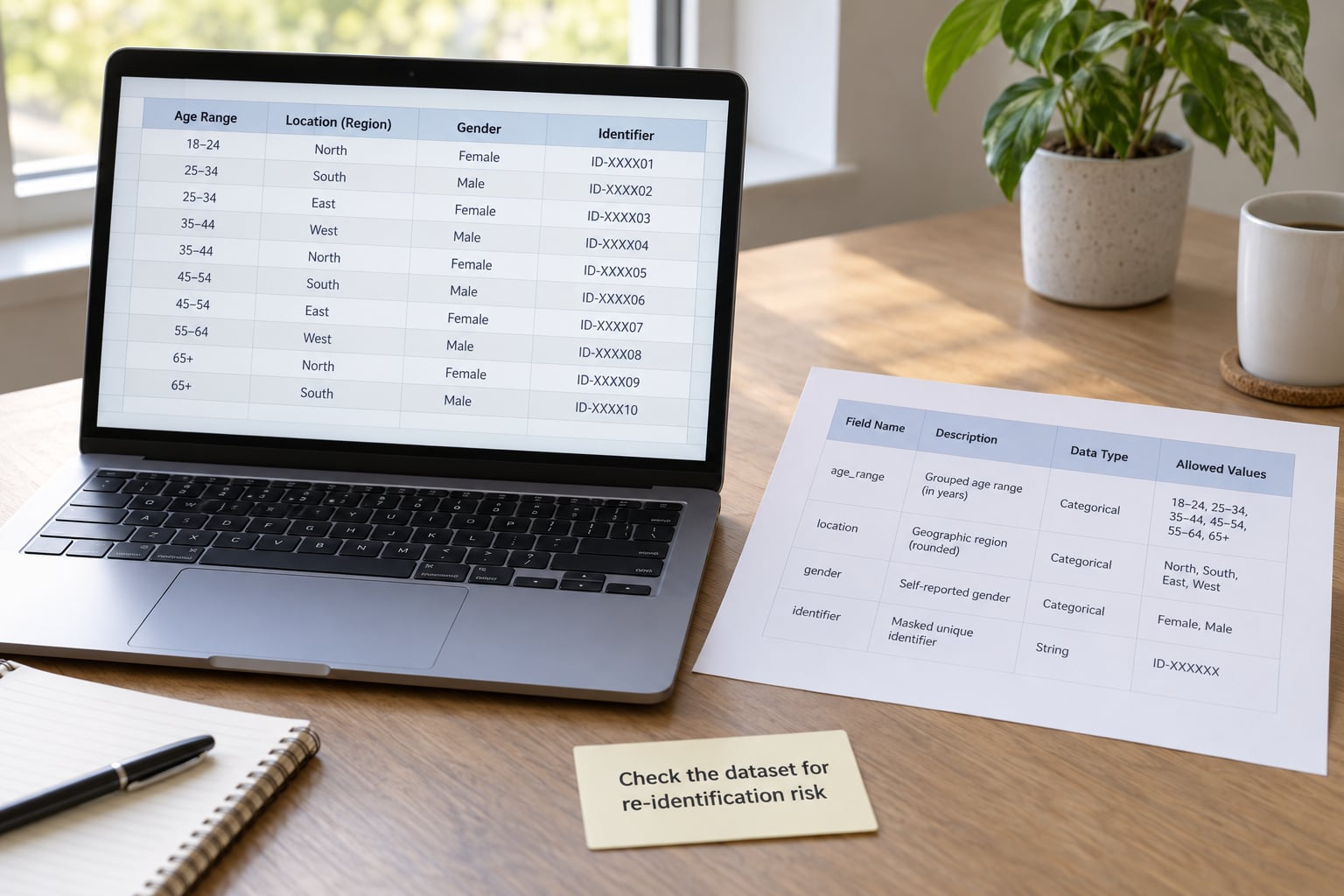
This is the step that turns opinion into evidence, and it is where most informal processes stop early. Four models are worth knowing, and they stack rather than compete.
k-anonymity says every combination of quasi-identifiers must match at least k rows. It is the baseline everyone uses, and it is easy to compute. Its weakness is homogeneity: a group of ten people sharing postcode, age band and gender can still all have the same sensitive attribute, so k-anonymity protects against linkage attacks more than inference attacks.
l-diversity tightens that by requiring a minimum number of distinct sensitive values inside each equivalence class. t-closeness goes further and requires the distribution of the sensitive attribute in each group to be close to the distribution in the whole dataset, which handles skewness attacks that l-diversity misses.
Differential privacy is a different kind of promise. Instead of checking each row, you add carefully calibrated noise to query results and bound how much any single record can move an answer. Epsilon is the privacy budget: smaller means stronger privacy and less usable data. For a one-off static file release it is rarely worth the complexity, but for repeated statistical releases, or a database people can query, it is the right tool.
| Model | What it guarantees | Weakness |
|---|---|---|
| k-anonymity | No combination of quasi-identifiers isolates fewer than k rows | Ignores the sensitive attribute, so homogeneous groups still leak |
| l-diversity | Each group contains at least l distinct sensitive values | Weak against skew, and costs a lot of utility |
| t-closeness | Each group’s sensitive distribution resembles the overall distribution | Expensive to optimise, hard to explain to an editor |
| Differential privacy | A bounded, quantified effect of any one record on any answer | Requires query-based release and careful budget management |
Three practical tests complement the models. Check uniqueness: count how many rows are alone in their quasi-identifier combination, and treat any non-zero result as a leak. Run a linkage check by asking whether an outside dataset, a voter roll or a previous extract could narrow those groups, and simulate the join where you can. Then look at outliers, because a single row with an unusual combination stands out even inside a group of ten.
6. Validate the transformed data
Validation answers a second question: did the file survive? A dataset nobody can query is not anonymized data, it is wasted effort.
Confirm the intended variables are still there and still usable, then check that row counts, totals and category counts are broadly what you expect. Run a handful of the questions the file is meant to support and compare the answers against your pre-anonymization version. If a headline number moved a lot, you probably generalized too far.
Then inspect the artifact rather than the plan. Open the exported file fresh and search it for names, email patterns, the original identifiers and any stray fragments of free text. Check that no sheet is hidden, that no row is filtered, that document properties and revision history carry nothing, and that the code, if you used any, is saved somewhere the reviewer can read. Writing the anonymization rules into a reusable script instead of hand-editing rows is what makes a repeat release safe.
7. Document the process and publish safely
Publish the method, not just the file. A short methodology note covering what you removed, what you generalized, the minimum group size you chose and why, the residual risk you still see, and the date of the release lets a reader judge the file, and lets you repeat the process consistently next time.
State the limitations plainly. Practitioners who publish records about identifiable people, including sensitive legal matters, put weight on saying explicitly what a reader cannot learn from the data. It costs a paragraph and it is the single strongest trust signal in the release.
Match access conditions to sensitivity. A file with rare categories or sensitive attributes is usually better behind a click-through licence with a stated purpose, or released only as an aggregate, than posted openly. Archive the transformation code alongside the data so the process can be audited, and put an expiry or review date on anything you are not fully confident about.
Common Mistakes
These are the failures I see most often in published extracts, and each has a straightforward correction.
- Deleting the name and stopping there. Contact details, notes and comments survive. Build the identifier inventory across every column including free text, not just the obvious ones.
- Treating hashed values as anonymous. Low-entropy inputs like postcodes and dates can be brute-forced. Use a per-release salt with a slow algorithm, or generalize instead.
- Publishing rare categories. A diagnosis or job title held by two people identifies those people. Consolidate rare levels and suppress anything below your k threshold.
- Testing columns one at a time. The risk lives in combinations. Test quasi-identifier pairs and triples, not single fields.
- Ignoring file metadata. Hidden sheets, comments, revision history and formulas have undone more careful releases than any clever attack. Export fresh and inspect the artifact.
- Over-anonymizing into uselessness. If every value reads Unknown, you have published nothing. Work back up the generalization hierarchy until the questions can be answered again.
- Calling pseudonymized data anonymized. Under GDPR, data that can be linked back to individuals by any reasonable means is still personal data. Say which one you have.
Before you release, run this short pass: identifier inventory complete, direct identifiers removed, quasi-identifiers generalized, no combination below k, small cells suppressed, free text inspected, file metadata clean, original identifiers absent, intended queries still work, methodology note written, editor sign-off recorded. An afternoon is enough for all eleven items, and each one has caught a real problem before.
One limit is worth stating plainly. Smaller datasets break these methods, because equivalence classes of size k need enough rows to exist. When a story rests on forty records, the honest answer is often to publish less: aggregate the results, drop the geography, widen the date range or release a summary rather than row-level data that identifies people by their scarcity.
Frequently Asked Questions
What is the most effective way to anonymize data?
The most effective approach combines generalization and suppression until every combination of quasi-identifiers matches at least k rows, then applies masking or pseudonymization to any remaining direct identifier. No single technique is sufficient on its own, because risk comes from field combinations rather than individual columns. For repeated statistical releases, differential privacy adds a quantified guarantee on top.
How do I deidentify a dataset?
Classify every column as a direct identifier, quasi-identifier, sensitive attribute or safe field. Remove or transform the direct identifiers, coarsen the quasi-identifiers by date, geography, age and time precision, suppress any group smaller than your chosen k, then re-test the output for unique rows and leftover identifiers. Record every change so the process can be repeated and reviewed.
What are the common techniques for anonymizing data?
The usual techniques are suppression, masking, pseudonymization, hashing, generalization, perturbation, data swapping and aggregation. Generalization is the most widely used because it preserves statistical value, while suppression is the safest and the most lossy. Most working releases combine several: remove direct identifiers, generalize the rest, suppress rare cells.
What are the best tools for anonymizing data?
OpenRefine is the most approachable option for cleaning and generalizing messy values in a spreadsheet, and ARX is the strongest free desktop tool for computing k-anonymity, l-diversity and risk metrics. Python with pandas covers the same ground once you are comfortable scripting. For repeated releases, a scripted pipeline beats repeated manual editing because the rules stay versioned and auditable.
Is a hashed email address anonymous?
Not reliably. Hashing only resists reversal when the input has enough entropy and the output is salted with a slow algorithm. Email addresses, postcodes and dates of birth have too few possible values for an attacker to brute-force a table and match it against known records. Generalize the field or drop it instead of relying on a hash.
How do I know my anonymized data is safe to publish?
Test rather than assume. Count rows that are unique within their quasi-identifier combination, check the smallest groups against your k threshold, try linking the file against public records you can access, and inspect the exported artifact for hidden sheets, comments and metadata. Then confirm the file still answers its intended questions, and write a methodology note recording the rules you applied and the risk you are accepting.
Conclusion
If you take one thing from this, build the identifier inventory first. List every column, mark the direct and indirect identifiers, and decide the publication purpose before editing anything. Then test the result for unique combinations, check the exported file rather than your intentions, and write down what you changed so the next release starts from a known baseline.