Knowing how to use court records for investigations is mostly a question of which door you knock on. Define your question, work out which court has jurisdiction, search that court’s own database by name, read the docket sheet, then pull the actual filings. Most of the difficulty is not access. It is picking the right court, and telling an allegation apart from what a judge actually decided.
There is no single national database of American court records. The federal system, fifty state systems and thousands of county courts each keep their own, and none of them talk to each other. That fragmentation is also why a paid background-check site can miss a case that a county clerk would find in a minute, and why “no results” almost never means “no record.” It usually means you searched the wrong court.
The workflow below is what I use when a story depends on a specific fact — did this person actually lose that case, is that company a real defendant or a typo, was a conviction ever entered. It takes a couple of hours for a single subject in one county, longer when you cross jurisdictions. This guide covers what to gather first, the eight steps, and the mistakes that quietly produce wrong conclusions. Procedures and portals described here are current as of 2026, and court systems change their interfaces often enough to check the clerk’s own instructions before you rely on a search box.
Table of Contents
- What You Need
- How to Use Court Records for Investigations: Step-by-Step
- Step 1: Plan how to use court records for investigations
- Step 2: Find the right court and its case database
- Step 3: Search by every credible name and identifier
- Step 4: How to read a docket and pull the underlying filings
- Step 5: How to build a case chronology that holds up
- Step 6: Connect people, organizations and events across cases
- Step 7: Corroborate every material finding
- Step 8: Document the research and report it fairly
- Common Mistakes
- Frequently Asked Questions
- Which court records should I search first for an investigation?
- Can I use sealed court records in a published investigation?
- How do I find someone in court records when I only have an alias?
- Does appearing in a lawsuit prove that someone did something wrong?
- What is the ethical way to collect and publish court information?
- Conclusion: Start With the Question and Jurisdiction
What You Need
Most failed searches fail before the first query because the researcher arrived with a name and nothing else. Gather these six things first, and you will usually finish in a fraction of the time.
The question, written as a fact claim
“Look into this guy” is not a workable instruction. “Determine whether the civil judgment in the 2026 contract dispute was satisfied or vacated” is. Fact claims are checkable against a specific record, which tells you exactly what document you need and what would disprove it.
A jurisdiction map
Start with geography. Where does the subject live, where did the relevant event happen, where was a business registered, and where would a contract have been signed and filed? Federal cases surface in PACER and the RECAP archive; state cases surface through the state’s own repository or the county clerk where the case was filed. Most people waste their afternoon searching the state system for a federal case or the reverse.
Every name variant the subject has used
Full legal name, former names, middle initials included and excluded, spelling variations, and known aliases. Write them all down before you search, because a court indexes the name on the caption and no other name. If you have only an alias and no legal name, you will have to work from case numbers, addresses or company records instead.
Other identifiers
Case numbers from any document you already hold, an employer or business name, a street address tied to a specific date range, a middle name plus birth year, and for companies, an exact legal entity name. One strong identifier is worth a dozen name searches, because it is what actually separates two people with the same name.
Access routes for each court on your list
Check whether each court offers a public portal, whether it covers the full date range you need, and whether it charges a per-page fee. Some counties give you index-only access remotely and require an in-person visit for the document images or a certified copy. Knowing that in advance saves a wasted trip.
An evidence log and your own publication rules
A spreadsheet with one row per search or document: date, court, query used, case number, URL, what it showed, and where you saved a copy. Alongside it, write down your own rules now, while you are not attached to a finding — which records you will treat as allegation only, what you will not republish, and what you will not do with juvenile or victim information. The ethics of court reporting are mostly decided in advance.
How to Use Court Records for Investigations: Step-by-Step
Step 1: Plan how to use court records for investigations
Turn the broader investigation into two or three specific factual questions, and for each one write down what evidence would confirm it and what evidence would disprove it. “Was the company sued and did it win?” is a good question. “Is this company shady?” is not, because no docket can answer it.
Then identify the likely court level and venue before you search. Civil disputes over money or property usually sit in state court, unless the federal government is a party or the dispute falls under federal question jurisdiction. Federal criminal cases are federal. Bankruptcy is a separate system entirely with its own courts and its own databases, and a bankruptcy filing tells you something quite different from a civil judgment.
You know it worked when you can name, in advance, the specific document that would answer your question — a complaint, a judgment order, a dismissal, a plea agreement. If you cannot name it, you do not yet have a researchable question.
Step 2: Find the right court and its case database
Court records live in four layers, and each has its own front door. Searching the right layer is most of the skill.
Federal. PACER, the Public Access to Court Electronic Records system, is the federal entry point, and RECAP, the free archive built on CourtListener, indexes a large share of what has been filed there. Use PACER as the official source and RECAP as a fast triage layer.
State. Every state runs at least one state-level repository covering appellate cases, and many also host a statewide criminal history search. A criminal conviction generally shows up in the state repository or the county where the case was filed; which one depends on the court that handled it.
County and local. This is where most civil cases, family matters, municipal ordinance violations and local criminal cases live. The county clerk’s office is the authoritative source, though many counties now push you to a vendor-hosted portal. Read what the clerk’s own site says the portal covers before you assume a blank result is meaningful.
Bankruptcy. Separate federal district with its own docket. A company that has been in litigation for years may have filed bankruptcy in between, which changes what the other cases mean.
Confirming that a result is the right kind of record is quick: the case caption should match the party you expect, the case number should carry the correct court code for the filing location, and the date range should include the year you are looking for. A result with the right name and wrong court code is usually a different person with a common name.
Step 3: Search by every credible name and identifier
Search the full name with the middle initial, then without it. Then try the name reversed, surname only with a first name, and every former name and alias from your list. Where the court allows it, narrow by county, case type and date range — narrowing is the single best defence against a common-name collision.
Watch for the two failure modes. False positives come from too-broad searches, where you get twenty hits and assume one is yours. False negatives come from too-specific searches, where a variant spelling or an omitted middle name quietly returns nothing. When a known case does not appear, the forum evidence is consistent: commercial databases miss cases that the clerk’s own index returns immediately, which is why the official source stays the final word.
If you have an alias and nothing else, work backwards. A business filing, a property record or a news article often carries a legal name or a middle initial that a name search cannot reach. News coverage, meanwhile, is often the only place a complaint’s substance appears at all — the filing itself is the document to go find next.
Step 4: How to read a docket and pull the underlying filings
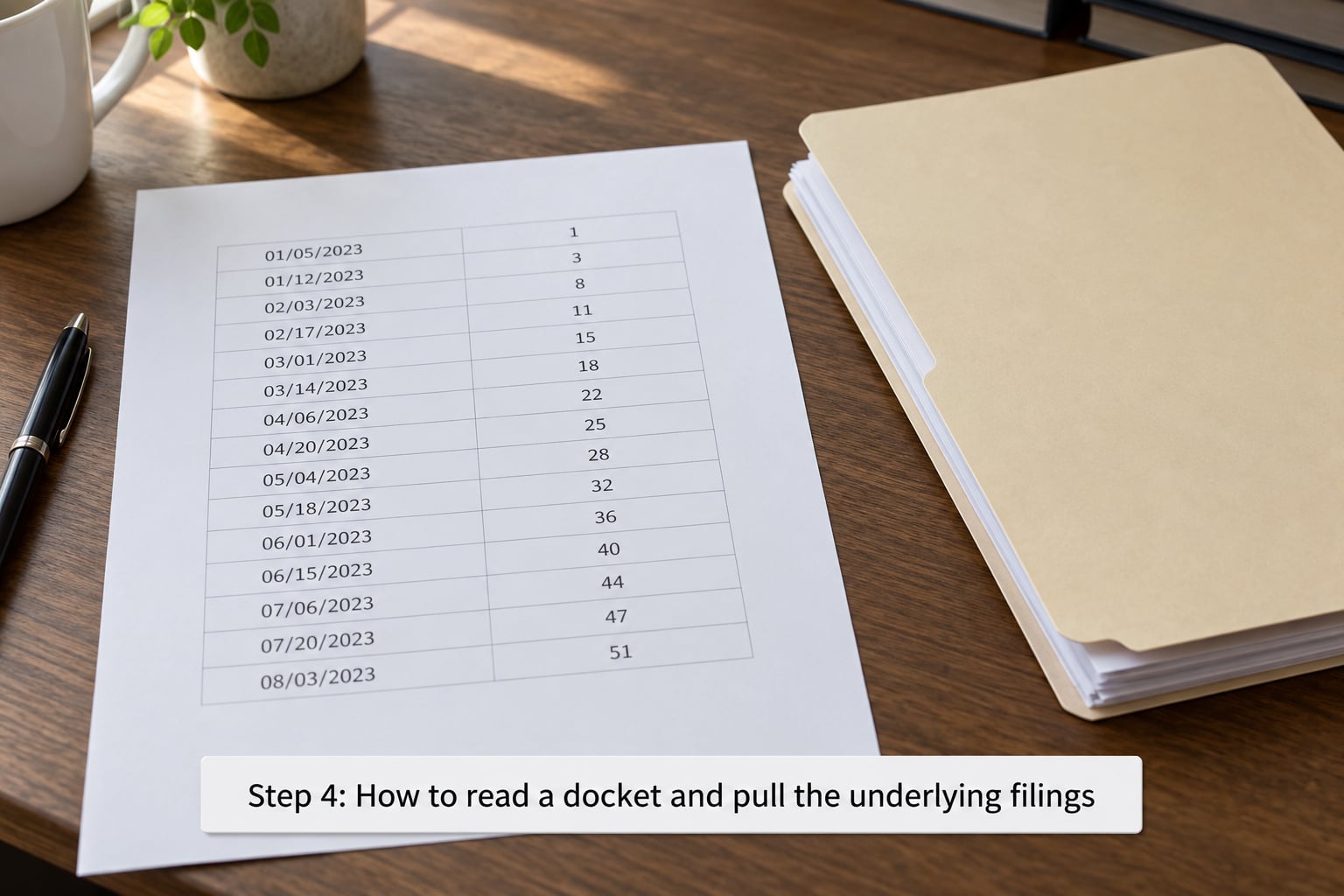
Most of what people mean when they ask how to use court records for investigations is really about this: reading a docket with confidence. The docket sheet is the spine of a case, a chronological list of every entry with a date, a document number, a short description and a page link. Learn to read it and you can reconstruct a case without opening every file.
A complaint is the document that starts a civil case and states the allegations. In a criminal case the equivalent is the charging document, followed by an arraignment. An answer or response is the other side’s reply. A summary judgment, dismissal or judgment order tells you how it ended. Exhibit lists and witness lists appear as separate document numbers, and in most jurisdictions you can request them without paying to pull everything else.
Dates matter more than titles. A case filed in 2026 might not have produced a decision until years later, and a docket that looks quiet may simply be a case that stalled. Note the procedural posture as you go: pending, on appeal, settled, dismissed, or closed with a judgment.
When a document is not available, write down that fact rather than guessing at its content. Sealed filings, juvenile matters, grand jury material and records under a protective order are routinely absent, and “I could not obtain” is an honest line in a story. “Unavailable” also happens for dull reasons — a case file microfilmed decades ago, a clerk’s system that only indexes the last decade, or a document scanned but not yet processed.
Step 5: How to build a case chronology that holds up
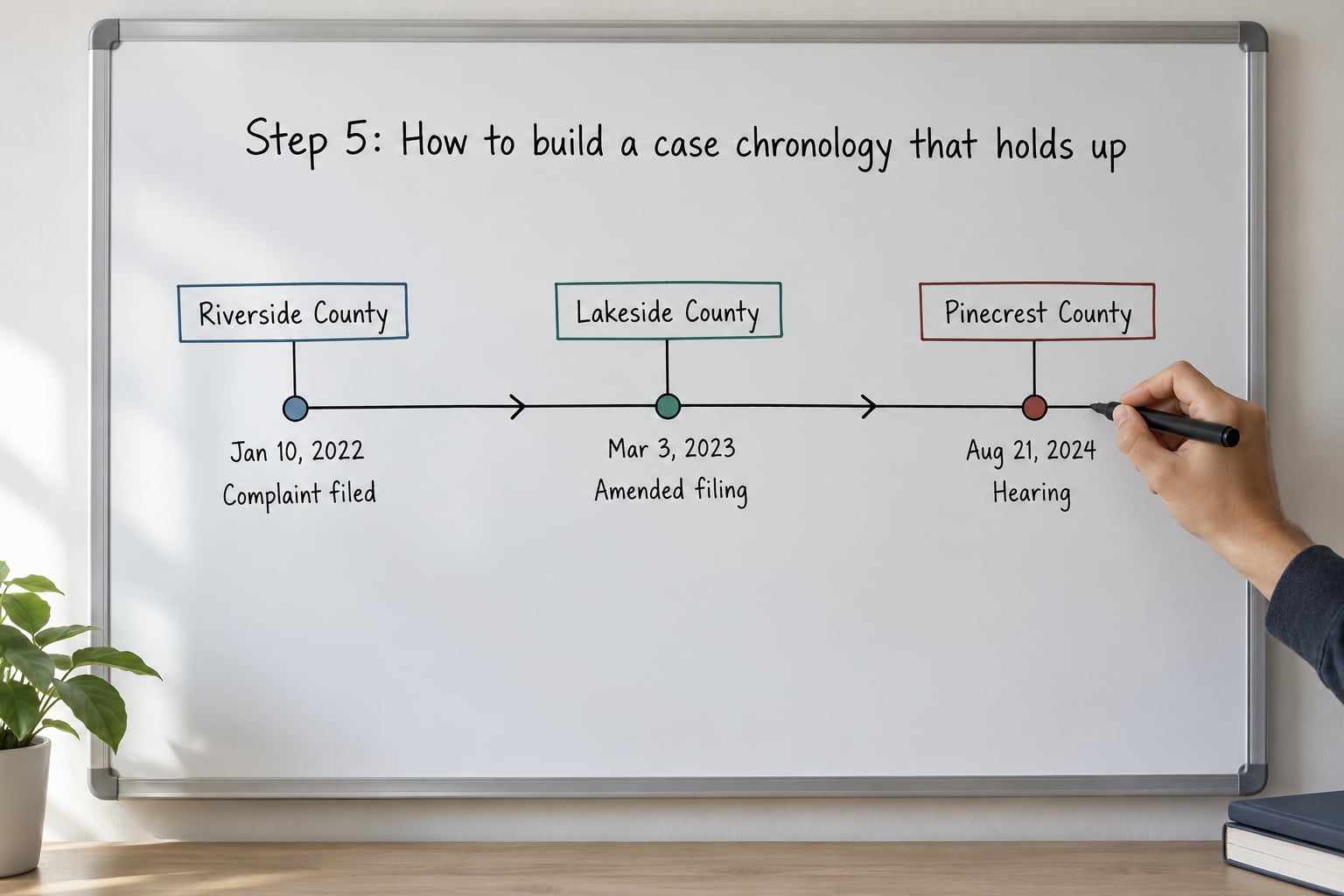
Turn the docket into a timeline with one row per entry: date, court, case number, what happened, and a link to the document. Once entries from several cases sit on the same timeline, the pattern is usually obvious — the same witness, the same address, the same company name across three matters in two counties.
Flag anything amended, sealed or filed later as a correction. An amended complaint supersedes the original, and citing the superseded version is a real error that editors do catch. Note the sequence of filings rather than just the last one, because a dismissal followed by a refiling tells you something quite different from a dismissal alone.
You know the chronology works when someone who was not in the room can read it and reach the same conclusion you did. That is a fair test of whether your evidence trail is actually documented.
Step 6: Connect people, organizations and events across cases
Names, addresses, roles and dates are the linking fields, and they are all fallible. A shared surname proves nothing. So does a shared business address when that address is a registered agent or a coworking space. A shared date of filing is suggestive, not confirmatory.
Look for combinations instead: the same uncommon middle name plus the same county, or a role listed identically in two captions, or an address that appears as a residence in one case and a mailing address in another. Legal entities make this harder than people — parent companies, subsidiaries and dissolved entities file under names that do not obviously connect, so check the state corporation registry before you assume two defendants are unrelated.
Keep a “possible link” column separate from your “confirmed link” column. When a connection rests on inference, it stays visible as inference all the way to publication, and nobody downstream has to guess which was which.
Step 7: Corroborate every material finding
Set a verification routine before you start rather than at the end, when the story is written and you are tired. This is the part of how to use court records for investigations that most often gets skipped, and skipping it is how a fair-looking story turns out to be wrong. For each finding that will appear in print, open the original filing, confirm the court clerk’s index agrees, and look for at least one independent public record that speaks to the same fact.
What corroboration looks like depends on the claim. For a criminal conviction, the docket plus a certified disposition from the clerk is strong; an arrest alone is not a conviction, and a pending charge is not a finding. For a company’s litigation history, pair the docket with the entity’s own filings and any regulatory record. For a claim made by a source, check whether the underlying document exists at all, because a great deal of “court records” in circulation are only ever reported on second-hand.
Label uncertainty explicitly as you go. “The complaint alleges,” “the order states,” “no responsive pleading was filed” and “the clerk’s index does not show a disposition” are four different things, and collapsing them is how legal reporting goes wrong.
Where a third-party aggregator and the official clerk disagree, believe the clerk and say so in your notes. Aggregators are useful for triage, but they run on scrapes with their own lag and their own errors.
Step 8: Document the research and report it fairly
Your evidence log should let someone else repeat the work: every query you ran, the court and portal, the date, the case numbers, the URLs, the files you saved, and a short note on what each document did and did not establish. Keep copies of the documents themselves, not just the links, because portals change and links rot.
Write findings in language that matches the record. Allegations belong to whoever filed them, not to the court. Rulings belong to the judge, and you name which judge. Unresolved questions are stated as unresolved. Where you relied on a public document that remains sealed but is being litigated in public, say that plainly rather than implying you obtained the sealed material.
Run a pre-publication check before the story goes anywhere: every name confirmed against a caption, every date against a filing stamp, every allegation labelled, every sealed or expunged record handled per your own rules. Legal review matters most when minors, victims, ongoing investigations or uncharged people are involved, because those are the situations where a fair story can still do real harm.
Common Mistakes
Treating a name match as an identity match. This is the single most common error, and the most consequential. The fix: require at least one corroborating identifier before you connect any record to any person, and treat a bare name match as a lead rather than a finding.
Trusting a docket that is months out of date. Federal case data and many county indexes update on their own schedule, and a case that is still listed as pending may have been disposed of quietly. The fix: check the filing date against today, and confirm anything load-bearing with the clerk’s office or a fresh index query.
Missing amended filings. An amended complaint or a corrected judgment replaces what came before. The fix: read every docket entry, not the first three, and cite the version that was in force at the time you are describing.
Reading a blank result as a clean record. A missing result may mean sealed, expunged, juvenile, non-reportable, in a court you did not search, or simply not indexed yet. The fix: before you write that someone has no record, check the other three layers and the clerk directly, and describe the absence as unverified rather than negative.
Confusing an allegation with a finding. A complaint is one side’s account; a judgment is the court’s conclusion; a plea is a resolution. The fix: attribute everything to its source in the sentence itself, and never let a verb like “did” sit next to a word like “alleged” without the attribution in between.
Downloading everything in sight. Pulling entire case files in bulk costs real money on fee-charged systems, generates access notices you did not need, and collects material you have no intention of using. The fix: pull the specific documents your questions require, and use the free archive and case indexes to decide what deserves a copy.
Overreaching from the record. A dismissal is not a statement that the allegations were false, and a conviction in one matter is not a pattern. The fix: report what the record says, in the record’s own terms, and leave interpretation to your readers and to any expert you quote.
A few handling habits make the rest easier. Save an unmodified copy of every document you rely on, with the retrieval date in the filename. Keep your notes in plain text alongside the files, not only in an email thread. Note which court supplied which fact, so that a question from an editor takes a minute rather than an afternoon. And when you rely on a summary someone else wrote, go back to the filing it came from — the gap between a docket entry and a retelling of it is where errors live.
Frequently Asked Questions
Which court records should I search first for an investigation?
Start with the court where the event happened, not where your subject lives. Civil and criminal cases usually sit in the county of the courthouse that handled them, federal cases sit in a US district court, and bankruptcy has its own system. Check the county clerk first for local matters, the state repository for appellate and statewide criminal history, and PACER plus the free RECAP archive for federal cases. The absence of results in one layer means nothing until the other three are checked.
Can I use sealed court records in a published investigation?
Rarely, and never by default. If a filing is sealed by court order, the proper route is a motion to unseal, an appeal, or a records request where the law allows it. If sealed material reaches you anyway, publishing it can expose you to contempt consequences and to a separate privacy claim, and it can damage people who had no chance to respond. Describe the litigation, the arguments and the ruling. Say plainly that the underlying document is sealed and therefore unavailable to you.
How do I find someone in court records when I only have an alias?
Work backwards from other sources rather than guessing at the legal name. Property records, business filings, professional licensing records and news coverage often carry a fuller name or a middle initial that a court caption uses. If you find any case, the caption will give you the exact legal name, and that name then works everywhere. A unique combination such as an unusual middle name plus a specific county or employer narrows the search far more than the alias alone.
Does appearing in a lawsuit prove that someone did something wrong?
No. A complaint is one party’s account, filed to begin the case, and most civil suits settle or are dismissed. Even a criminal conviction reflects a finding by a court on the charges brought, not a general finding about a person’s character or honesty. What the record does establish is that named parties are connected by a dispute, on a date, in a particular court. Report the disposition accurately, including dismissals, acquittals, sealed matters and charges that were never filed.
What is the ethical way to collect and publish court information?
Collect the minimum you need, store it securely, and never republish juvenile records, victim identities, addresses of people connected to open investigations, or material whose significance depends on a document you have not read. Give every named person a genuine chance to respond, state your evidence for each claim, and separate what a record shows from what you infer. Legal review earns its cost when a story involves minors, allegations that were never charged, or a case still being litigated.
Conclusion: Start With the Question and Jurisdiction
How to use court records for investigations well comes down to a short list of habits, and the first one is the one most people skip. Write your question as a checkable fact claim, name the document that would answer it, and work out which court holds that document before you open a single search box. The rest is disciplined repetition: search every name, read the whole docket, build a timeline, confirm each finding against a source independent of the one that produced it, and record everything as you go.
Most court record research is not difficult, it is just unforgiving of shortcuts. Treat a blank result as an open question rather than a clean record, treat a name match as a lead rather than a person, and describe allegations in the words of whoever made them. Do that consistently and your file will hold up to scrutiny, which is the only real test of whether the reporting was worth doing. Portals, fees and access rules shift over time, so confirm current procedures with each clerk’s office before you rely on them in 2026 or any year after.