A news app developer spends the day building and maintaining the mobile and web products a news organization uses to deliver journalism: the app readers open every morning, the breaking alert pipeline, the live coverage pages, and the publishing system behind them. A large part of the day is not coding. It is stand-ups, triage, testing alongside reporters, cutting releases and watching how the product behaves while the news cycle moves.
A news app developer, defined in one sentence, is the engineer who decides how journalism reaches people. The title covers far more ground than it sounds, and the schedule is unlike almost any other software job because the deadline is an editor’s story going live, not a quarterly target.
This site is written by people who build these products, so the schedule below is a composite of real newsroom days rather than a generic office routine. Tooling changes fast, so treat the names as examples of what a 2026 newsroom stack tends to look like, not a shopping list.
Table of Contents
- What Does a News App Developer Do All Day?
- How Does the Developer Work With Reporters and Designers?
- What Skills Does a News App Developer Need?
- Which Tools Are Used to Build a News App?
- How Do Developers Make News Apps Fast and Reliable?
- What Happens After a News App Launches?
- Is News App Development a Good Career?
- Frequently Asked Questions
- Start With the Story Behind the App
What Does a News App Developer Do All Day?
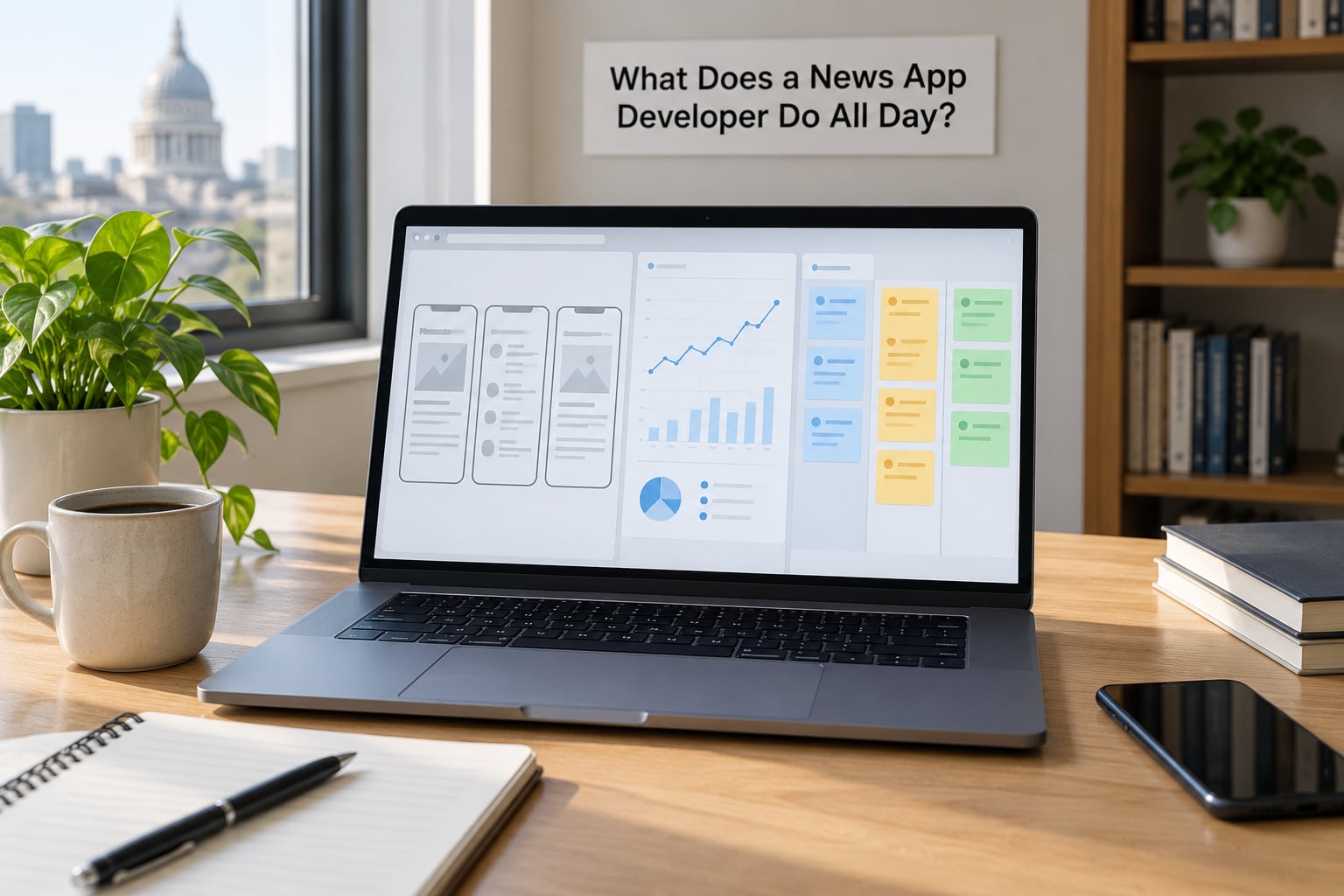
The core job is turning an editorial need into a product that works when a reader opens it in a hurry. A reporter wants a searchable archive of budget documents. An editor wants election results that update without anyone pressing refresh. A graphics reporter has a chart that reads well on a laptop and falls apart on a phone. Each request becomes a technical plan, a build, a test pass and a release.
Here is how that work divides across a normal week.
| Responsibility | What it actually looks like | Share of a normal day |
|---|---|---|
| Planning and stand-ups | Reading the overnight list, reporting status, picking the two things that matter most today | About an hour, spread across the morning |
| Building features | Writing and reviewing code for a feed, an alert, a live page or a membership flow | The largest block, usually three to four hours of uninterrupted work |
| Integrating data | Wiring official results, public records or a wire feed into a page that updates itself | Intermittent, and heavy on big story days |
| Testing and quality checks | Opening the app on a phone, a tablet and an old device, hunting for the layout that breaks | Rising as readers spend more time on phones |
| Collaboration | Sitting with a reporter or designer to fix the thing they meant, not the thing you built | Constant and hard to protect |
| Documentation | Writing release notes and leaving enough context that someone else can pick it up at midnight | Skipped under pressure, which causes future pain |
| Maintenance | Responding to a broken feed, a rejected app release or a slow page after traffic jumps | Rises to fill the day when news breaks |
The stereotype people carry into this job is that developers sit and write code all day. Practitioners push back on that hard, and the reason is simple: most of a news app developer’s day is spent on things no one can screenshot from a commit log, such as waiting on a designer, waiting on an editor to confirm a headline, or working out why a paywall counted the wrong reader.
What Changes from Morning to Afternoon?
The shape of the day is more predictable than people expect. Mornings are for coordination, afternoons for review and release. Exact hours depend on the team, but the rhythm repeats.
| Time | Activity | Who you work with | Typical tools |
|---|---|---|---|
| 8:30 | Stand-up and status, plus anything that broke overnight | Other developers | Chat, issue board |
| 9:00 | Newsroom sync: what is publishing today and what the pages must do | Editors, reporters, product | Chat, publishing calendar |
| 9:30 to 12:00 | Deep build time on the agreed feature | Mostly alone, code review after | Editor, repository, branch |
| 12:00 | Alert and publishing checks: drafts, scheduled stories, push notifications | Copy desk, alerts desk | Publishing system, alert console |
| 13:00 to 14:30 | Design and editorial review of what was built | Designers, reporters | Design file, staging link |
| 14:30 to 15:30 | Cross-device testing and fixes found there | Developers, QA | Real devices, test runs |
| 15:30 to 16:30 | Release or release preparation, then watching the monitoring dashboard | Engineers on call, release manager | Release tools, dashboards |
| 16:30 to 17:30 | Wrap-up: notes, backlog cleanup, tomorrow’s plan | Whole product group | Issue board, docs |
That table is a normal day. A major story day looks nothing like it, and understanding that difference is the fastest way to grasp the job.
How Does the Developer Work With Reporters and Designers?
Newsrooms are split into departments that talk to each other constantly. Julia Beizer, chief product officer at Bloomberg, put it plainly: technology and news are technically different departments, but everyone partners together every day. A developer sits somewhere in the middle of that, translating editorial intent into technical decisions.
The translation usually starts with a user story. Someone writes “As a subscriber on a phone, I want to see live results without reopening the page,” and the developer turns that sentence into acceptance criteria: how fast data must refresh, what happens when a feed is late, whether the page still works when the reader is offline.
Design handoff matters more than in many industries, because newsroom design decisions carry legal and ethical weight. Fonts, spacing and image cropping determine whether a page is accessible to a reader with low vision. The developer is usually the one who has to argue that contrast requirements are not optional decoration.
Consider election night. A developer building a results tracker has to satisfy several stakeholders at once: the politics editor wants every race, the data reporter wants the district detail to be correct, the audience team wants readers who are not signed in to see results before hitting the paywall, and the mobile team wants the whole thing to survive a traffic spike nobody forecast. That is a four-way negotiation before a line of code gets written.
Editorial review is the step outsiders find hardest to accept. A story can be finished, edited and approved, but if the product the reader sees behaves oddly, the release waits. Sometimes it does not wait. Then a known flaw goes live, gets logged, and gets paid back later. One rule from the NPR apps team is a good summary of the whole culture: build for use, refactor for reuse.
What Skills Does a News App Developer Need?
The skill list looks long until you sort it into three buckets: technical, editorial and collaborative. Newsroom hires weight the second and third more heavily than a generic software job posting does.
Technical skills. Reading and writing JavaScript or TypeScript for the web side, and Swift or Kotlin for native mobile work, though plenty of teams use a cross-platform framework and a good deal of Python for data work. Working with REST APIs and data feeds, since news arrives as JSON from wire services, government portals and the CMS. Performance work: page load time, image weight, caching, offline reading. Automated testing and version control, because release day is not the time to try something clever.
Editorial skills. News judgment is the one that surprises people. A developer needs to understand what a live blog is, why a correction notice matters, how a paywall is expected to behave for members, and what “breaking” actually means for the alert desk. Understanding the difference between an embargoed document and a published one has real consequences in code.
Collaborative skills. Writing a user story, explaining a technical limit to an editor without jargon, and disagreeing in a way that leaves the relationship intact. On a breaking story the developer is negotiating with people whose professional reputation depends on the hour, not the sprint.
Which skill matters most depends on the role. Someone building interactives and charts leans on data work and visual design judgement. Someone maintaining the app’s reading experience leans on performance and mobile ergonomics. Someone on the alerts pipeline needs to understand audience behaviour as much as notification APIs.
Which Tools Are Used to Build a News App?
Nobody uses all of these, and the stack changes as newsroom teams consolidate. Grouping tools by what they help a developer accomplish is more useful than any inventory.
| Purpose | Common examples | What it lets the developer do |
|---|---|---|
| Planning and issue tracking | Jira, Linear, a shared board | See what is in the sprint and who is blocked on whom |
| Code and review | GitHub or GitLab | Track changes, review a colleague’s work before release |
| Design handoff | Figma | Read spacing, type scale and tap-target sizes instead of guessing |
| Conversation | Slack with channel conventions | Reach the alerts desk or the copy desk in seconds during a live story |
| Content and data sources | CMS, wire feeds, official results APIs, document archives | Pull stories and structured data into the product automatically |
| Charts and maps | Open mapping and data-visualisation libraries | Draw results, turnout and incident maps that update on their own |
| Testing | Unit and integration tests, real device farms | Catch the broken layout before an editor opens the story on their phone |
| Release and distribution | App Store Connect, Google Play Console, CI pipelines | Cut a release, meet store review rules, roll it back if it misbehaves |
| Analytics | Product analytics, page-speed monitoring, crash reporting | See whether readers are actually reading, and on what |
The pattern worth noticing: most of these tools exist to make a decision quickly, because the decision window is short.
How Do Developers Make News Apps Fast and Reliable?
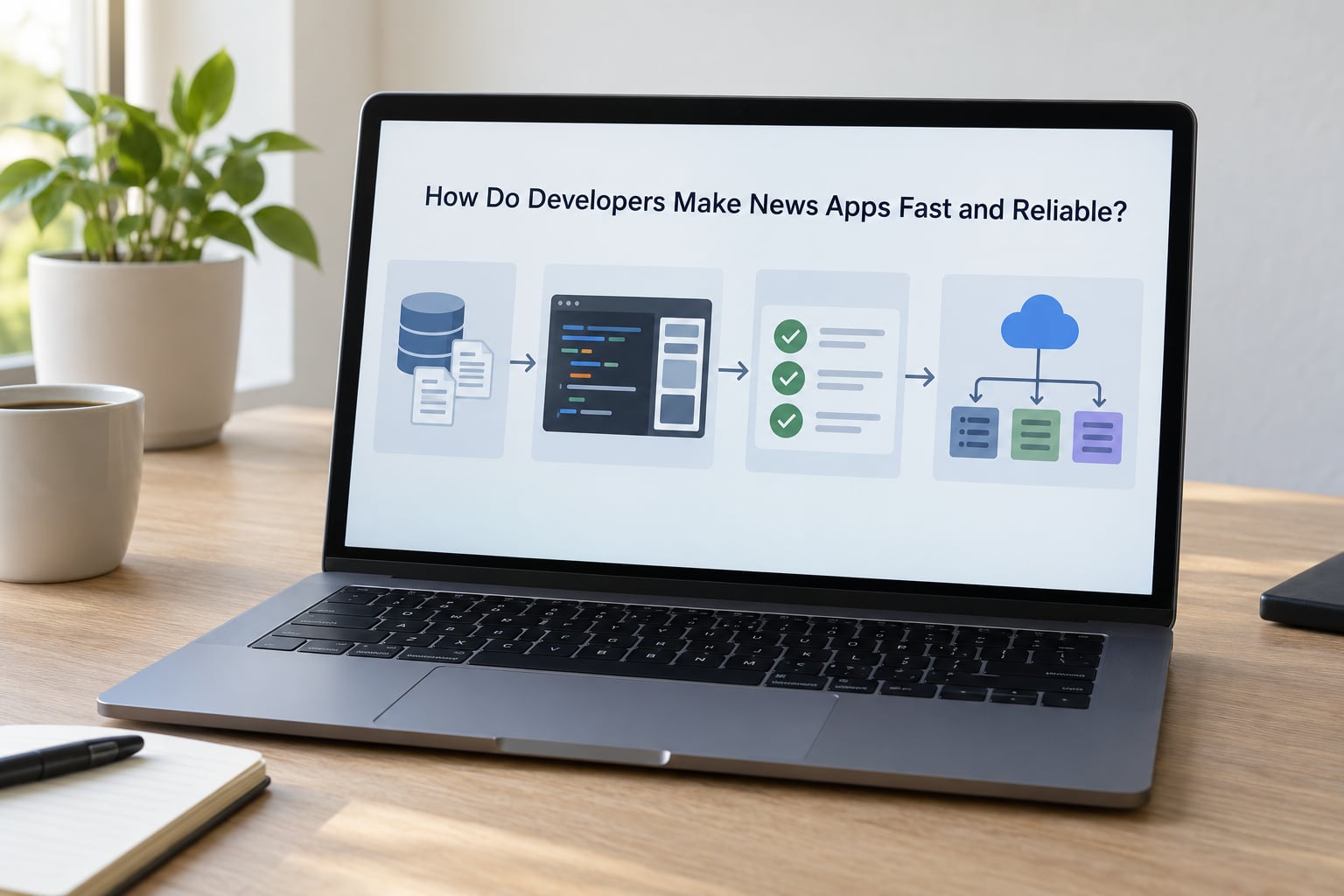
Speed in a newsroom does not mean sloppy code. It means a process where the cheap mistakes are caught before a reader can find them. The pipeline runs roughly like this.
- Source data first. The feed, CMS field or results API is checked for shape, update frequency and failure behaviour before anything visual is built.
- Prototype with real content. A wireframe is tested with an actual headline, an actual photo and a real byline, because long headlines and thin vertical images break layouts that look fine with placeholder text.
- Iterate with editorial input early. Designers and reporters look at a staging link in week one, not at a reveal in week six.
- Write automated checks. The tests cover the parts that break quietly, like a paywall miscount or a stale timestamp.
- Test on the devices readers actually hold. An older phone on a slow connection is the honest test, and it is a hard one to pass.
- Verify with the desk. Someone on the editorial side confirms the page renders the story as intended before release.
- Release, then watch. Dashboards are checked closely for the first hours, because a bad release is discovered by readers if nobody else finds it.
One newsroom rule that ages well: if it does not work on mobile, it does not work. That single sentence decides a lot of argument about fonts, interaction patterns and page weight.
What Happens After a News App Launches?
Launch is the least interesting part of the story. What follows is the part that fills the second half of a developer’s year.
Monitoring comes first. Page speed, crash rates, and whether the alerts people opted into are still arriving on time. Then there is reader feedback, which arrives as screenshots, complaint emails and the occasional long social thread about something that took eleven seconds to load on a train.
Data feeds break. A results API returns an empty array at 11 p.m. on election night and nobody knows why, so someone has to find out. A public records site changes its response format overnight and the story page starts rendering blanks. These are the incidents that eat a morning.
Accessibility issues surface late and matter. A caption missing from a video, a chart with no text alternative, a heading structure that makes a screen reader wander. These get filed as bugs by people using the product for real, and they get fixed because the alternative is indefensible.
Then the news itself changes the roadmap. A big investigation needs an interactive that did not exist in the plan. A new section launches and needs its own navigation. A story format that readers keep closing gets rebuilt. News app developers do not ship a finished product; they maintain a moving one.
Is News App Development a Good Career?
It suits people who want their work to be read the same day they write it. The feedback loop is unusually short and unusually public: an editor opens your feature, ten thousand readers open it too, and you find out quickly whether it was a good idea.
The constraints are real. Deadline pressure is part of the job rather than an occasional crisis, and you will ship things you are not proud of. You also need genuine curiosity about journalism, because a workflow that makes sense to an engineer can be completely opaque to an editor, and the product breaks when those two views collide. Newsroom budgets are tighter than most, which usually means fewer people doing more work.
On entry: a computer science degree helps but is not required, and plenty of people arrive from data journalism, design or a decade on a reporting desk. What tends to matter more is whether you can build something end to end and explain it to a non-engineer. An internship on a visuals, product or interactive team is the most direct door, and open-source newsroom tooling is a good way to show judgment rather than just syntax.
For anyone curious about the wider craft, learning the newsroom vocabulary early — live blog, embargo, correction notice, alert desk — saves a lot of confusion in your first week.
Frequently Asked Questions
Is a news app developer mostly writing code all day?
No. A news app developer probably spends a third of a normal day writing or reviewing code. The rest goes to planning with editors, testing on devices, reviewing designs, cutting releases, answering questions from the alerts desk and fixing whatever broke overnight. The code is the visible part of the job, not the whole job.
Do you need a journalism degree to become a news app developer?
No. Most news organizations hire on technical ability plus newsroom judgment, not on credentials. Plenty of developers in news app teams came from software jobs, and plenty came from reporting desks or data journalism. What matters is being able to build something end to end and explain it clearly to an editor who is not technical.
How do I become a news app developer without experience?
Build one real project that solves a news problem: an election results tracker, a public records search tool, an interactive explainer. Publish it, write up what you built and what broke, and get feedback from working journalists. An internship or fellowship on a newsroom visuals, product or interactive team is the fastest route in, because it teaches the editorial constraints that tutorials skip.
Do news app developers work long hours during breaking news?
Sometimes, yes, and it depends on the newsroom rather than the company. Election nights, disasters and major court rulings usually mean being reachable past normal hours, with the work split across a team so nobody carries it alone. Quiet weeks look much more like normal office hours. The honest answer is that evenings and weekends belong to the job in the same way late print deadlines once did.
What should I include in a news app developer portfolio?
Show one finished project and explain your decisions, not just the screenshots. Say where the data came from, how often it updates, what happens when a feed fails, and which device or screen size broke your layout. That reasoning is what newsrooms hire for, because most candidates can list tools. Linking the code and writing about a mistake you fixed both help.
Start With the Story Behind the App
The clearest way to understand the work is to trace one story from request to release. Someone in the newsroom needs a number that updates itself, the developer asks what happens when the source is late, the designer makes it readable on a phone in sunlight, an editor checks the wording, and it goes live before the news cycle moves on.
If you want to try it, pick one public dataset and one news question, build the smallest version that answers it, and write down what you learned when it broke. That write-up is what a newsroom hiring manager actually reads.