
How to pitch a data story to an editor comes down to one paragraph: state the finding in a single sentence, prove it with a number, say why it matters to that outlet’s readers right now, and offer one easy next step. If you can do that in 150 words, the pitch is basically written.
A data pitch is a short, targeted email to an editor that explains what you found in a dataset, why it matters to their readers now, and what you can hand over if they say yes. It is not a press release, not a job application, and not a description of your toolkit.
The difference between a pitch that gets commissioned and one that disappears is usually not talent. It is whether the editor had to do any interpretive work. Hand them the meaning, and they can say yes on a phone between meetings.
Table of Contents
- What You Need
- How to Pitch a Data Story to an Editor
- How to Pitch a Data Story to an Editor: Start With the News
- How to Pitch a Data Story to an Editor: Prove the Finding
- How to Pitch a Data Story to an Editor: Show the Audience Impact
- How to Pitch a Data Story to an Editor: Propose a Clear Format
- How to Pitch a Data Story to an Editor: Make the Collaboration Plausible
- How to Pitch a Data Story to an Editor: Submit the Pitch
- Common Mistakes
- Frequently Asked Questions
What You Need
A successful pitch connects a meaningful data finding to a story with public interest, and it hands the editor everything required to decide in one reading. Nothing else is optional, and most of it takes an afternoon to assemble.
Six ingredients matter, in this order:
- A one-sentence news angle. The change, contradiction or consequence a reader should know about.
- Evidence of significance. At least one specific number, and a sentence on why the pattern is not noise.
- Source and access details. What data you already hold, what records you have requested, and whether you can hand over the analysis itself.
- Audience relevance. Which of this outlet’s readers is affected, in a phrase the editor would recognise.
- A proposed format. One deliverable, matched to what the finding actually needs to communicate.
- A realistic production plan. Roles, schedule, and who does the cleaning, design and development work.
Methodology belongs here too, but in compressed form: three or four lines on sample size, time period, geographic scope and known limitations. Editors do not want a methods paper in the email. They do want to know you are not fooling yourself.
How to Pitch a Data Story to an Editor
A data pitch should travel from the finding to its journalism and production implications. Describing a dataset or a piece of software is what gets a reply of “interesting, let us know what you find.” Naming the consequence is what gets a commission.
This is the structure editors describe when they describe what they read first: the finding, why it matters, who is affected, how you verified it, and what the finished piece could contain.
| Pitch element | Target length | What it does |
|---|---|---|
| Subject line | 6-10 words | Gets the email opened, names the finding |
| Personalisation | 1 sentence | Shows you read their coverage, not a mailing list |
| The finding | 1 sentence | States the news as a completed claim |
| Why it matters | 2-3 sentences | Connects the finding to a specific group of readers |
| Proof and method | 2-4 sentences | Number, sample size, scope, limitations |
| Format and access | 1-2 sentences | Says what you can deliver and what you can share now |
| Next step | 1 sentence | One low-friction ask, easy to say yes to |
Keep the body between 75 and 150 words. Go to 200 only when the investigation genuinely needs the room. Anything past that tends to get skimmed rather than read, and the ask usually hides at the bottom of a long email.
Four qualities recur in every pitch that works: concise, concrete, credible and current. Concise means the reader never rereads a sentence. Concrete means real numbers and named places. Credible means the method survives a sceptical glance. Current means the finding lands on a live conversation, not a settled one.
How to Pitch a Data Story to an Editor: Start With the News
Identify the newsworthy claim before you write anything else. A newsworthy claim names a change, a contradiction, or a consequence. “I analysed 400,000 permit records” is not a claim. “Building permits in this county were approved at four times the rate of neighbouring counties for a decade” is.
Editors working this beat can tell within seconds whether a pitch is a story or an announcement. The difference shows up in the first two lines: a story asserts something that has consequences, an announcement describes something that happened to you.
To tell an original finding from a familiar trend, ask whether anyone has already published the same comparison. If they have, your angle is probably something narrower: a different geography, a different time window, a subgroup that got averaged away, or a question the earlier work never asked.
Unexpected and null results deserve a paragraph of their own. If you looked for an effect and found none, that can be a real story when the effect was assumed to exist: a widely repeated claim that the data simply does not support. Pitch it as the contradiction it is, not as a failed analysis. Editors hear “the data does not show what everyone assumed” far more clearly than “I could not find the effect.”
Protecting the finding matters too. Send enough to be credible and withhold the part that would let someone else reproduce the story while you are still reporting it. Keep the raw source unpublished, keep your analysis notebook private until a commission is agreed, and avoid presenting an unpublished angle at an open pitch event where it can be scraped. Nothing is lost by emailing a named editor directly instead.
How to Pitch a Data Story to an Editor: Prove the Finding
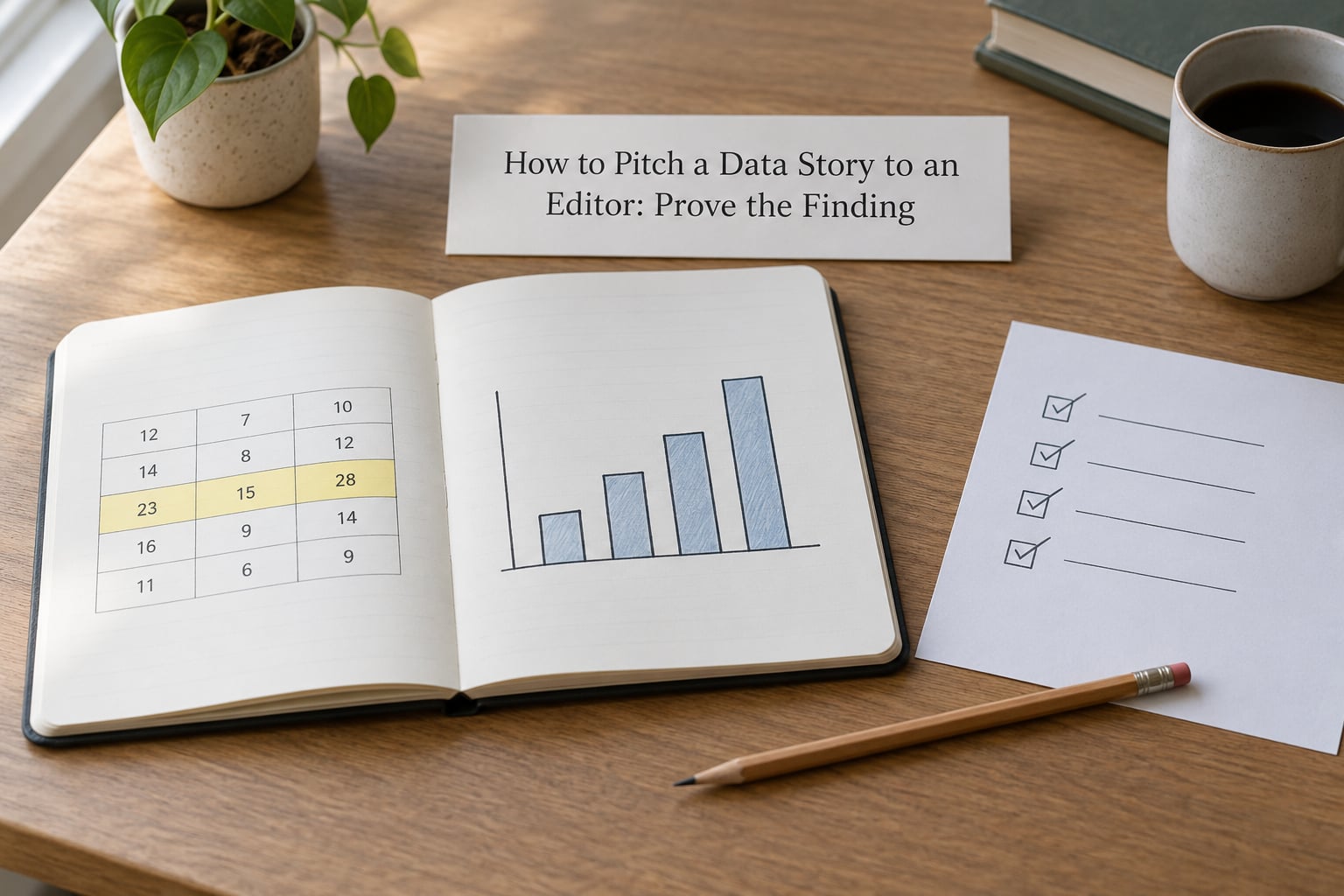
Summarise the data in three moves: what it shows, what it cannot show, and how you checked. That is enough. Anything longer buries the story, and the story is the only reason the email is open.
What it shows: the pattern, the magnitude, the population. What it cannot show: the confound you could not rule out, the missing months, the group too small to report. What you checked: the second source, the sanity total, the obvious alternative explanation you tested and rejected.
Name the sample size and the time period in the pitch itself. Editors who commission analysis worry about standards and legal review as much as they worry about readers, and a sentence that shows you already understand the limits of your own data makes that conversation shorter later.
Offer the underlying material as proof rather than as homework. A link to the dataset, the notebook or a draft chart does more for credibility than three paragraphs of description, and it lets the editor look without downloading a 40MB spreadsheet.
How to Pitch a Data Story to an Editor: Show the Audience Impact
Connect the finding to a specific group of people and name the decision it could change. “This affects 200,000 residents” is arithmetic. “This affects the county board vote scheduled for the spring budget hearing” is journalism.
Five framings cover most cases:
- Local. Name the council, the district, the agency. Local editors can act on it this week.
- National. Show how a local anomaly repeats in several places, or how a national average hides a large group.
- Workplace. If the pattern shows up in hiring, wages, safety or scheduling data, there is an obvious reader.
- Consumer. Prices, fees, insurance, coverage. The test is whether a reader can check their own situation against it.
- Accountability. Follow the money, the promises and the reporting requirements. Where a stated commitment and the records disagree, that gap is the story.
The “why now” question is where most pitches lose ground. Tie the finding to something already happening: a vote, a hearing, an earnings season, a rule change, an anniversary of a policy. If nothing is scheduled, say what makes the moment: a release of data that has not been examined before.
How to Pitch a Data Story to an Editor: Propose a Clear Format
Propose one deliverable that fits what the finding needs to communicate, and say what each element helps a reader understand. Over-promising interactivity is a fast way to lose a newsroom that has to maintain it.
- Annotated chart. Best when one comparison carries the story. One takeaway line at the top, the units and the source underneath.
- Searchable database. Best when readers want to check their own record, a company, a ward or a provider. Needs a clear update owner.
- Interactive map. Best when geography is the point. Expensive to build and to maintain, so pitch it only when the pattern is genuinely spatial.
- Annotated timeline. Best for policy, enforcement or slow-burn change, where the reader needs to see sequence rather than magnitude.
- Explanatory article. Often the right answer. When the finding needs interpretation rather than scanning, a reported piece with strong graphics beats a tool.
- Visual essay. Best for a human story that the numbers set up but cannot carry alone.
Whatever you choose, mention the two or three elements inside it: the annotated chart, the methodology note, the searchable records. Editors build stories from components, so naming the pieces makes the commission easier to approve.
How to Pitch a Data Story to an Editor: Make the Collaboration Plausible
An editor is not just asking whether the story is good. They are asking whether it can be staffed by people they already have, or by you, in a window they already have. Give them a plan they can staff.
Cover roles and reporting needs first: interviews to secure, records to request, and how long the records process realistically takes. Then the technical workload: data cleaning, matching records across systems, and building or designing the deliverable.
Flag review early. If the analysis touches a named company, a person or a contested claim, a standards or legal editor will see it, and a newsroom that expects that costs less than one caught by surprise.
Then give a schedule with real slack. Six weeks with two weeks of buffer reads as experienced. Six weeks with nothing spare reads as someone who has never had an editor change a question mid-report.
Expect the questions about capacity, maintenance and risk. Who updates the database after publication? What happens if a record is corrected? Who owns the notebook in a year? Answer them in a line each, and you signal that you have thought about what comes after the first publish, which is a question freelancers often forget.
Money comes later, but worth thinking about early: rate, kill fee if the story is commissioned and then dropped, and whether the data or analysis carries reuse rights. Raise it once interest is real, not in the first email.
How to Pitch a Data Story to an Editor: Submit the Pitch
Send a short email, tailored to the outlet, with one low-friction next step. Sixty to one hundred fifty words is the working range. Keep the subject line under ten words and put the finding in it, not the offer.
Subject lines that work for data angles:
- PITCH: The permit gap nobody has measured
- The number that contradicts the council’s own figures
- Data: hiring slowed in four districts, not one
- Your chart of X is missing the people who show up later
- We found the opposite of what the reports predicted
Here is the fill-in-the-blank version:
Subject: PITCH: [finding in under 10 words]

Hi [first name],

Your [month] piece on [specific story, linked or named] made me check
[same thing] across [scope]. The result: [one-sentence finding with
a number].

It matters for [specific reader group] because [consequence].
[One line on how you verified it, plus sample size and time period.]

I have [dataset / notebook / draft chart] ready. Happy to send the
data, or to talk for 15 minutes about whether this holds up.

[Name]
[Role or affiliation]
[One line of relevant work]
Before you send, read the recipient’s last ten published pieces and check the pitch names at least one of them. Freelancers who keep a simple tracker tend to find that referencing something specific an editor actually wrote is the difference between a reply and a delete. A mass send with a generic opening is recognised and discarded.
Follow up once, after three to five business days, with two new lines rather than “just bumping this”. If there is still no reply, stop. Pitch somebody else and note the date, the outlet and the angle in a tracker so you do not pitch the same idea twice.
Two adaptations worth knowing. For a newsletter or podcast producer, lead with the conversation the finding creates and offer the chart as a companion graphic. For a trade publication, keep the same structure but swap the audience line for the industry segment, which is the only thing that changes.
Common Mistakes
Most pitches fail for a small number of repeatable reasons. Each one has a fix you can apply before you hit send.
Leading with your tools. The objection behind it is “so what”. Fix: delete every mention of your language, library or database from the first paragraph and start with the claim instead.
Describing the method before the meaning. The objection is that the editor cannot tell whether it is a story. Fix: put one methodology line at the bottom, not three at the top.
Overstating causation. Correlation written as cause invites the standards editor in early. Fix: use “associated with” where that is what you have, and say so plainly in the limitations line.
Raw data with no public-facing purpose. The objection is the familiar one: an interesting chart with no stakes attached. Fix: name the person or decision affected before you mention the data source.
Hiding uncertainty. Fix: state the largest limitation in one sentence. Volunteering the weakness is what makes the rest of the claim believable.
Proposing five formats. The objection is that the work is unstaffable. Fix: propose one deliverable and one optional add-on.
Never stating the decision you are asking for. Fix: end with one line, such as “worth a 15-minute call to see if the data holds up”.
A few habits that help across the board: write the finding sentence first, before anything else; cut the draft in half and cut it again; read it out loud for anything that sounds like an announcement; and make sure a stranger could tell what changed and who noticed.
Frequently Asked Questions
How do I write a story pitch to an editor?
Write the finding first, as one finished sentence with a number in it, then explain who is affected and what they can now decide. Add three or four lines on method, sample size and limitations, propose one format, and close with one low-friction request such as a 15-minute call. Keep the body between 75 and 150 words and reference something specific the editor recently published.
How long should a data pitch be?
Between 75 and 150 words for almost everything, with about 200 as the ceiling for a complex investigation. Anything longer tends to get skimmed rather than read, and the ask usually ends up buried. If your pitch runs long, move the methodology detail into an attached note and keep the email itself tight.
Should I attach my data or analysis to a pitch email?
Link rather than attach, and send the dataset, notebook or draft chart when you offer them. Large attachments are a common reason pitches get binned, and a link lets the editor look without downloading anything. Offer the material explicitly as proof of the finding, and hold the unpublished source or the full notebook back until a commission is agreed.
How do I pitch an idea without it getting stolen?
Send the pitch by email to a named editor rather than presenting it at an open pitch event, and keep the raw source dataset unpublished. Give enough of the finding to be credible, hold back the specific comparison that would let someone else reproduce the story, and release the notebook once the commission is agreed. Direct emailing removes most of that exposure.
What makes a data story newsworthy to an editor?
Four qualities recur: it is concise, concrete, credible and current. Concrete means a real number and a named place. Credible means the method survives a sceptical glance, including honest limitations. Current means the finding connects to something already happening, such as a vote, a hearing or a rule change. Without all four, a pitch tends to get filed rather than assigned.
How do I follow up when an editor does not respond?
Follow up once, after three to five business days, and add something new: a sharper number, a second source, or a draft chart. Never write just bumping this, and never follow up twice. If there is still no reply, stop and log the pitch with its date and angle in a simple tracker, so you can tell over time which outlets and which framings actually convert.
Write the one-line finding before you write anything else, then send it to ten editors instead of perfecting it for one. Volume teaches you which angles convert faster than any amount of rewriting will.