
A newsroom sprint is a short, timeboxed working session where an editorial team takes one consequential audience problem, prototypes a possible answer, tests it with real readers, and walks out with a decision and a named owner. It is not a Scrum sprint, and it has nothing to do with the defunct mobile carrier. It borrows the discipline of a sprint, then spends that discipline on journalism instead of software.
Below is how to run a newsroom sprint end to end: what you need beforehand, the eight steps in order, the failure modes that kill these sessions, and a copyable agenda with minute-by-minute timeboxes. Everything here runs in a single working day with no budget. Last updated October 2026.
Short version for the impatient: spend 90 minutes or a full day, keep the group under eight people, give the decision-maker the floor at the end, and leave with a prototype, evidence, and a calendar slot. The sessions that fail usually fail at the handoff, not in the room.
Table of Contents
- What You Need
- Step-by-Step: How to Run a Newsroom Sprint
- 1. Frame one consequential newsroom problem
- 2. Choose the right team and decision-maker
- 3. Set the goal, evidence, and prototype scope
- 4. Map the reader journey and newsroom workflow
- 5. Generate and select ideas quickly
- 6. Build the smallest testable prototype
- 7. Test the prototype with target readers or colleagues
- 8. Demo, decide, and document the next step
- Common Mistakes
- Frequently Asked Questions
- Conclusion: Start With One Reader Problem
What You Need

You need eight things, and most of them are decisions rather than equipment. A sprint without a decision-maker is a brainstorm with a timer, which is where a lot of newsroom workshops end up.
- One focused problem. A sentence that names a reader or newsroom problem, not a theme. “Improve engagement” is a theme. “Readers abandon our weekly data newsletter after the first section” is a problem.
- A decision-maker in the room who can approve a prototype, a trial, or a small build on the spot. If that person cannot be there, the session is a pitch practice run.
- A cross-functional group of five to eight. Reporters, an editor, a designer, a developer or data person, and someone who knows the audience.
- Audience or reader evidence to work from: analytics exports, support tickets, newsletter retention data, social replies, reader letters, session recordings, prior story performance.
- Source material the team already has: past coverage, published projects that worked, a list of reader questions, the existing newsletter archive.
- Tools you already pay for. A wall or a shared board for sticky notes, a timer someone can see, a clickable prototype tool, and a screen for demos.
- A prototype scope you set in advance and a clear line between what you are testing and what you are building.
- A calendar slot after the sprint where the decision lands. Block it in the editorial calendar before you start, not after.
One more piece of prep saves the session: write the problem statement on a single sheet of paper and put it where everyone can see it for the entire day. A team that spends the first twenty minutes re-arguing the framing has already lost half its timebox.
Step-by-Step: How to Run a Newsroom Sprint
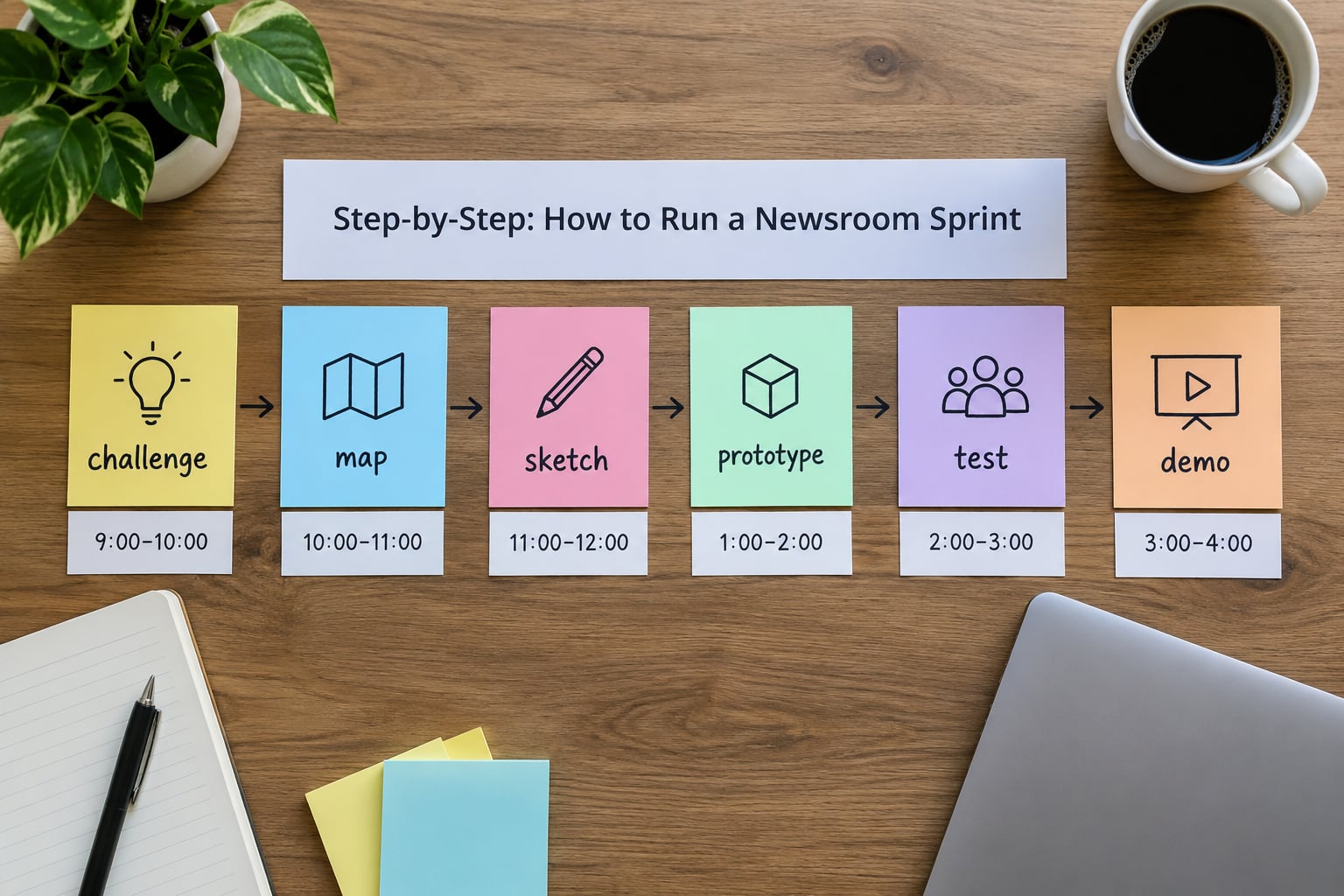
The sequence below is the run-of-show: how to run a newsroom sprint end to end, in order. The full-day agenda is laid out in the table; the same phases compress into 90 minutes for a smaller sprint, and the phases never change order.
| Time | Block | What happens |
|---|---|---|
| 0:00 | Frame | Read the problem statement aloud, agree the sprint goal, set the rules and roles |
| 0:20 | Map | Map the reader journey and the newsroom workflow on one surface, mark friction |
| 1:00 | Sketch | Silent divergent round, then cluster duplicates on the wall |
| 1:40 | Select | Score clusters against impact, evidence and effort, cut to two or three |
| 2:10 | Prototype | Build the smallest realistic version, usually a clickable flow or a paper version |
| 3:40 | Test | Five short sessions with target readers or colleagues on realistic tasks |
| 4:30 | Demo | Present, state what was learned, decide, assign owners and dates |
| 5:00 | Close | Capture unanswered questions, schedule the follow-up, thank the team and end on time |
1. Frame one consequential newsroom problem
Start by writing one problem statement the team can disagree with, because a statement nobody can disagree with will not guide a decision. A useful version names the reader, the moment they struggle, and what the newsroom currently does: “When a reader finishes our election guide they cannot tell which races are worth their time, and we have no way of knowing they left.”
Read it aloud and ask the team to modify it, not to approve it. Ten minutes is enough. If the framing changes twice in twenty minutes, you did not pick a problem yet.
2. Choose the right team and decision-maker
Five to eight people is the working range, and the number matters less than the mix. You want the reporter who knows the beat, the editor who assigns it, the person who builds, the person who designs, and one person who holds reader data.
Keep the group flat on paper. If your most senior editor is in the room, name the decision-maker explicitly and set one rule: everyone writes ideas silently first, so rank does not set the first idea on the table. The decision-maker listens through the divergent phase and speaks in the demo.
3. Set the goal, evidence, and prototype scope
Write a sprint goal in one sentence that starts with a verb and describes a decision, not a deliverable. “Decide whether we run a public-interest data desk and what its first format is” beats “build a data desk.”
Then set the prototype boundary out loud. A one-sprint prototype is a clickable flow, a paper version, a sample annotated graphic, or a hardcoded demo using real data. Anything with a production integration, a CMS component, or an editorial workflow change is out of scope, no matter how much the team wants it in.
Hand out the evidence before the session, not during. Ten minutes reading real numbers beats an hour of opinion in a room like this.
4. Map the reader journey and newsroom workflow
Put the reader journey on one surface: entry point, first question, the moment they decide to stay, the moment they leave. Beside it, put the newsroom’s own path, from assignment through reporting, standards and legal review, to publication. Teams routinely find the friction is on the newsroom side of the line.
Mark every handoff where something gets dropped. The gaps between audience insight and assignment, and between a pitch and a slot in the calendar, are the usual culprits. You are looking for one high-value opportunity, not a list of complaints.
5. Generate and select ideas quickly
Run a silent divergent round first: six minutes, everyone alone, ten ideas on paper, no discussion. Silence is the feature. It stops the first senior voice from setting the ceiling for everyone else, and it is the single cheapest fix for a hierarchical newsroom.
Cluster duplicates, then score the clusters against three agreed criteria: reach for the audience we care about, strength of evidence, and effort to test. Cut ruthlessly. Two surviving ideas beat nine survivors, because two ideas can be prototyped and tested inside the timebox.
6. Build the smallest testable prototype
Prototype the riskiest assumption, not the whole idea. If the risk is whether readers will scroll past a certain point, prototype a scroll. If the risk is whether a format fits a twice-weekly cadence, prototype two issues of it in a shared doc.
Use the fastest appropriate tool: paper and markers, a clickable wireframe, a spreadsheet mock of a page, or a hardcoded chart. Fidelity is not the goal. Realism is, because a low-fidelity prototype invites polite feedback while a realistic one reveals what people actually try to do.
7. Test the prototype with target readers or colleagues
Give five people a task, not a question. Ask them to find a specific fact, judge whether something is trustworthy, or complete the next step, and watch silently. What people do tells you more than what they say they liked.
Record three things per session: where they paused, what they tried that did not exist, and whether they got to the end unaided. Separate essential findings from preference, then write the essential ones down while they are fresh. “Blue is boring” is a preference; two people hunting for a date that was never shown is a finding.
8. Demo, decide, and document the next step
Demo to the room in five minutes: what you built, who you tested it with, what people did, and what surprised you. Then stop talking and make the decision explicit. Proceed, revise, or stop, said out loud, in front of the team. A decision that lives only in the notes is not a decision.
Name an owner, a date, and a scope for whatever comes next, and put it in the editorial calendar before people leave the room. Capture the unanswered questions as follow-up experiments with their own owners and dates. End on time; the discipline of the finish is what people remember.
Common Mistakes
Most newsroom sprints do not fail in the room. They fail in the same five ways, and each one has a fix you can apply next time.
The challenge is a theme, not a problem. “How do we grow our audience” cannot be tested in a day. “Why readers drop after the interactive in our explainer” can. The fix: rewrite the challenge so it names a reader, a moment, and a decision.
The team is too big. Twelve people produce twelve opinions and no decisions. The fix: cap it at eight, publish the list a day ahead, and give people a reason not to attend. Everyone else gets the written output the same afternoon.
No reader evidence in the room. A session with no data is an opinion session with better catering. The fix: bring three specific facts, one piece of reader language you can quote, and one example of coverage that already outperformed the rest of the same period.
The prototype became production work. The moment a designer starts polishing type and a developer starts wiring the CMS, the day is gone. The fix: state the boundary in step 3 and have the facilitator call it out loud the first time someone proposes it.
The session ends without a decision. This is the one that matters most, because it is where most of these sessions quietly die. Ideas leave the room as enthusiasm and arrive nowhere. The fix: put the decision on the agenda with a start time, and hold the last fifteen minutes for nothing else.
The junior voices never spoke. In a hierarchical newsroom the first idea usually comes from the most senior person and the rest of the room calibrates to it. The fix: silent writing first, and round-robin before open discussion, where each person speaks for sixty seconds with no interruption.
One tip that covers most of this: keep a visible “parking lot” surface for anything that is a good idea but not today’s job. Unparked ideas become arguments about scope; parked ideas become next sprint’s input.
Frequently Asked Questions
How long should a newsroom sprint last?
Ninety minutes works for testing a narrow format or revising an existing feature. Half a day covers mapping, idea generation, prototyping and one test round. A full day is right when you need a coded demo or five reader sessions, which adds about 90 minutes. Protect the closing decision above all: if time runs short, cut the divergent round, never the demo.
How many people should be in a newsroom sprint?
Five to eight. Below five you lose enough range to miss an obvious solution; above eight, discussion dominates and the day turns into a pitch meeting. The mix matters more than the count: include a reporter, an editor, a builder, a designer and someone who holds audience data. Send the rest of the newsroom the written output afterwards.
Is a newsroom sprint the same as a Scrum sprint?
No. A Scrum sprint is an engineering cycle for shipping software increments against a backlog, measured in story points. A newsroom sprint is a facilitated working session for choosing and testing journalism, measured in reader evidence and a go, revise or stop decision. The shared element is timeboxing and a fixed goal. Nothing else carries over, and importing backlog and estimation language tends to derail the room.
Can you run a newsroom sprint remotely?
Yes, with one change: run the divergent round asynchronously. Post the problem statement, give people 24 hours to submit ideas in writing, and spend the live hour clustering, selecting and assigning. Live remote sessions lose the silent-idea advantage and the whiteboard, so compensate by sharing a single board in advance and requiring cameras on during the demo. Never run a remote session longer than 90 minutes.
Who should facilitate a newsroom sprint?
Someone who is not the person being evaluated. That usually means a newsroom manager, an audience or strategy lead, or a colleague from another desk. The facilitator runs timeboxes, guards the rules, and speaks least. Do not let the editor-in-chief facilitate their own priority sprint, because the group will spend the day managing that relationship instead of testing the prototype.
What do you do with the ideas a newsroom sprint does not pick?
Write every unselected idea on a single sheet with the reason it lost: not enough evidence, too costly to test, or a duplicate of something already running. Send it to the whole group the same day. Undocumented ideas resurface in a month as somebody’s frustration that the process ignored them, and the next sprint gets harder to run.
Conclusion: Start With One Reader Problem
The whole method fits in one sentence: pick one reader problem that matters, get the people who can act on it into a room for a fixed half day, prototype the riskiest piece, test it with real readers, and leave with a decision that has a name and a date attached.
Start smaller than that if it helps. Most of how to run a newsroom sprint well comes down to constraints: a 90-minute sprint on one feature, with four people and one decision-maker, beats a full-day innovation offsite that produces a slide deck nobody reads.
And do not skip the follow-through. Block the calendar slot before the session starts, because that single detail is the difference between a newsroom that tests things and a newsroom that discusses testing things.