
To get a journalism fellowship, you need three things reviewers can verify: published evidence of your reporting, one specific project they can fund, and an application that answers every prompt on the page. Most rejections are not about talent. They are about unclear ideas, thin work samples, or proposals that ignore the stated rules.
This guide walks through the whole process, from screening eligibility to following up after you hit submit. It takes most serious applicants three to six weeks of steady work once they have a project idea, and the step people skip is the first one.
What is a journalism fellowship? A journalism fellowship is a competitive program, usually six to twelve months long, that funds a journalist to pursue a specific reporting, technology, or innovation project. It typically pairs a stipend with mentorship, access to a newsroom or cohort, and sometimes equipment or travel money, in exchange for a defined deliverable.
Funding is attached to the project, not to the person in the abstract. That distinction explains why a fellowship application reads differently from a job application: nobody is assessing your personality in paragraph one, they are assessing whether a defined body of work can happen on schedule and reach people who need it.
Table of Contents
- What You Need
- How to Get a Journalism Fellowship: Step-by-Step
- Common Mistakes
- Frequently Asked Questions
- What is a journalism fellowship?
- Do I need published work samples to apply for a journalism fellowship?
- How much do journalism fellowships pay?
- How competitive are journalism fellowships?
- Can international journalists apply for US fellowships?
- Why was my journalism fellowship application rejected, and when can I reapply?
- Conclusion
What You Need
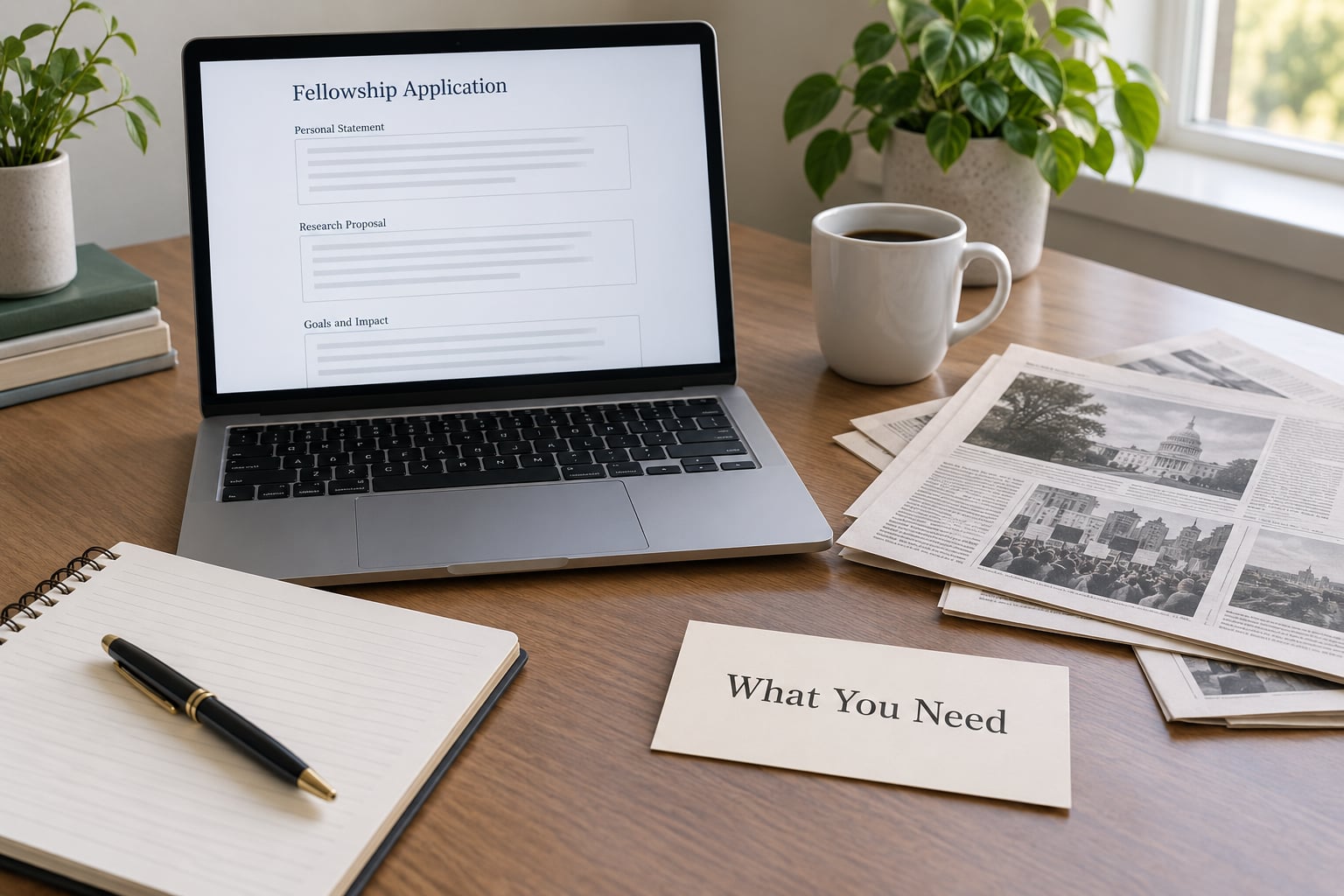
Before you write a single sentence of the proposal, you need the raw material. Here is the checklist that comes up again and again across program pages.
Eligibility proof. Most programs draw a line around career stage: some want fewer than five years of professional work, others only consider reporters with a staff job, and a large group accept students and recent graduates. Eligibility is usually defined by years of experience, geography, and whether you hold a full-time reporting role.
A body of work. Committees ask for a set number of published clips or links, commonly three to five, and some programs specify that they must be recent. Some reporting grant programs ask for three published or aired work samples, a bar that surprises students who assume student work is excluded.
A project with a defined output. The number of deliverables, the format, and the length are all specified somewhere. A proposal for a series of twelve data-driven stories is judged against a program expecting one longform investigation, and the mismatch is fatal even if the reporting is better.
A timeline and a budget. Many applications require a month-by-month schedule and a line-item budget. Committees read budgets as feasibility tests. A travel line that has no math attached reads as a guess.
Recommendation contacts. Two editors, a newsroom leader, or a faculty member who can speak to your reporting. Ask them early, because a referee approached the night before the deadline rarely writes something specific.
Proof you can deliver. A portfolio, a data notebook, a published investigation, or a documented project. This is the part early-career applicants struggle with most, and the fastest fix is publishing work under your own name before you apply.
How to Get a Journalism Fellowship: Step-by-Step
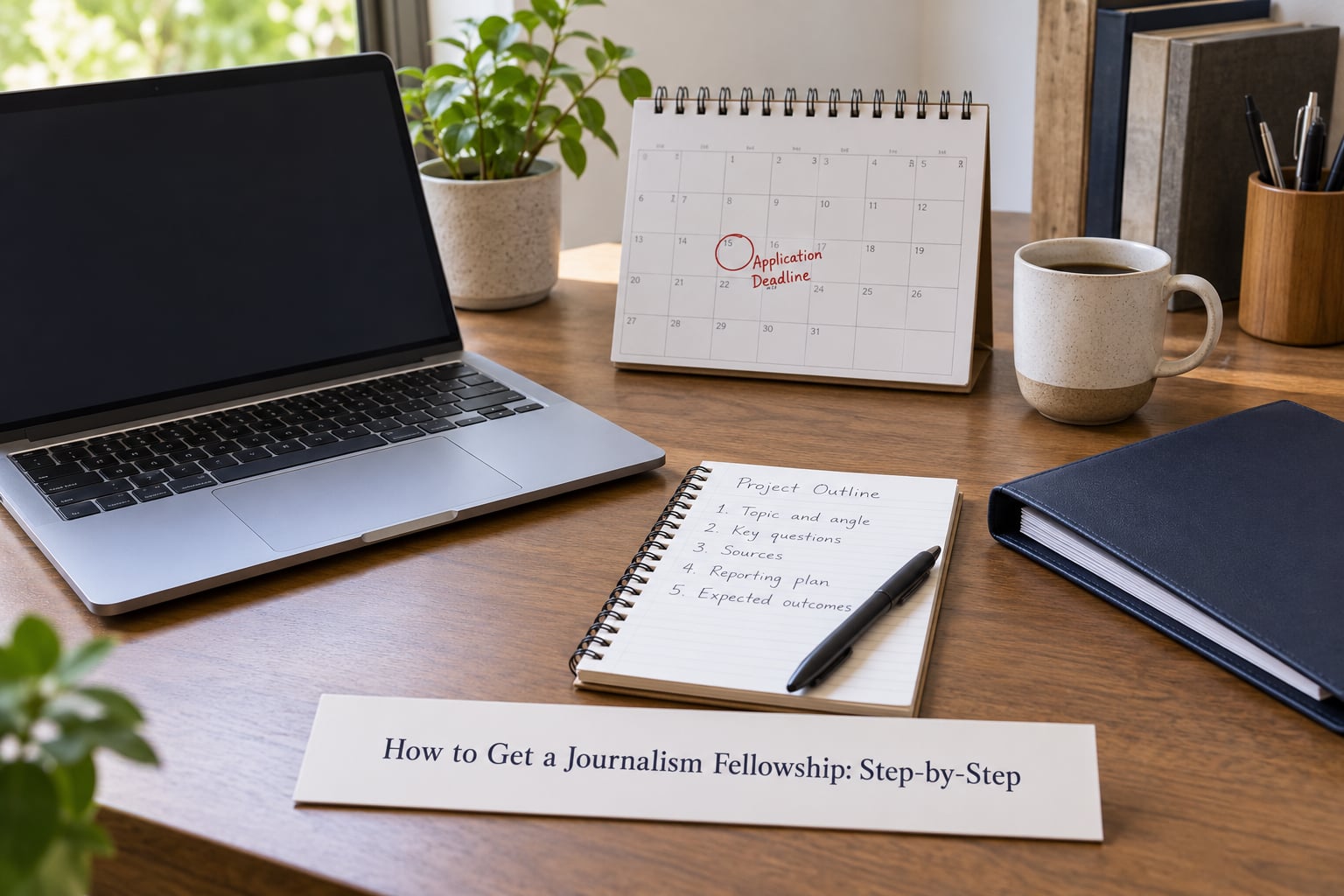
The workflow below is the order that saves time. Skipping step one is how applicants end up spending a weekend on a proposal to a program they were never eligible for.
Step 1: Research the Fellowship and Confirm Eligibility
Read the whole program page before anything else, then answer the boring questions first. Are you in the eligible career window? Are you in an eligible country or region? Does the program fund individuals, whole teams, or both? Is the application limited to one project per cycle, and does that limit apply per funder or per program?
Then dig into the material that actually tells you who won. Past fellows’ project pages, selection committee names, and published announcements describe the caliber of work that gets funded, and they tell you far more than the mission statement does.
Assess fit against four criteria, and be honest about each one. Does your idea sit inside what this program funds? Can you complete it in the stated window with the resources you control? Does your work sample show you have done something this hard before? Does your career stage match who they usually select?
If two of the four are shaky, the fellowship is not the right target this cycle. There will be another one.
Step 2: Build a Strong Journalism Portfolio
Work samples are where weak applications die. Reviewers read them fast, looking for evidence of reporting skill: did you find something others missed, did you verify it, did you explain why it matters.
Assemble the packet in this order:
- Your strongest published clip, first, with a one-line note on what you did and what came of it.
- Two or three supporting pieces that show range, such as a data project next to a narrative feature.
- One unpublished or in-progress project with a memo explaining the reporting you have already done.
- A link to your work rather than pasted text, plus a short note if any piece sits behind a paywall.
- A one-paragraph methods note on how you verified your biggest claim. Few applicants send one, and it is read closely.
No bylines yet? Publish your own. A data investigation on a public dataset, a documented local story, or a visual explainer with a methodology note all count as work samples when you host them and stand behind the reporting. The bar is verifiable evidence, not a masthead name.
Make one page per project. Reviewers open fifteen applications in a session, and a wall of text loses to a clean page with a headline, a date, an outlet or publication name, and a sentence of context.
Step 3: Choose a Project That Fits the Fellowship
A funded project answers four questions in one breath: who is affected, what is broken, what you will produce, and what changes when it exists. If you cannot finish that sentence, you have a topic, not a project.
Test your idea against the program’s own categories. Programs that fund technology want a working tool with a newsroom workflow, not an idea for a tool. Programs that fund reporting want published accountability journalism, not a research agenda. The same topic reframed for the right program is a strong proposal; the same topic pitched at the wrong one is a rejection with a polite note.
Scope the deliverable to what you can genuinely finish. Twelve ambitious stories become three finished ones, and a fellowship ends when the money ends. Narrow scope plus clear public benefit beats a wide topic every time.
Write the one-sentence version of your project now and reread it a week later. If it is still the sentence you want to fund, it is probably right.
Step 4: Write a Compelling Application
Answer every prompt in the order given, and answer the one that was asked. Reviewers notice when a candidate answers a different question well instead of the actual question, and they notice word limits that were ignored.
A strong proposal has these parts:
- The problem, described from the audience’s side, with a specific number, date, or document where possible.
- The approach: sources, records, data, or communities you will work with, and why you have access.
- The output: format, length, number of pieces, and where they will publish or be hosted.
- The timeline, month by month, with reporting milestones rather than vague phases.
- The budget, with real arithmetic and a short justification for each line.
- The impact: who uses the result, and what changes for them, described without inflated claims.
- Why you: the specific experience that makes this project executable by you rather than anyone else.
On the personal statement, applicants ask whether it should be a journalism mission or a life story. Both work when the story produces the reporting; neither works when it substitutes for it. Explain why this project, using concrete detail from your past work, and keep the personal material to a couple of sentences that earn their place.
Write to the prompt’s limit, not to your own sense of a good length. Many programs cap proposals around 500 words, others at two pages, and a shorter well-shaped proposal usually beats a longer one.
Name the work you have already done. Numbers, publication counts, response rates, and reach are the details that get cited and remembered, and vague claims about passion for storytelling carry no information at all.
Step 5: Seek Feedback and Revise
Revision is where applications separate from the rest of the cycle. Give the draft to two people outside the project: an editor who understands reporting standards, and a person who knows the fellowship but not your idea.
Ask specific questions rather than what do you think. Ask where they got confused, which claim they could not verify, whether the timeline is believable, and whether the budget makes sense. Ambiguous feedback is wasted, and vague praise is worse than nothing because it hides the problem.
Revise for four things: clarity, feasibility, distinctiveness, and fit. Clarity means a reader who knows nothing about your beat can follow it. Feasibility means the schedule survives contact with reality. Distinctiveness means the idea is yours, not a topic every applicant in the pool could pitch. Fit means the language matches the program’s stated priorities.
Revise the opening last. Most readers decide early, and a first paragraph that buries the public value costs you the rest of the application’s attention.
Step 6: Submit Early and Follow Up Professionally
Submit two or three days before the deadline, not two hours. Technical failures, login timeouts, and file size limits cause a surprising share of late-night panic, and reviewers who start reading on the closing day do not read carefully.
On submission day, confirm the receipt email, download or save every uploaded file, and check that your references were notified if the program requires it. Keep a record of what you sent, because a missing attachment is invisible to you and fatal to your application.
Afterward, send one short follow-up only if the program lists a contact and only if you add something useful, such as a late source document or a clarification of a sentence in your proposal. One message, under a hundred words, no pressure, no follow-up chase. Silence is a normal outcome of a submitted application.
Then write down what you would change, and start the next application. Applicants who treat each cycle as practice get better at this faster than applicants who treat it as a verdict.
Common Mistakes
1. A topic with no deliverable. I want to explore the future of local news cannot be funded, because there is no end point. Fix: name the number of pieces, the format, and the publication outlet before you write anything else.
2. Ignored word limits. Long proposals get skimmed, and skimmed proposals lose. Fix: set a hard character counter in your editor, then cut the setup paragraph first, because the setup is the part reviewers most often have already read in your work samples.
3. A personal statement about everything except the project. Family history, career transitions, and childhood reading occupy space the committee wanted spent on reporting. Fix: two sentences of personal context, then evidence of what you have done.
4. Thin or borrowed work samples. Three links to lightly edited wire rewrites signal a shallow portfolio. Fix: lead with one piece only you could have made, and add a methods note explaining your verification.
5. A budget with no arithmetic. Round numbers and missing costs read as a wish list. Fix: give each line a quantity, a rate, and a total, and add a short sentence on why the money moves the reporting forward.
6. Applying where you do not fit. Career-stage and geography filters exist because the cohort is built as a group. Fix: screen eligibility before the project, and keep a shortlist of two or three programs that genuinely fit your stage.
Two habits fix most of the rest. Start the calendar early, because the proposal depends on groundwork you may not have done yet, such as securing records requests, testing data access, or confirming that a partner newsroom will host the work. And talk to your employer before you apply if you are employed, framing the fellowship as funded continuing professional development with a defined return date rather than as time away.
Frequently Asked Questions
What is a journalism fellowship?
A journalism fellowship is a competitive program, usually six to twelve months long, that funds a journalist to pursue a specific reporting, technology, or innovation project. It usually combines a stipend with mentorship, access to a newsroom or peer cohort, and sometimes equipment or travel money, in exchange for a defined deliverable such as a published investigation or a working tool.
Do I need published work samples to apply for a journalism fellowship?
Most programs expect three to five published clips, though some reporting grants ask for fewer and others specify recent work. If you have no bylines, publish your own reporting on a public dataset, a documented local story, or a visual explainer with a methodology note, and submit that with a short memo on the reporting you already did. Reviewers look for verified work, not a masthead name.
How much do journalism fellowships pay?
Amounts vary widely by program, duration, and funding source. Individual fellowships commonly range from a few thousand dollars for a short grant to a full-year residential stipend, while institutional and leadership programs have historically paid far larger sums, sometimes tens of thousands of dollars for a year. Stipends are usually treated as taxable income, so check the rules in your country before you rely on a figure.
How competitive are journalism fellowships?
Popular residential and leadership programs receive hundreds of applications for a cohort that often numbers in the dozens, so acceptance rates can sit in low single digits. Smaller regional and grant programs are far less crowded, and institutional applications from a newsroom with a defined budget are judged on a different scale. Applying to two or three programs per cycle raises your odds without raising the work much.
Can international journalists apply for US fellowships?
Many programs welcome applicants from outside the US, but eligibility rules vary and some restrict funding to US citizens or residents. Check the eligibility page before investing time, and plan for visa, relocation, and tax questions early, since stipends are usually taxed as income and cross-border payments can take weeks to set up. Programs such as those run by international journalism organizations often have clearer guidance for non-US applicants.
Why was my journalism fellowship application rejected, and when can I reapply?
The most common reasons are an unclear project, weak work samples, a budget that does not add up, or a mismatch between your career stage and the cohort the program builds. If the program gives feedback, read it carefully and change the specific thing it names. Fellowships hire slowly and often remember strong rejected applicants, so waiting roughly six months before reapplying to the same program is a common piece of advice from fellowship applicants themselves.
Conclusion
Start this week, not when a deadline appears. Shortlist two or three fellowships you actually qualify for, confirm each eligibility rule line by line, and publish or repackage three work samples that show verification skills. Then write the one-sentence version of your project and expand it into the prompts those programs actually ask.
Most of the work in how to get a journalism fellowship happens before the application opens. Do that work early and the proposal writes itself.