
A newsroom developer builds the tools journalists actually use to report and publish: interactive graphics, data pipelines, story templates, election-night pages, newsletter products and, increasingly, AI-assisted reporting workflows. They sit on the editorial side of the newsroom, working with reporters and editors rather than in an IT department.
Learning how to get a job as a newsroom developer is unusual in one genuinely good way: almost nobody arrives with the right job title on their resume. Newsrooms keep hiring from adjacent roles, software engineers, data analysts, designers and graphics editors who taught themselves to code. What they screen for is whether you can ship a story tool and explain it to an editor, which is a far lower bar than most applicants assume.
Two honest caveats before the steps. The market is small: a single metro area might have a handful of relevant openings in a year rather than hundreds. And the pay sits below big tech almost everywhere except a few lead and AI-focused positions. If you can accept that trade, the work is interesting and the hiring bar is unusually reachable.
Plan on six to eighteen months of focused work. It is faster if you already write code for a living, and slower if you are starting from HTML and CSS.
Table of Contents
- What You Need
- Step-by-Step: How to Get a Job as a Newsroom Developer
- 1. Choose a newsroom developer specialty
- 2. Build the technical skills employers expect
- 3. Create newsroom-specific portfolio projects
- 4. Learn to collaborate with reporters and editors
- 5. Find newsroom developer opportunities
- 6. Network without making it awkward
- 7. Tailor each application to the newsroom
- 8. Prepare for interviews and technical conversations
- 9. Follow up, negotiate, and start well
- Common Mistakes
- Frequently Asked Questions
- Do I need a journalism degree to get a job as a newsroom developer?
- Can I become a newsroom developer without newsroom experience?
- What projects should I include in my newsroom developer portfolio?
- Which programming languages are most useful for newsroom technology work?
- How do I find newsroom developer jobs when I do not have a journalism background?
- What should I expect in a newsroom developer interview?
- Conclusion
What You Need
The prerequisites are shorter than people imagine. Nobody hires on a certificate. Every item below can be built or borrowed in the six months before you start applying.
A portfolio with something shipped. One live project with a real audience beats a dozen tutorial clones. Publication counts for more than a GitHub repo with three forks, because it proves someone else trusted the work enough to put their name on it.
Version control and deployment. If you cannot branch, review a diff, and ship a change on a Friday afternoon, you will struggle on day one. Git plus one hosting and deploy path is enough.
Data and API experience. Newsroom work is full of cleaning a messy government spreadsheet, joining it to a shapefile, and rendering it in seconds. Scraping, SQL, JSON, and one public data source you have actually used end to end will carry you a long way.
Newsroom workflow literacy. Know how a story moves from pitch to publish, what an editor reviews, and what a correction looks like. This is the leg most candidates skip, and it is the one editors notice.
Plain-language communication. You will explain a trade-off to a reporter who is not technical, and you will do it while a deadline is close.
| Role family | Must have | Nice to have |
|---|---|---|
| Interactive and front-end | JavaScript, HTML and CSS, D3 or a comparable charting library, responsive and accessible layout | TypeScript, animation, performance profiling, mobile-first debugging |
| Data | SQL, Python, cleaning and joining public data, scraping, data visualisation basics | Geographic data and shapefiles, statistical reasoning, reproducible analysis |
| Back-end and automation | One server-side language such as Python, Django, Ruby or Rails, APIs, deploys and CI | Cloud storage, caching, monitoring, cost control |
| AI-assisted reporting | Prompt design, retrieval over newsroom archives, evaluation and fact-checking discipline | Pipeline orchestration, model serving, guardrails against fabricated output |
Pick one row to be genuinely strong in and stay honest about the rest. Hiring managers for interactive roles rarely care that you have never touched a model, and the reverse is just as true.
Step-by-Step: How to Get a Job as a Newsroom Developer

1. Choose a newsroom developer specialty
Apply as a specialist, not a generalist. A resume that says full-stack developer gets read by nobody; one that says interactive graphics and data visualisation gets forwarded to the graphics editor.
The main specialties are data journalism, interactive graphics, news apps and story templates, mapping and geospatial work, newsroom automation, audience and newsletter products, and now AI-assisted reporting tools. Each has a different daily reality and a different hiring manager.
Choose based on what you have actually built, not on which sounds most impressive. If your strongest work is a scraper and a chart, you are a data person and should say so. You will tell it worked when you can name three specific jobs you applied for and can point to the same kind of work in all three.
2. Build the technical skills employers expect
The practical baseline is JavaScript plus one server-side language, HTML and CSS, APIs, Git, some form of automated testing, accessibility, data handling, deployment and enough security awareness to know why a token belongs in a server environment.
Accessibility is not optional in a newsroom. Public-service media and large publishers are frequently bound by requirements that carry legal weight, and a keyboard trap in an interactive graphic is a real problem rather than a polish issue.
Some of this you can learn on the job, and newsrooms know it. Server-side depth, infrastructure and performance tuning are common gaps that a hiring editor will accept because the harder-to-teach things are editorial instinct and taste.
How do you know you are ready? Build a project where someone else uses it without you in the room. If your editor had to explain the tool to a reporter before it went live, you still have work to do.
3. Create newsroom-specific portfolio projects
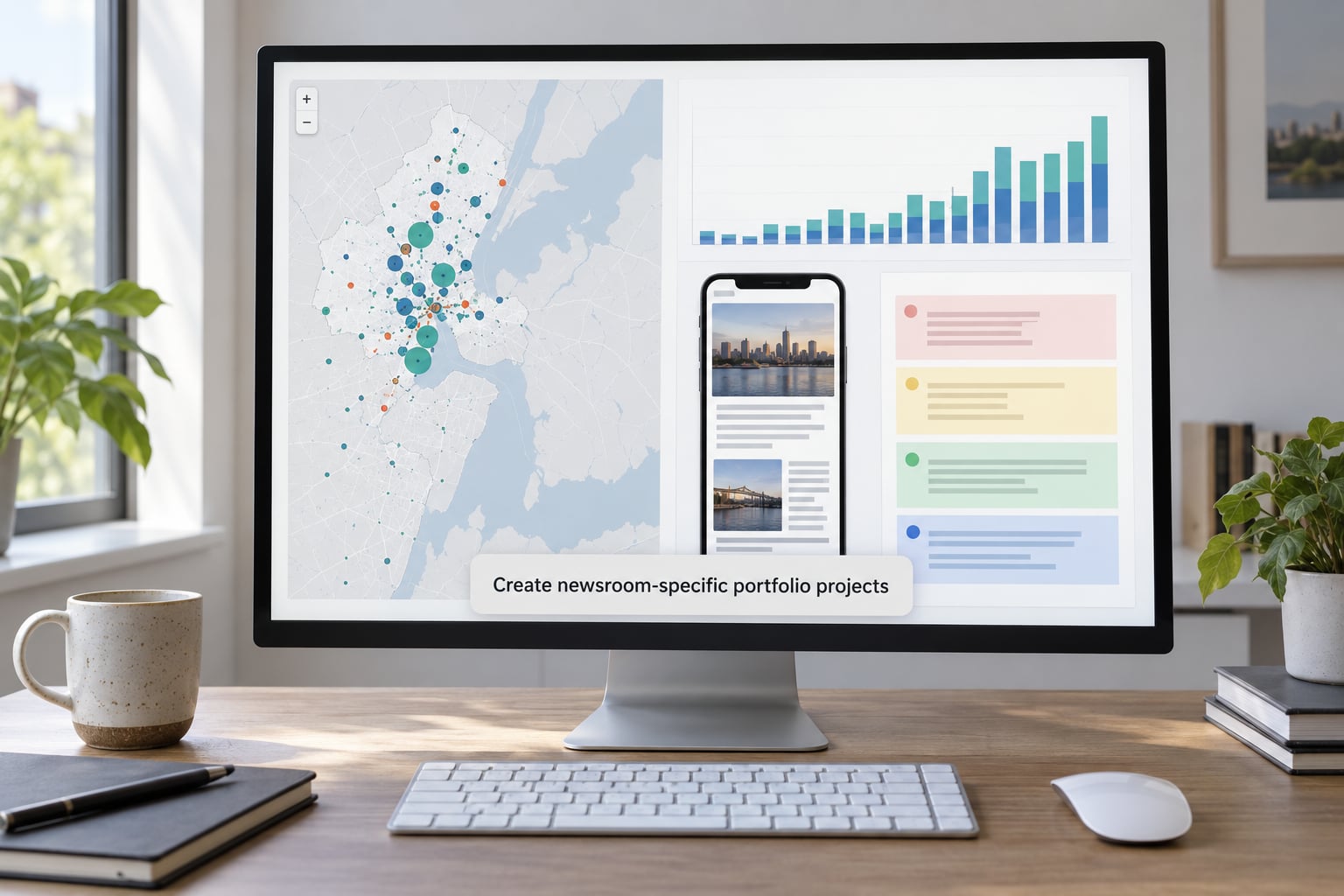
Two or three well-written case studies beat a wall of screenshots. Each one should read like a short editorial memo, not a readme: the reporting problem first, then the editorial workflow, then your design decisions and technical architecture, then testing, limitations and any measurable result.
The reporting problem matters most. An editor scanning your portfolio is asking one question: would this person understand what we do? A write-up that opens with the stack reads like a job application, and one that opens with the reader question reads like a colleague.
A good mix is one data project using a real public dataset, one visual or interactive piece built from scratch, and one tool that solves an internal newsroom annoyance. That third category is quietly the most persuasive, because most developers only show the first two.
Limitations are worth a paragraph. Saying what you would do differently, and what you deliberately left out, reads as judgment rather than as an apology.
4. Learn to collaborate with reporters and editors
This is the part candidates cannot practise alone, and it is the part editors weight most. A newsroom developer plans with a reporter, sits in an edit meeting, gets design feedback, hands the story to an editor, and answers questions about how a tool behaves under bad data.
Practise the translation. When a reporter asks for something, the useful response is what the reader will see and what it costs, not what the code will look like.
You can rehearse this outside a newsroom by doing volunteer or contract work for a small publication, student outlet or civic project. Any of these give you a real editor, a real deadline and a real correction, which is the entire point.
It worked when your first draft came back with substantial edits and you took them without arguing about the stack.
5. Find newsroom developer opportunities
The obvious employers are not the only ones. National and legacy publications, nonprofit and investigative outlets, public-service media, local television newsrooms, product studios inside media companies, research organisations that publish, and agencies that build for publishers all hire for this work.
Search titles rather than one title. Useful strings include news apps developer, interactive news engineer, newsroom developer, data engineer for news, graphics engineer, audience engineer, newsletter product engineer and AI newsroom developer. Large media companies have started naming AI newsroom developer fellowships and roles outright, so keep that phrase in your rotation.
Set an alert on the unusual strings. If you only search one phrase you will miss most openings, because the job is usually titled after the product rather than after the function.
6. Network without making it awkward
The version of this that works is giving something useful first. Offer to fix a broken interactive on a small outlet’s site, to talk through a stack decision, or to review a beginner’s portfolio. Ask about their problems, not about openings, and let the relationship do its own work.
Communities are where most of this actually happens. Conference programmes, nonprofit training programmes and journalism-focused Slack groups are the professional network for people who do this work, and people describe them as the closest thing the field has to summer camp.
Open-source work counts as networking too. Fixing a documentation typo or an accessibility bug in a charting library puts you in front of people who can vouch for you later, and it is evidence you work in someone else’s code.
7. Tailor each application to the newsroom
Write the summary for an editor. Two or three sentences on what you built, who used it, and what changed as a result. Skip the stack inventory in the summary and move it lower down where a technical reader will find it.
Read the publication before you apply. Notice their audience, the products they ship, and any interactive work already on their site. Mentioning one specific thing you read is often the difference between a reply and silence.
Lead your project intro with the editorial problem in their language. If they do investigative work, describe the reporting question. If they run a daily news site, describe the deadline and the performance constraint.
8. Prepare for interviews and technical conversations
The loop usually includes an editor, a designer, a reporter and sometimes a product or engineering lead. Each is testing something different. The editor tests newsroom judgment, the reporter tests empathy, the designer tests taste, the engineer tests whether your work will survive contact with their stack.
Be ready to talk through live coding or a debugging exercise, an API you integrated, a dataset that was worse than advertised, and a piece you shipped that was not perfect. The last one is the most useful answer you can give, and you should have it ready.
Deadlines are a legitimate topic. Saying that you scoped a project down, shipped the core version on time and scheduled the rest is a better answer than pretending everything went smoothly.
9. Follow up, negotiate, and start well
Send one short follow-up within a week. Three lines is plenty: something specific from the conversation, one thing you have since looked at, and one line confirming interest. Nothing else.
Evaluate the offer on more than the number. Ask what the technical team looks like, who you report to, how much of your time goes to new work versus maintenance, and what happens during a slow week. A newsroom with no other developer will teach you a lot and quietly consume all of it.
In your first weeks, write things down, name every internal system you touch, and ask questions early rather than at the point of failure. Teams built around a lone technical person rarely have a runbook, so the documentation you create is a real contribution.
Common Mistakes
A portfolio of tutorial clones. Every candidate has a weather app. The fix is one project using real public data that solves a question a real reader would ask, with a write-up that leads with the question.
Treating editorial judgment as something a newsroom will teach you. It will, expensively, and you will be competing with people who already have it. The fix is showing evidence you understand verification, sourcing and correction, even informally.
Writing to an engineering manager instead of an editor. Your summary reads like a standard engineering resume. The fix is to lead with reader impact and shipped work, and let the technical detail support it.
Skipping accessibility. It is treated as a launch blocker in several large newsrooms, not a nice-to-have. The fix is keyboard testing, contrast checks and semantic markup before you demo anything.
Applying without reading the publication. A generic cover note is the fastest way into an ignore folder. The fix is one specific, truthful sentence about their work in the first paragraph.
Hiding the messy parts. A project with no limitations described reads as inexperienced, not as excellent. The fix is a short paragraph on what you would do differently and what you deliberately cut.
Three closing tips. Keep a record of everything you ship, because portfolio evidence is easier to gather as you go than to reconstruct later. Stay in one community rather than skimming five, since depth is what turns a contact into a referral. And expect the first job to be a starting point rather than the destination, which is normal in a field where most teams are small.
Frequently Asked Questions
Do I need a journalism degree to get a job as a newsroom developer?
No. Most newsroom developer roles are filled by people who came from software, data or design, and hiring managers care about shipped work and newsroom instinct. A journalism degree is useful in a narrow set of places: newsroom management, some public-service media roles, and reporting-heavy positions. If you lack one, compensate with editorial literacy you can demonstrate, and be honest about the gap in interviews.
Can I become a newsroom developer without newsroom experience?
Yes, and most people do. The realistic entry path is volunteering or doing contract work for a small publication, a student outlet or a civic project, which gives you a real editor, a real deadline and a real correction. That experience counts far more than a certificate. Apply to roles that describe the stack rather than the newsroom pedigree, and lead with whatever you shipped for a real audience.
What projects should I include in my newsroom developer portfolio?
Two or three projects with clear write-ups beat a long list of repos. A good mix is one data project using a real public dataset, one interactive or visual piece you built from scratch, and one tool that fixes an internal newsroom annoyance. For each, lead with the reporting problem and the reader question, then cover workflow, design decisions, architecture, testing, limitations and any measurable result.
Which programming languages are most useful for newsroom technology work?
JavaScript is the common denominator, because almost every interactive graphic runs in a browser. Pair it with one server-side language so you can own a full stack, and add Python for data work. Data visualisation libraries such as D3 matter as much as the language itself. Pick the one you enjoy, get good enough to ship, and stop collecting languages you have never used in production.
How do I find newsroom developer jobs when I do not have a journalism background?
Search job titles, not the phrase newsroom developer. Try news apps developer, interactive news engineer, graphics engineer, data engineer, audience engineer and AI newsroom developer, then set alerts on each. Also check nonprofit and investigative outlets, public-service media, product studios inside media companies, and agencies that build publishing tools. Many newsrooms post on their own careers pages rather than aggregators.
What should I expect in a newsroom developer interview?
Expect several conversations rather than one. You will likely meet an editor, a designer, a reporter and possibly an engineering or product lead, each testing something different. Technical discussion usually involves live coding, debugging an imperfect dataset, or walking through an API you integrated. Expect questions about accessibility and about shipping under deadline. Prepare one honest story about imperfect work.
Conclusion
The path to newsroom work is narrower than a software career and less credentialed than a journalism one. Choose a specialty, build one project with a real audience and a clear editorial explanation, then get in front of a small number of teams whose work you actually care about.
Start this week by picking the single role family you want, rebuilding one project against real public data, and writing the case study that an editor would read. That is the part you control, and it is the part that gets interviews.